SOL Enters CME's First Crypto Basket Futures as Part of Market-Wide Institutional Benchmark

CME Group and Nasdaq launched the Nasdaq CME Crypto Index futures on June 8, placing SOL alongside BTC and ETH in CME's first market-cap-weighted basket product.
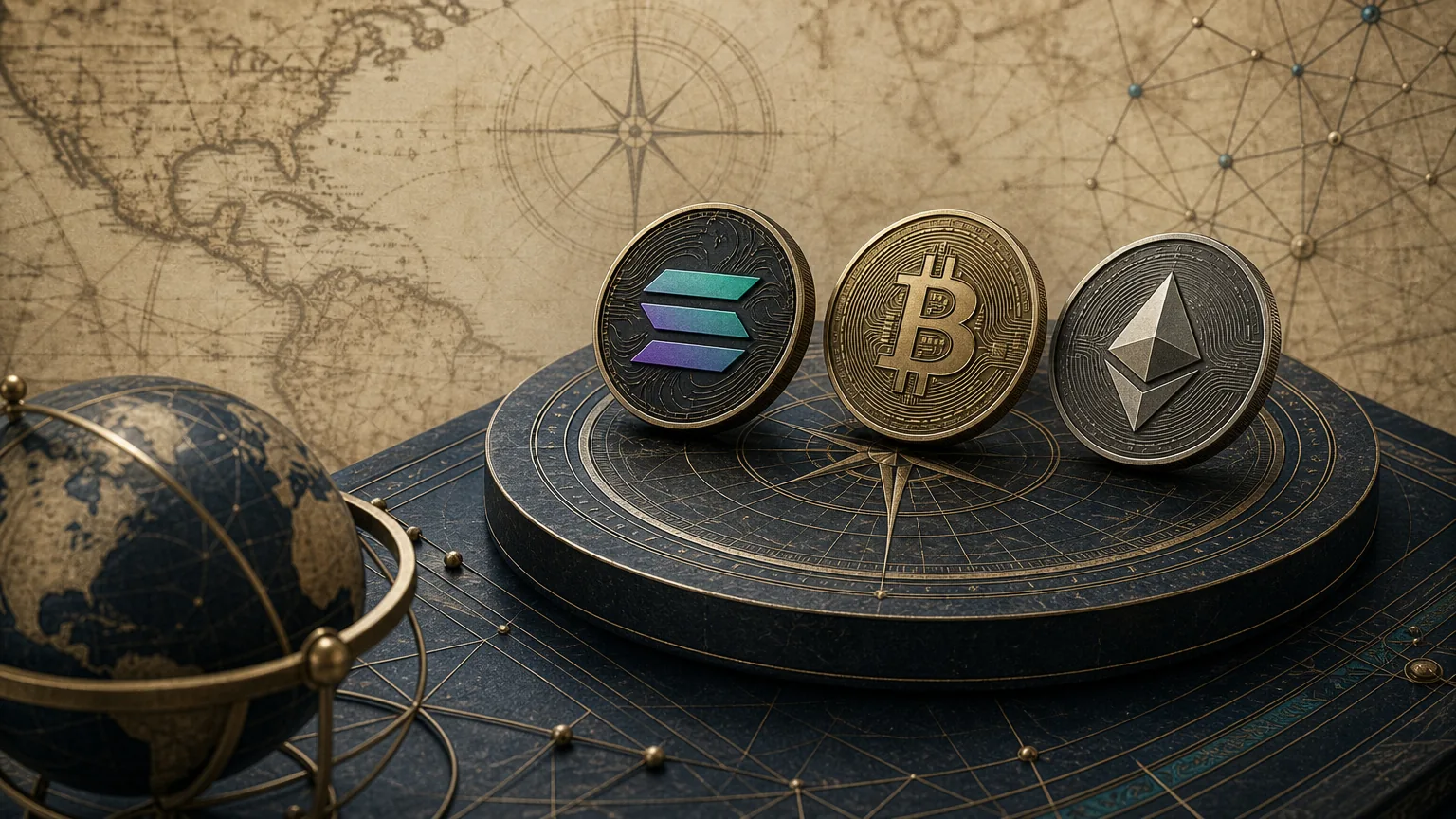
CME Group and Nasdaq launched the Nasdaq CME Crypto Index futures on June 8, placing SOL alongside Bitcoin and WETH in CME's first market-cap-weighted crypto basket futures product. It is the first time SOL has appeared in a CME-listed basket contract, the regulated derivatives venue that functions as the institutional pricing benchmark for crypto.
The product offers two contract sizes: a standard futures contract with ticker NCI and a micro version under MCI. Both are cash-settled against the Nasdaq CME Crypto Settlement Price Index, giving institutions a single, financially settled instrument for broad crypto market exposure without holding any underlying assets.
Seven Assets, One Index
The Nasdaq CME Crypto Index is free-float market-cap weighted and rebalances quarterly. At launch, Bitcoin accounts for 76.96% of the basket, with Ethereum at 12.68% and XRP at 5.80%. SOL holds a 3.23% weighting. Cardano, Chainlink, and Stellar round out the index at 0.65%, 0.37%, and 0.30% respectively, per Crypto Briefing.
SOL's weighting is small. Bitcoin and Ethereum together represent nearly 90% of the index, and investors seeking concentrated Solana exposure will not find it here. What they will find is SOL in the same regulated institutional derivatives wrapper as the two assets that have defined the institutional crypto market since 2017.
CME describes the product as offering "a capital-efficient way to gain exposure to the top cryptocurrencies by market cap — all through a single, financially settled futures contract," according to its official launch announcement.
Why the Venue Matters More Than the Weight
CME is the world's largest derivatives exchange and has served as the de facto institutional pricing benchmark for Bitcoin since it launched BTC futures in December 2017. Ethereum futures followed. CME added standalone Solana futures in early 2025. The basket product is a different structure: it defines which assets institutions can use to access broad crypto market exposure through a regulated venue, in the same way an S&P 500 futures contract defines what constitutes the equity market benchmark.
Inclusion in that basket is a classification decision as much as a trading decision. The index methodology, free-float market-cap weighted and rebalanced quarterly by Nasdaq, considers SOL a core component of the addressable crypto market.
Giovanni Vicioso, CME's global head of cryptocurrency products, cited accelerating institutional demand as the backdrop for the launch: "Demand for regulated cryptocurrency futures continues to increase, with average daily volume in our suite up 43% year-to-date." He added that the new futures "will provide another way for investors to manage their risk" as investment in the asset class grows, according to CoinDesk.
According to CoinDesk, CME's crypto product suite crossed $7.3 trillion in lifetime notional volume as of the announcement, with average daily volume in Q1 2026 reaching 310,000 contracts, up from 191,000 in the same period a year prior. The basket product addresses a separate segment of that demand: traders seeking broad index exposure rather than single-asset positions.
Part of a Longer Institutional Arc
The basket inclusion is the latest in a sequence of regulated infrastructure additions for SOL in 2026. In early June, Charles Schwab added 24/7 SOL futures to thinkorswim, making Solana the first product the firm trades around the clock across its $12.6 trillion client base. Days later, Morgan Stanley and Galaxy Digital extended a lending arrangement that treats SOL as a first-class collateral asset alongside BTC and ETH. US spot Solana ETFs have drawn $1.13 billion in cumulative inflows since launching in October 2025, with May 2026 producing the strongest monthly total since launch.
The CME basket adds a futures layer to that stack. Spot ETFs provide passive allocation; standalone futures allow active risk management on a single asset; the basket futures give institutions a benchmark-indexed position across the whole market, with SOL now inside that benchmark.
The global crypto derivatives market processes roughly $85.7 trillion in yearly volume and $264.5 billion in average daily turnover, with derivatives accounting for nearly 80% of all crypto trading activity, according to CoinDesk's reporting on the product announcement. The NCI and MCI contracts give regulated participants a new instrument within that market.
SOL's 3.23% Weighting in Context
At a 3.23% weighting, a $100 notional NCI position buys roughly $3.23 in SOL exposure. Investors seeking concentrated Solana positioning have the standalone SOL futures CME launched in early 2025 for that purpose. The basket is not a Solana-specific product.
The basket is also a TradFi instrument with no direct effect on Solana's on-chain activity, developer ecosystem, or DeFi metrics. Its significance sits entirely in the institutional infrastructure layer.
What the basket does reflect is where SOL now stands in CME and Nasdaq's definition of the regulated crypto market: inside it, alongside BTC and ETH, as one of seven assets that together constitute the institutional benchmark.

Solana 🧭 Compass
@SolanaCompassSolana Compass is an independent Solana analytics and staking platform, operating a validator on Solana mainnet since September 2021. Its network statistics and...
Comments
Please login to leave a comment.
Contents


Related Content
Ship or Die at Accelerate 2025: Fireside Chat on Crypto Derivatives and Regulation
Ship or Die at Accelerate 2025: CFTC Commissioner and CME Executive Discuss Crypto Derivatives
The Solana Playbook With Leah Wald
Will We See A Solana ETF In 2025? | Matthew Sigel
Pyth Network Brings Crude Oil Pricing On-Chain With 24/7 WTI and Brent Indices
Building Binance On-Chain | Cindy Leow & Chris Heaney, Drift Protocol
All 21 Pyth Indices Are Live as Kraken Launches Oil Perpetuals and Coinbase
Pyth Network Becomes Approved External Distributor of Nasdaq Basic
E*TRADE from Morgan Stanley Launches Spot Crypto Pilot With SOL Among Three Initial Assets
Charles Schwab Adds 24/7 SOL Futures to thinkorswim
Can Solana DEXs Compete With Hyperliquid?
DATs & ETFs Will Be Solana's Next Big Catalyst
TradFi Unlocked: Discussing the VanEck JitoSOL ETF S-1 Filing
Solana Foundation Launches Frontier Traders, an Invite-Only Program for Institutional Market Makers
Market Maturation | ep. 34
Latest news
SIMD-0675 Analysis Recommends a 10% Stake Floor and a Run Length of 3 to 7 for Solana's Geo-Aware Leader Schedule
Solana Mobile Names Ledger Its First Hardware Expansion Partner, Preinstalling the Seeker App on Ledger Atom
NEAR Launches Confidential SOL Yield on Kamino via Gauntlet Vault as NEAR Token Lists on Solana Through Sunrise
Bitso Lists Western Union's Solana Stablecoin USDPT in Mexico
Bastion Trading Won't Tender Into SkyAI's $3.00 Offer, Demands Disclosure of SOL Sales
ckSOL Goes Live as DFINITY Says the Internet Computer Now Speaks Solana
Collector Crypt Posts Record $433.5M Q3 Pack Sales as 548 Wallets Supply 83%, Pine Analytics Finds
Jito Announces BAM Direct Bundle Ingest, Routing Solana Bundles Past the Block Engine's 50ms Hop
Helium Moves Mobile Network Data to Apache Iceberg Tables Anyone Can Query With SQL, Switch-Over Due November 1
Squads Builder Says Falcon-512 Post-Quantum Multisig Voting Has Been Tested on Solana Mainnet
Solana Token Markets


