All 21 Pyth Indices Are Live as Kraken Launches Oil Perpetuals and Coinbase

Pyth Network has all 21 financial indices live, with Kraken using oil
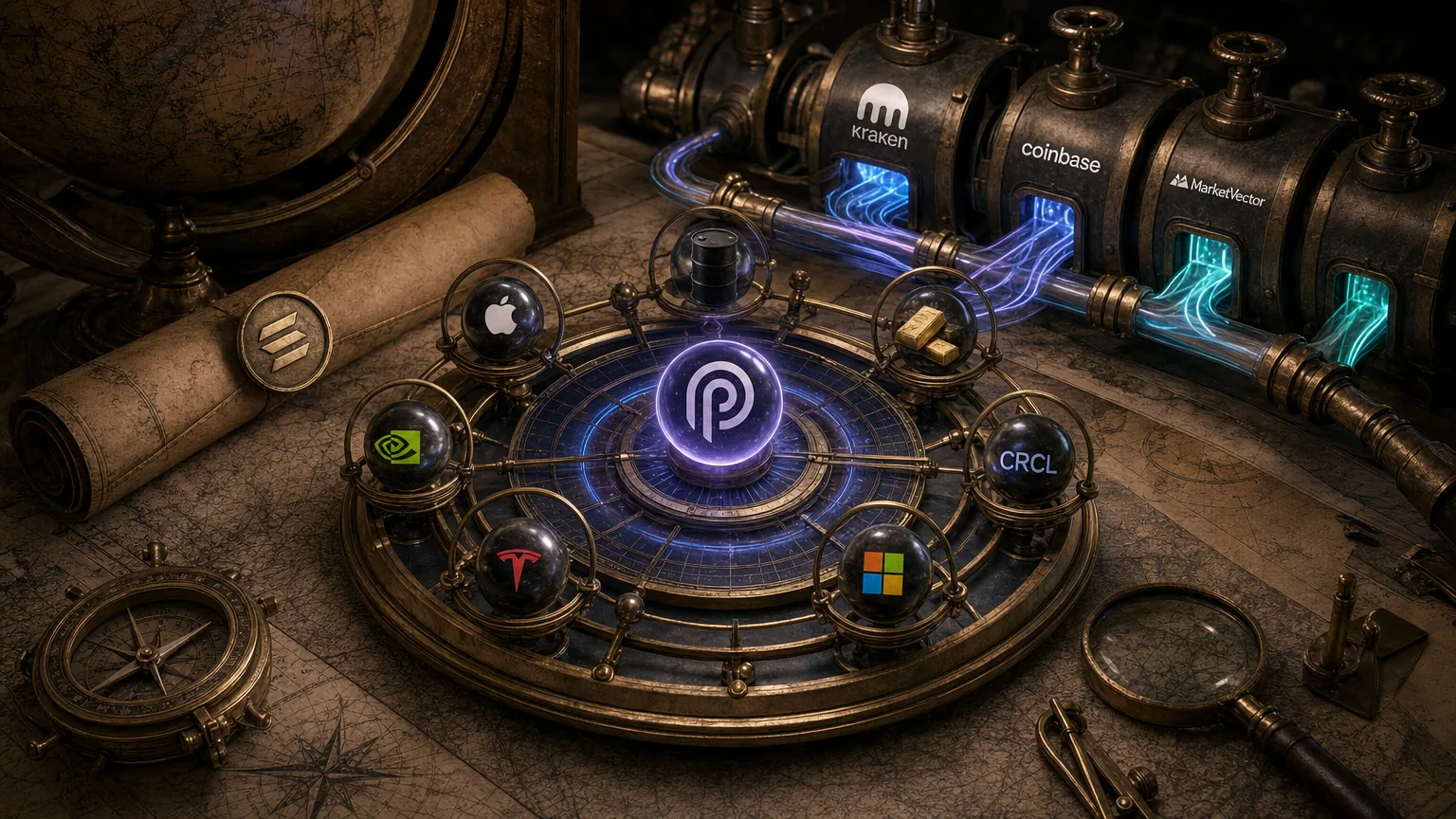
Pyth Network PYTH$0.079-4.8% confirmed all 21 of its Pyth Indices are live on July 17, completing a 24/7 pricing benchmark suite spanning US equities, oil, metals, and foreign exchange. Kraken is using the oil indices to launch perpetual contracts on WTI and Brent crude, and Coinbase cbBTC$83,323.67+1.1% has built four thematic equity index products (AI10, Defense10, China10, and Tech100) on the Pyth and MarketVector framework.
A Full Roster Across Equities, Oil, Metals, and FX
The complete Pyth Indices suite covers five asset class groupings. Nine single-stock US equity feeds cover NVDAx, TSLAx, AAPLx, MSFTx, GOOGLx, INTCx, HOODx, MSTRx, and CRCLx. Commodity feeds include WTI and Brent crude oil, plus gold and silver. FX pairs cover EUR/USD, GBP/USD, and USD/JPY. Equity index futures cover the E-mini S&P 500, the Dow, and an Emerging Markets basket.
The rollout came in stages across June: WTI and Brent went live June 17, FX pairs on June 18, and gold and silver on June 24. Today's announcement confirms the full 21-index suite is operational and names the first exchange users building commercial products on top.
Kraken's Oil Perpetuals and the 24/7 Reference Price Problem
Kraken's use case illustrates the specific infrastructure problem these indices exist to solve. Perpetual futures have no expiration date, so they trade continuously, but WTI and Brent crude oil have traditionally priced only during exchange hours. Without a continuous benchmark, an oil perpetual has no reference price once the CME closes.
John Palmer, Global Head of Derivatives at Kraken, explained the dependency directly: "Pyth Indices give us a continuous benchmark for assets where the underlying market doesn't trade round the clock. That matters because Kraken is launching perpetual contracts on oil, and a perpetual needs a 24/7 reference price to function."
Kraken is not alone in this space. dYdX and Nado were already running oil perpetuals when the WTI and Brent feeds went live in June. ICE and OKX brought competing WTI and Brent crude perpetual products to crypto markets during the same period, with the CFTC simultaneously opening a review of 24/7 energy futures trading rules. The timing reflects a broader convergence: always-on crypto markets are creating demand for always-on pricing infrastructure across the same underlying assets that trade on regulated exchanges.
Coinbase's Thematic Baskets: AI10, Defense10, China10, and Tech100
Coinbase's engagement with the indices operates at a different layer. Working with Pyth and MarketVector, Coinbase constructed four thematic basket indices: AI10, Defense10, China10, and Tech100. These function as sector-level products, giving derivatives traders exposure to a curated group of equities rather than a single stock, similar in concept to a sector ETF but designed for 24/7 continuous trading.
Boris Ilyevsky, Head of Derivatives at Coinbase, described the institutional logic behind the demand: "Institutional-grade, 24/7 markets are becoming the standard. As this shift continues, the demand for continuous pricing across equities and commodities will only accelerate."
Josh Kaplan, Head of Research and Investment Strategy at MarketVector, noted what co-building these products required from an index governance perspective: "Extending our thematic equity expertise into 24/7 infrastructure is not simply a technical upgrade — it is a rethinking of what continuous price discovery looks like."
MarketVector is a VanEck subsidiary that provides IOSCO-compliant governance for the Pyth Indices equity products. The International Organization of Securities Commissions' Principles for Financial Benchmarks set the regulatory standard for index construction; meeting that bar is what allows institutional platforms to use an on-chain index in regulated derivatives products rather than treating it as an informal reference.
First-Party Pricing From 125+ Trading Firms and Exchanges
The structural claim behind all 21 indices is consistent: prices source directly from the trading firms, market makers, and exchanges that set markets, not from intermediaries or data vendors who repackage those prices downstream.
Pyth aggregates from 125+ first-party publishers, per its official announcement. The result is that prices reflect actual market activity across global trading hours rather than end-of-day official closes or vendor-reconstructed off-hours estimates.
Mike Cahill, CEO of Douro Labs and a primary Pyth contributor, framed the product's significance at launch: "Traditional data feeds were built for a world where trading stopped at the closing bell. Pyth Indices mark an inflection point in access to 24/7 markets, where 'market close' no longer means the end of trading," per The Block.
How Pyth Competes With Chainlink and Traditional Index Providers
Pyth is not the only provider filling this gap. Chainlink offers 24/5 US equities data streams, covering pre-market, regular, and post-market sessions. Stork, an oracle protocol focused on perpetuals, provides 24/7 feeds for overlapping assets including gold, silver, WTI, Brent, NVDA, TSLA, MSTR, and CRCL. Traditional index providers, including S&P Dow Jones Indices, have been expanding into crypto benchmarks, though oriented toward digital asset indices, not toward the reverse problem of continuous traditional-asset pricing for crypto derivatives.
The differentiation Pyth emphasizes is first-party aggregation: institutions publishing their own prices directly to the network, rather than Pyth reading from secondary data vendors who redistribute that data after the fact. Whether that produces measurably better index behavior for end users (the exchanges and fund issuers who compare reference prices across providers) is what the market will determine as these products accumulate trading history.
Pyth's existing position in the perpetuals market gives it starting leverage. The network powered $110 billion, or 52%, of global RWA perpetual trading volume in May 2026, according to CoinDesk Markets data. Kraken's oil perpetual launch and Coinbase's thematic basket products extend that footprint into derivatives that previously had no credible always-on reference price.

Solana 🧭 Compass
@SolanaCompassSolana Compass is an independent Solana analytics and staking platform, operating a validator on Solana mainnet since September 2021. Its network statistics and...
Comments
Please login to leave a comment.
Contents
- A Full Roster Across Equities, Oil, Metals, and FX
- Kraken's Oil Perpetuals and the 24/7 Reference Price Problem
- Coinbase's Thematic Baskets: AI10, Defense10, China10, and Tech100
- First-Party Pricing From 125+ Trading Firms and Exchanges
- How Pyth Competes With Chainlink and Traditional Index Providers


Projects


Related Content
How Pyth Propagates Financial Data At The Speed of Light | Mike Cahill
Validated | How Pyth Is Changing the Oracle Game w/ Jayant Krishnamurthy
Pyth Network Brings Crude Oil Pricing On-Chain With 24/7 WTI and Brent Indices
Pyth Network Reaches 50 Live Indices Spanning Equities, ETFs, Metals, FX, and
Pyth Pro Reaches $7.49M ARR in July With 22% Monthly Growth and 3,501 Market Feeds
Pyth Network Adds FX Indices for EUR/USD, GBP/USD, and USD/JPY, Completing Traditional Asset Class Coverage
Pyth Network Crosses $10.4M ARR in August, Its Strongest Commercial Month on Record
The True Price: How Pyth Is Rebuilding the $50B Industry You've Never Heard Of
Pyth Network Adds Anthropic and OpenAI as First Pre-IPO Price Indices
Ship or Die 2025: Finance's Best-Kept Secret: Market Data Powers Everything
Nasdaq Selects Pyth Network to Distribute TotalView Market Data Through Blockchain Infrastructure
Pyth Network Adds 100+ Korean Equities — Samsung, SK Hynix, NAVER, Kakao — to Pyth Pro
Pyth Network Powered $110 Billion, 52%, of Global RWA Perpetual Volume in May 2026
Pyth Network Adds Gold and Silver Indices, Giving DeFi 24/7 Pricing for Safe-Haven Assets
Pyth Network Launches Six Constant Maturity Futures Indices for Energy Commodities
Latest news
Jito Announces BAM Direct Bundle Ingest, Routing Solana Bundles Past the Block Engine's 50ms Hop
Helium Moves Mobile Network Data to Apache Iceberg Tables Anyone Can Query With SQL, Switch-Over Due November 1
Squads Builder Says Falcon-512 Post-Quantum Multisig Voting Has Been Tested on Solana Mainnet
Pando Solana ETF (2831) Starts Trading in Hong Kong With 268,300 Units Changing Hands on Day One
Building Financial Software on Solana: Quicknode's Free Book Builds Ten Finance Programs, From Escrow to Perps
Anza Sets Alpenglow Mainnet Date: Solana's Consensus Switch Is Scheduled for October 21 at About 14:50 UTC
SkyAI Sells About 1M SOL to Fund Planned Tender Offer of Up to $201M, Rejects Forward Industries' Proposal
USDGO Goes Live on Jupiter Lend's AMM on Solana in Anchorage-Issued Stablecoin's 'DeFi Debut'
ASTER on Solana: Sunrise Lists Aster''s Token and Names a Contract Address, With No Word Yet From Aster
Solana's First Full Epoch at the 200ms Slot Time Target Averaged 218.3ms and Lasted 26.2 Hours
Solana Token Markets


