BitRobot Launches Access ID System, Opening Its Robotics Lab Publicly on Solana

BitRobot launched public applications for its Open Robotics Lab on August
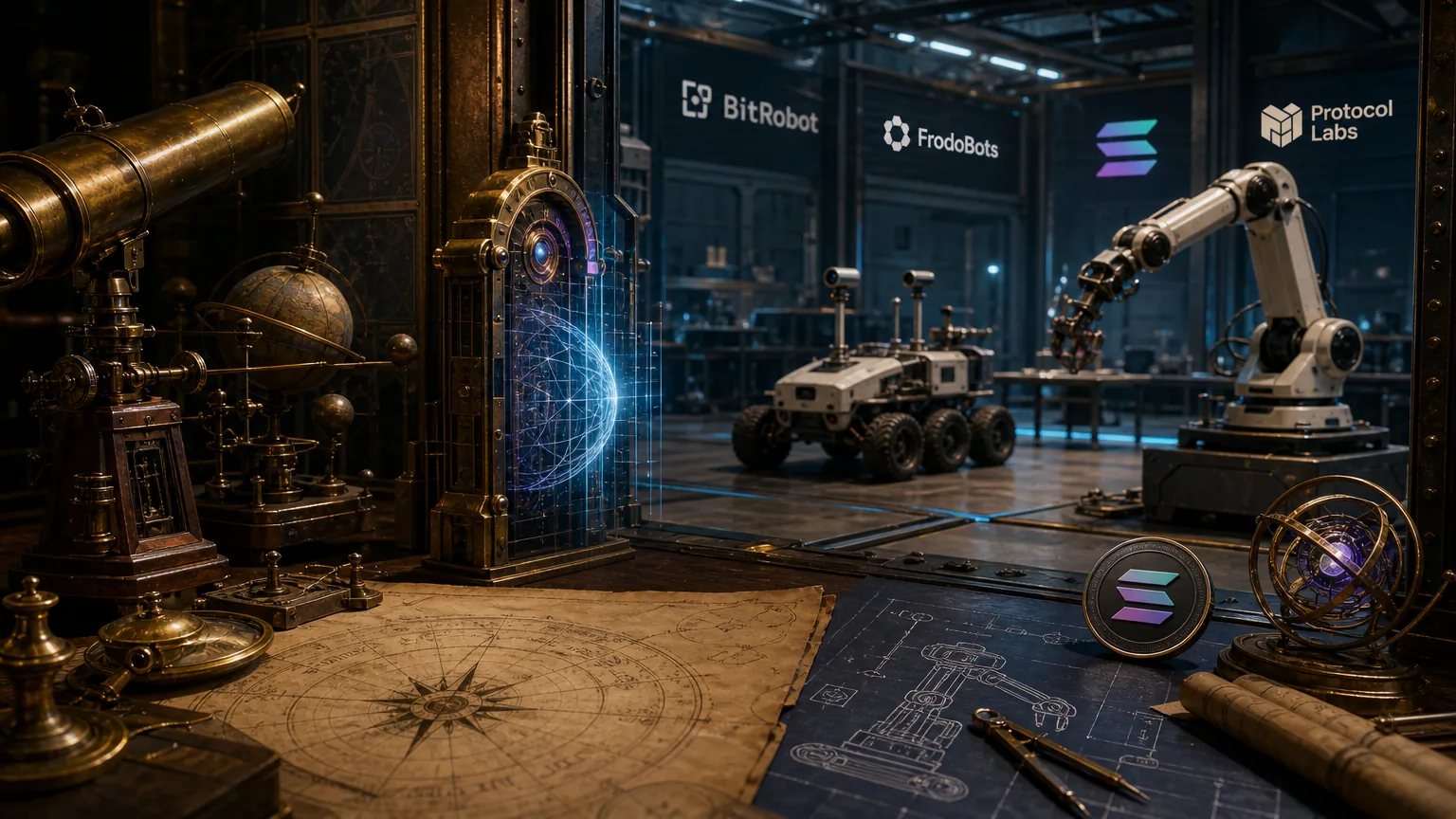
BitRobot opened public applications for its Open Robotics Lab on August 12, activating an Access ID system at app.bitrobot.ai that lets anyone apply to participate in the network, earn Bolts for their work, and build verifiable robotics credentials on Solana.
The launch moves BitRobot from invite-only beta to a public application portal. Participants earn Bolts by contributing robotics work, completing subnet campaigns, and referring new applicants. Badges accumulate as credentials reflecting the scope and quality of contributions. The referral mechanism was active in the first hours after the announcement, with existing participants sharing invite codes and reporting that alliance tasks were already syncing.
How the BitRobot Access ID and Bolts System Works
An Access ID is a researcher's verifiable identity within the Open Robotics Lab. The Bolts-and-Badges structure is the network's approach to distinguishing contributors by quality and scope of work rather than just participation, which matters when the goal is producing usable robotics datasets at scale.
BitRobot coordinates three kinds of participants: hardware operators who deploy robots, contributors who perform teleoperation and simulation tasks, and compute providers who process and verify outputs. The Access ID is the entry point for contributors. Applicants submit through app.bitrobot.ai and can start accumulating work history across active subnets immediately after approval.
The underlying chain handles coordination, agent execution, and verifiable data validation. Verified robotic work is scored and attributed on-chain, giving researchers a portable and auditable credentials record.
Eight Subnets, Each a Standalone Research Problem
BitRobot runs eight active subnets, each targeting a specific gap in embodied AI training data that conventional lab settings struggle to fill at volume.
ET Fugi (SN/01) puts contributors behind the controls of sidewalk rovers in a global scavenger hunt across more than 40 cities, per BitRobot, generating navigation trajectory data at scale. Seesaw (SN/02) collects egocentric video through mobile phone tasks and has surpassed 4.5 million tasks completed, per BitRobot's network dashboard. TeleArms (SN/03) routes participants into simulated robotic arm control, logging more than 50,000 teleoperation missions and 1,400 hours of teleop-in-simulation data, per BitRobot. The fourth subnet, Axis (SN/04), takes the teleoperation work into physical hardware, collecting manipulation trajectories from real Franka FR3 arms.
University research groups active in the network include MIT CSAIL, UC Berkeley, UCLA, Peking University, and the University of Amsterdam, per BitRobot's documentation.
Michael Cho, FrodoBots Lab co-founder, described the competitive design as deliberate: "We envision each subnet to be a standalone robotic competition."
Beyond standard data collection, three Grand Challenges are active under a $5 million program: the Earth Rover Grand Challenge targeting autonomous navigation, Robotic Origami pitting AI systems against human experts from the Nippon Origami Association, and Robotic IKEA Assembly benchmarking furniture assembly performance against human baselines.
The Data Problem Embodied AI Has That Language Models Do Not
Language models trained on internet text scale with compute because training data exists at massive scale. Robotics AI does not have the same advantage. A manipulation model trained to handle a robotic arm needs recorded trajectories in specific environments, and generating those requires human operators, physical hardware, and dedicated lab time that no single institution can sustain at the volume state-of-the-art models require.
FrodoBots Lab started from that constraint. As Michael Cho discussed at Breakpoint 2024, FrodoBots has been operating at the intersection of crypto-incentivized gaming and robotics data collection since 2022, deploying hundreds of sidewalk robots across 12 or more cities on six continents, per the company. FrodoBots open-sourced FrodoBots-2K, a 2,000-hour real-world urban robotic navigation dataset, per FrodoBots, that researchers at UC Berkeley's RAIL Lab used to train advanced navigation models. The company placed first at the 2024 IROS Earth Rovers Challenge alongside researchers from Google DeepMind, per FrodoBots.
BitRobot generalizes that approach across multiple research domains using a shared subnet architecture and crypto incentives to coordinate distributed participants who would otherwise have no economic reason to share hardware time, training data, or compute. Juan Benet, Protocol Labs founder and BitRobot whitepaper co-author, puts the case for distributed incentivization directly:
$8M in Funding, Anchored by Protocol VC and Solana Co-Founders
The funding behind BitRobot includes $8 million in aggregate, from a $2 million pre-seed round and a $6 million seed round led by Protocol VC, per a February 2025 press release and Blockworks reporting. Additional investors include Big Brain Holdings, Fabric Ventures, Zee Prime Capital, Tioga Capital, Sfermion, Solana Ventures, and Virtuals Protocol. Anatoly Yakovenko and Raj Gokal, Solana Labs co-founders, participated as angel investors, alongside eight DePIN founders from projects including Aethir and Gensyn.
Lacey Wisdom, Protocol VC partner, framed the investment thesis at the time of funding: "BitRobot represents an ambitious effort for the crypto world to make a meaningful difference" in robotics and AI research.
The BitRobot whitepaper, co-authored by Cho, Benet, and Jonathan Victor (formerly of Protocol Labs, now at Ansa Research), outlines a BRB token with planned subnet emissions and NFT-based robot identifiers called ENTs as the long-term incentive layer. The token has not yet launched. For now, Bolts and Badges are the active reward and credential mechanism, with the BRB token a stated future milestone in the network roadmap.
Jonathan Victor, who led the incentive design, described the goal plainly: "Our goal while designing the incentives is to encourage active sharing of knowledge and resources."
Applications for an Access ID are open at app.bitrobot.ai.

Solana 🧭 Compass
@SolanaCompassSolana Compass is an independent Solana analytics and staking platform, operating a validator on Solana mainnet since September 2021. Its network statistics and...
Comments
Please login to leave a comment.
Contents


Related Content
Solana Foundation: The Future of DePIN On Solana | Amira Valliani
Phantom CEO: Will Phantom IPO In The Future?
Guaranteed Solana TX Inclusion with Raiku, feat Robin, Founder and CEO of Raiku
The Future Runs on Pipe | ep. 43
The Rise Of Crypto's App Ecosystem - Mike Dudas
Solana's Largest Transaction Upgrade Ever (BAM)
Jito and the Future of Solana w/ Lucas Bruder | ep. 2
Grape Network: Are Gated Communities the Future?
The Internet Capital Markets Roadmap | Lucas Bruder, Max Resnick & Austin Federa
Understanding zkTLS With Opacity Network | ep. 42
Going Public on Internet Capital Markets: Metaplex Foundation
Ship or Die at Accelerate 2025: Lightning Talk: GEODNET
The Metaverse Episode featuring Webaverse, Loomdart & Jin
a16z's Crypto Thesis With Ali Yahya
Doosan Robotics and peaq Partner on Physical AI, Bringing Industrial Cobots
Latest news
Bitquery Traces $1.4B of Raydium CLMM Volume, 22.7% of the Total, to One Wash-Trading Wallet
J.P. Morgan Asset Management Brings Its MONY and JLTXX Tokenized Money Market Funds to Solana
Decrypt Picks Jupiter to Power Trading in Its Money Accounts on Solana
Solana Company (HSDT) Named a Hong Kong Strategic Enterprise, Plans Solana Validators in the City
Kamino Says Its AUTO Market Passed $170M a Month After Fixed-Rate Borrowing Launched
Raydium Q3 2026 Net Revenue Jumps 264% to $7.99M on Tokenized Stocks and LaunchLab, Blockworks Report Shows
Solana Mobile Launches Seeker Connect, a One-Tap 'Connect with Seeker' Wallet SDK for Expo, Kotlin and Web Dapps
Arcium Opens Blackthorn Private AI Inference to Selected Users in Private Alpha
Solana Alpenglow Is Live on Mainnet as Anza Retires TowerBFT at Slot 459,653,000
Bastion Trading Tells SkyAI Chairman and Three Directors to Explain SOL Liquidation or Resign
Solana Token Markets


