
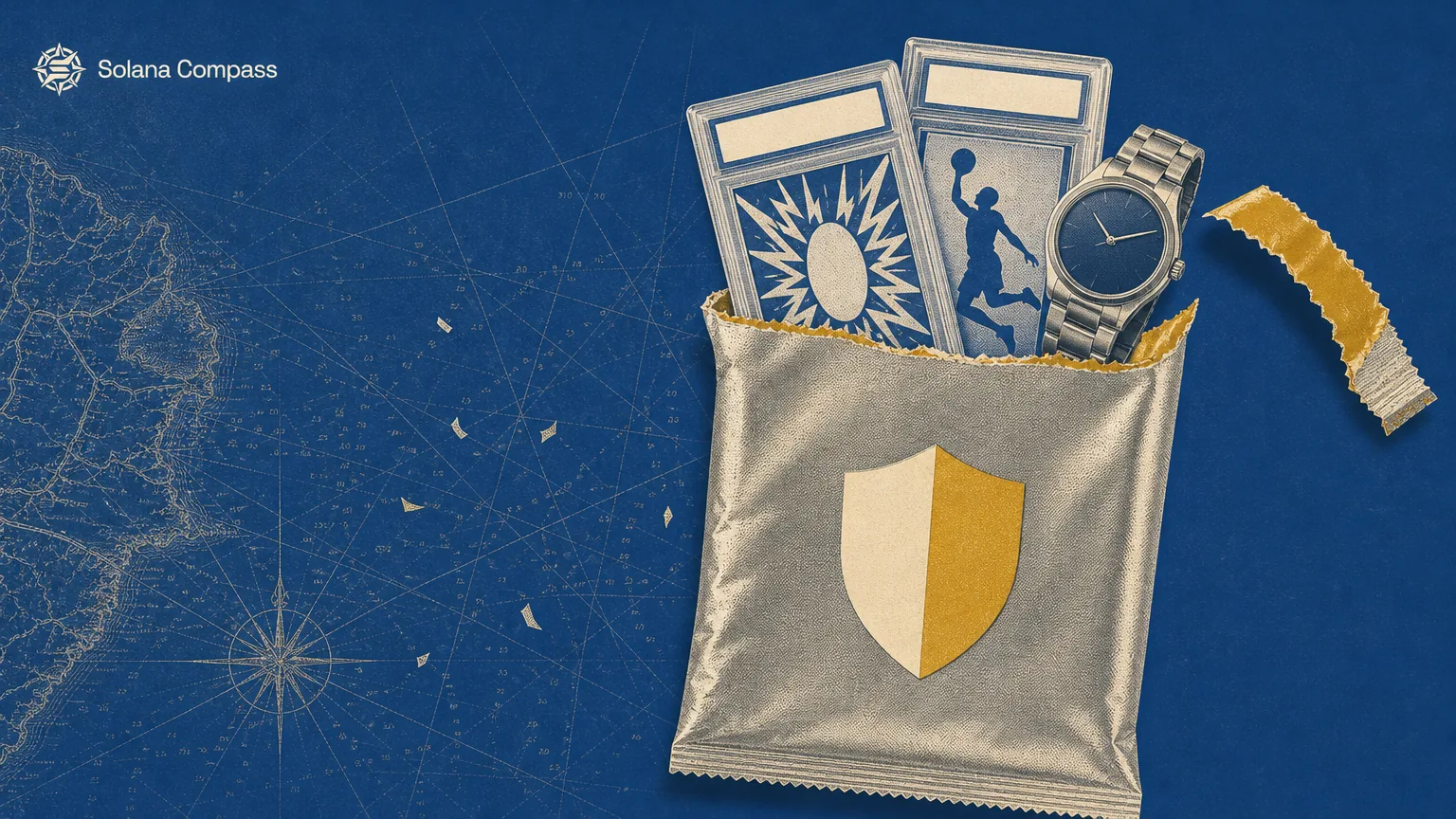
Trust Wallet TWT$0.314+0.0% users can now buy and open packs of graded Pokémon cards, basketball cards and watches inside the app. The packs are provided and operated by Collector Crypt, the tokenized trading-card marketplace, and are paid for in USDC on Solana.
Trust Wallet announced the launch in a blog post and an X post on 25 November 2026. Each card a user pulls arrives in their wallet as a Solana token backed by a physical item held with Collector Crypt, and for 72 hours it can be sold back for USDC.
How in-wallet Pokémon card pack opening works
Trust Wallet's blog sets out a short flow: open the app's Market tab, pick a collection and a pack, pay in USDC on Solana, tap the pack to reveal the card, then keep it or resell it. The user approves every purchase and every sale as their own transaction, and pulled cards are listed under a My cards tab.
The tapping is presentation. Trust Wallet says the card is fixed at the moment the payment confirms, and the reveal only displays the result.
Each token stands for a real object. "Every pull is a physical item held with Collector Crypt," the blog says, and the Pokémon cards are graded by companies such as PSA and sealed in tamper-proof cases. A Binance News item syndicating Odaily describes the vault holding the collectibles as insured.
Pack prices and odds: $25 Pokémon Starter packs to $5,000 Grail packs
Pokémon packs on Trust Wallet start at $25 and run to $5,000, with basketball and watch packs priced between $100 and $500, according to the blog:
- Pokémon: Starter $25, Elite $100, Master $500, Legendary $1,000 and Grail $5,000
- Basketball: Fire $100 and Goat $250
- Watches: Collector $250 and Prestige $500
Before paying, the user sees each pack's price, the odds for every rarity tier, the maximum value a pull can reach and what the pack contains. What a pack returns depends on the tier the card lands in, so the price paid and the value of the card pulled are two different numbers.
72-hour USDC buyback, custody and eligible jurisdictions
For 72 hours after purchase, every pulled card comes with a Resell offer: a buyback paid in USDC at "a set share of the card's value as determined in Collector Crypt's marketplace," in Trust Wallet's words. The blog does not give the percentage.
Trust Wallet says it "never holds your funds or your cards." According to the company's disclaimer post, the collectibles are provided and operated by Collector Crypt under its terms as well as Trust Wallet's, and the product is "only available in certain jurisdictions" with eligibility requirements. No country list is published, so availability depends on where the user is.
Collector Crypt packs in Solana apps: Solflare, Rarible, Jupiter and Trust Wallet
Trust Wallet is the latest app to put Collector Crypt's packs in front of its own users. Solflare launched Solflare Packs on Collector Crypt in June 2026 with the same 72-hour buyback window, as we covered at the time. Rarible's Gacha Station followed that month, and Jupiter JUP$0.215-8.9% built Jupiter Gacha in partnership with Collector Crypt.
Collector Crypt's pack sales are large, and a small group of wallets supplies most of the money. Pine Analytics' Q3 2026 report put Collector Crypt's quarterly revenue at $433.5M, almost all of it pack sales, with 21,876 wallets buying a pack on Solana in the quarter. Pine Analytics also found that 548 wallets spending $100,000 or more supplied 83% of the money, as we reported in October.
That concentration makes distribution the interesting part of this launch. A general-purpose, multichain self-custody wallet can reach buyers who may never visit a dedicated card site, while every purchase and buyback still settles in USDC on Solana and the card token sits in the user's own wallet. The thing to watch is Collector Crypt's next quarterly data, and whether the Trust Wallet channel widens its buyer base beyond the few hundred large spenders. For readers comparing self-custody apps, our guide to Solana wallets covers the main options.


