Collector Crypt Crosses $1.6 Billion in Volume as Solana's Tokenized Card Market Builds Scale

Collector Crypt has tokenized over 130,000 graded physical cards and crossed $1.6B in lifetime volume, holding 64% of Solana's tokenized trading card market.
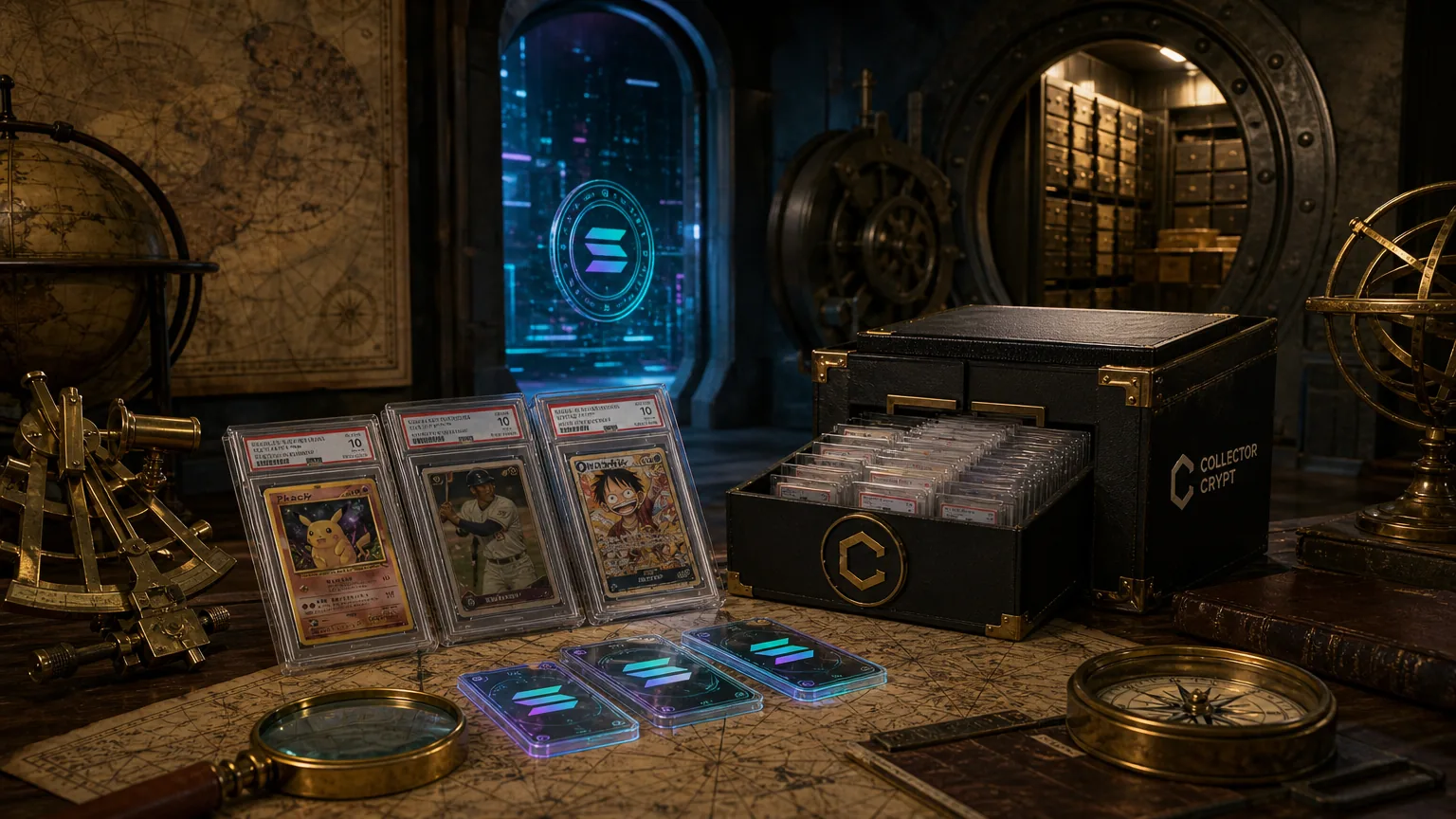
August brought fresh attention to Solana SOL$116.13-3.8%'s physical collectibles sector. Crypto Briefing reported on August 5 that Solana's tokenized trading card market logged $69.5 million in trading volume through the most recent monthly period, figures the outlet attributed to Collector Crypt, the platform that vaults professionally graded physical cards and issues NFTs representing ownership. The cumulative picture is more striking: the Solana Foundation's own market overview puts Collector Crypt's lifetime trading volume at $1.6 billion since its gacha system launched in December 2024, with over 130,000 graded physical cards now tokenized on-chain.
The platform holds roughly 63-64% of all tokenized trading card activity on Solana, a concentration that reflects both early-mover positioning and the advantage of having built the market's core vaulting infrastructure.
How Collector Crypt's Vault Model Turns Graded Cards Into On-Chain Tokens
Sending a professionally graded trading card to Collector Crypt puts ownership on-chain. Pokémon, One Piece, baseball, and soccer cards are all supported. The platform stores each item in a secure vault and issues an NFT on Solana representing that specific physical card. CARDS (CARDS) facilitates platform transactions and pack purchases; Solana Compass data puts its market cap at approximately $320 million as of August 6, 2026, held across roughly 19,300 wallets.
Holders can trade those NFTs on-chain at any time without shipping the physical card. When a collector wants the card in hand, they redeem the token and have it shipped from the vault. That redemption option is what separates this from standard NFT projects: the underlying object exists, is professionally graded, and can always be claimed. Over 18 months of operation, the platform has seen more than 30% of users redeem physical cards at least once.
Since crossing $50 million in cumulative protocol revenue and setting a 215,000-pack weekly record in June 2026, Collector Crypt has expanded its supported card categories beyond Pokémon to include football, soccer, and baseball sports cards.
Why Solana's Sub-Cent Fees Are Structural to This Market
Trading low-value physical cards on traditional platforms is economically punishing. A conventional marketplace sale involves platform fees, payment processing, and shipping on every transaction. For a $15 Pokémon card, those costs can absorb most or all of the margin.
Solana's transaction fees run a fraction of a cent, per the Solana Foundation's overview of the market. A buyer and seller can exchange an NFT representing a $12 card, pay negligible network fees, and keep the surplus that platform and payment fees would otherwise eliminate. Tight fee economics cascade through the entire model: more cards become worth tokenizing, more trades become worth executing, and pack-opening mechanics that require many small sequential transactions become viable.
That fee structure is what makes this market work at its current scale on Solana.
Solana Holds 75% of On-Chain Card Volume as Other Platforms Compete
Solana accounts for roughly 75% of global on-chain trading card game volume, ahead of Base and Polygon combined, per the Solana Foundation. Collector Crypt drives most of that share, but the competitive picture is shifting.
Phygitals, which operates a similar vault-and-NFT model, has processed over $250 million in total trading volume, per the Solana Foundation. Multiple distribution frontends now route pack pulls through Collector Crypt's underlying card inventory: Rarible's Gacha Station, Jupiter Gacha, and Solflare Packs each bring different user bases to the same underlying inventory. In Solflare Packs' first week alone, over 10,000 pulls drew from roughly $5 million in insured card value, according to the Solana Foundation.
That frontend distribution structure matters for interpreting Collector Crypt's market share. The platform's 64% figure reflects its role as the dominant vault and inventory provider: the backend of a market where trading interfaces are becoming more distributed.
Custody Concentration and the Limits of Volume as a Signal
Collector Crypt's 63-64% market share means the entire tokenized physical collectibles sector on Solana sits largely on one platform's operational track record. If the vaulting infrastructure, token mechanics, or the company itself faced a failure, there is limited redundancy in the market. That concentration carries real risk for a sector moving professionally graded cards, insured for significant dollar amounts, on behalf of collectors who have chosen on-chain custody over traditional alternatives.
Crypto Briefing's August coverage also noted a structural issue with trading card volume metrics: the same cards can change hands multiple times in short windows, inflating reported figures beyond what underlying demand supports. Collector Crypt's cumulative protocol revenue of $50 million against $1.6 billion in lifetime volume works out to roughly 3.1%, a ratio that suggests genuine economic activity behind the numbers but one worth watching as monthly reporting continues.
Physical collectibles tokenization is a different market from the tokenized equities, bond funds, and real estate vehicles that have drawn most institutional RWA attention on Solana. The custody requirements differ, the price discovery mechanisms differ, and the regulatory surface area is distinct. That separation may prove useful if one category faces headwinds the other does not, but it also means the physical collectibles segment is building its own infrastructure and regulatory precedents largely from scratch.

Solana 🧭 Compass
@SolanaCompassSolana Compass is an independent Solana analytics and staking platform, operating a validator on Solana mainnet since September 2021. Its network statistics and...
Comments
Please login to leave a comment.
Contents

Projects

Related Content
Collector Crypt: Onchain Capital Markets On Solana | Tuomas Holmberg
Collector Crypt Sets Weekly Pack Record With 215K Opens, Crosses $50M in Revenue
Collector Crypt Draws 40,000 Daily Users as Solana's Consumer App Layer Matures
Jupiter Gacha Hits $9M and 60,000 Packs in Five Days as Whale Spending Holds
CARDS Token Marks One Year With 22.5M Token Burn and $1.1B in Raydium DEX Volume
Rarible Gacha Station Goes Live on Solana, Powered by Collector Crypt
Seeker Summer 2026: Solana Mobile Offers 20% Off and a Free $50 Collector Crypt Pack
Tokenized Trading Card Market Hits $230M in May as Solana Claims 64% of Gacha Volume
Solflare's June 2026 Update Brings 134 xStocks, Google Pay Onramp, and Cards Borrow to Solana's Largest Self-Custody Wallet
Jupiter Gacha Beta Opens With $3.3M in Pack Pulls in First 22 Hours
Solforge Fusion: Combining Physical Card Games With Web3 Primitives | Justin Gary
Breakpoint 2024: Product Keynote: Bridge: Make Money Move
Product Keynote: Raise
Is This DeFi's Breakout Moment? | Michael Sonnenshein
Rizvi Haider (Product Lead at Metamask) Full Conversation
Latest news
VanEck Solana ETF (VSOL) Declares First Cash Distribution of $964,960 From Staking Income
Jupiter's Swap API Adds Opt-In Solana Transaction v1 Support for Integrators
Sanctum Burns Its CLOUD Community Reserve, Cutting Token Supply to 740.7 Million as SANC Ticker Appears
Orca Tokenholders Vote on Cutting xORCA Rewards to 10%, Moving 14.2M ORCA to the Team and Dissolving the Council
Triton One Publishes Alpenglow Integrator Guide: What Solana RPC, gRPC and Indexing Users Must Change
Solana's 200ms Slot Time Is Pending on Mainnet, Scheduled to Go Live at Epoch 1053 on October 9
Circle's USDC Bridge Adds Solana, Linking It to 18 Other Chains
Solana Foundation Announces @solana/web3.js v3, a Kit-Based Rebuild of the Classic JavaScript API, With a New Wallet Adapter
Kamino Opens Apyx Market, Letting apyUSD Holders Borrow USDC on Solana
Venice Token (VVV) Goes Live on Solana via Sunrise, Connected by Wormhole NTT
Solana Token Markets


