South Korea's Shinhan Asset Management Signs Four-Party MOU with Solana Foundation, Orca, and Etherfuse for KRW Tokenized Fund

Shinhan Asset Management signed a four-party MOU with Solana Foundation, Etherfuse, and Orca to pilot a KRW tokenized fund ahead of Korea's 2027 STO framework.
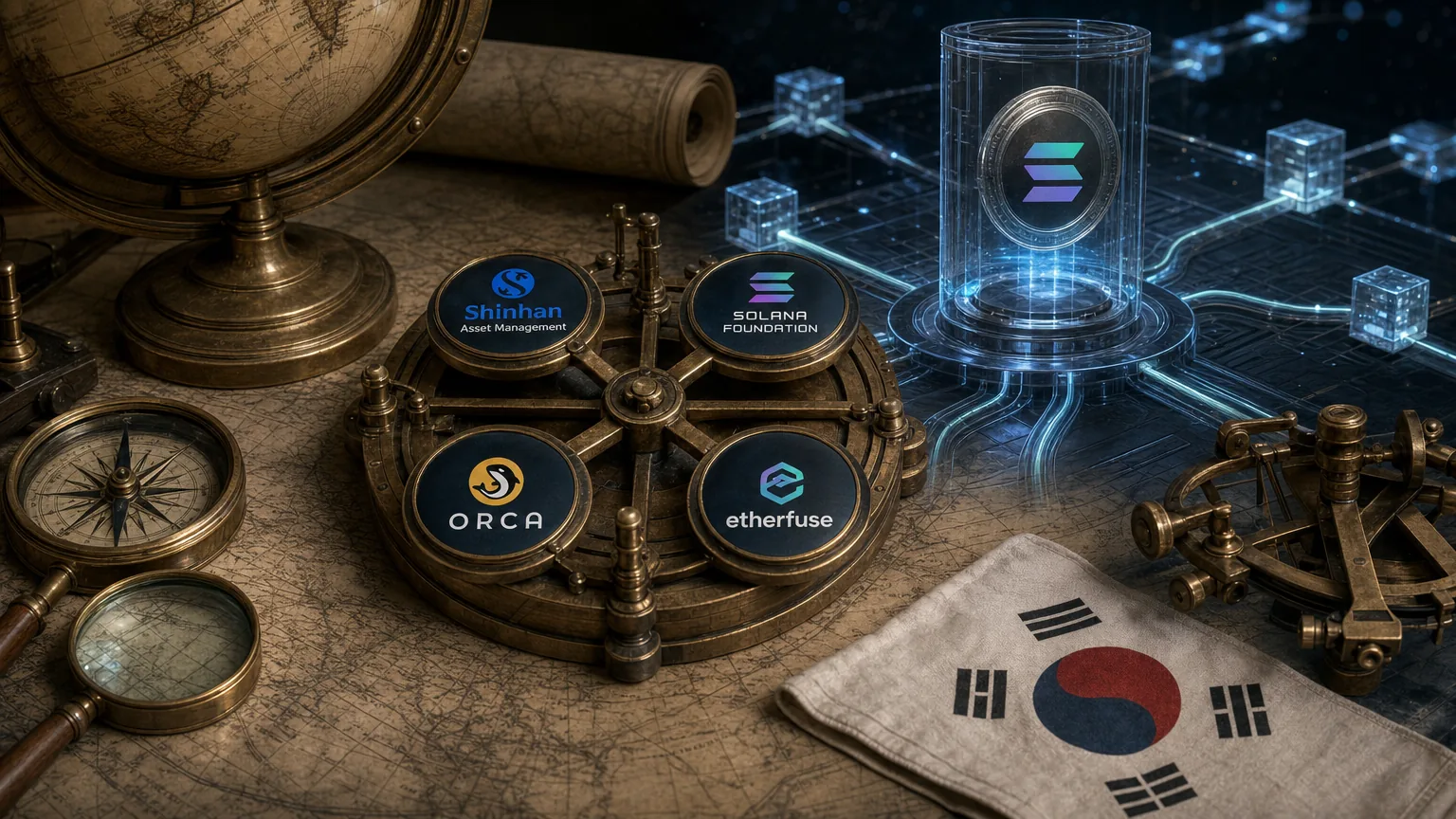
South Korea's Shinhan Asset Management, the country's largest asset manager with approximately $96.6 billion in assets under management per The Block, signed a four-party memorandum of understanding on August 21 with the Solana Foundation, Etherfuse CETES$0.067-1.1%, and Orca ORCA$1.83-1.7% to develop a proof-of-concept KRW-denominated tokenized fund on Solana SOL$103.47-4.2%.
The MOU is non-binding and limited to a proof-of-concept stage, but the institutional combination behind it is notable: South Korea's largest asset manager, Solana's own foundation as a direct party, a sovereign bond tokenization platform with an established Korean market presence, and the Solana DEX that handles the liquidity layer. The deal, announced by the official Solana account, is a distinct agreement from Shinhan Asset Management's separate MOU with BlackRock BUIDL-benchmarked platform Plume, signed one week earlier; the two agreements represent parallel proofs of concept as Shinhan tests different blockchain infrastructure providers ahead of Korea's 2027 regulatory window.
What the Four Parties Will Build and Test
The proof of concept centers on a KRW ultra-short-term bond fund managed by Shinhan Asset Management. Under the proposed structure, overseas institutional investors would purchase the fund and receive their holdings in tokenized form, issued on Solana's blockchain. Offshore market structure is the explicit scope; contractual and technical controls will exclude Korean residents from participating, as required by South Korea's Foreign Exchange Transactions Act.
The MOU sets out four areas to examine: know-your-customer and anti-money-laundering systems, blockchain operating methods and security audits, Foreign Exchange Transactions Act compliance, and on-chain liquidity design. Together, the parties will validate the complete issuance-to-distribution cycle, from fund creation through investor token receipt, before any commercial deployment is considered.
The product is modeled on the structural approach of BlackRock's BUIDL tokenized money market fund, which demonstrated that an institutional fund's ownership register can live natively on a public blockchain. The difference is asset denomination: BUIDL targets U.S. Treasuries in USD; Shinhan's pilot targets KRW short-term bonds for international institutional buyers.
No fund size, yield target, or commercial launch date has been announced. The MOU commits the parties to testing, not to shipping.
Etherfuse for Issuance, Orca for Liquidity
The two protocol partners cover distinct parts of the tokenization stack. Etherfuse is the issuance platform, responsible for converting Shinhan's fund positions into on-chain tokens and managing the compliance mechanisms around transfer controls and investor whitelisting. The company already has operational presence in Korea: in January 2026, Etherfuse partnered with Shinhan Bank, a separate Shinhan Financial Group affiliate, to tokenize Korean Treasury Bonds as part of a sovereign debt tokenization program across Asia, according to reporting from crypto.news. Etherfuse's existing infrastructure for Korean sovereign instruments makes it a natural fit for a KRW bond fund proof of concept.
Orca is the on-chain liquidity infrastructure provider. For institutional investors who receive tokenized fund holdings, secondary market access (the ability to rebalance or transfer positions without going through the fund manager's internal process) requires a DEX layer. Orca's concentrated liquidity architecture on Solana handles this role in the proof of concept. Over the past week, the protocol cleared $1.1 billion in trading volume across 871,000 traders, ranking among Solana's most active concentrated-liquidity venues.
Korea's 2027 STO Window and the Urgency Behind the MOU
South Korea's National Assembly passed security token offering amendments in January 2026. Implementation is scheduled for February 2027. The Ministry of Finance separately launched a deposit token pilot in April 2026, giving Korean financial institutions a structured environment to test digital asset infrastructure while the primary rules finalize.
The timeline explains the activity. Institutions that have already validated KYC/AML flows, onchain settlement mechanics, and whitelist-based transfer controls when the STO framework becomes enforceable will be in a materially different position than those building from scratch post-approval. Lee Seok-won, Shinhan Asset Management's CEO, framed the project in those terms in a statement reported by The Block: the goal is capabilities that can go live the moment rules permit.
The market context underscores the scale of what Korean institutions are positioning for. The tokenized real-world asset market, excluding stablecoins, stands at approximately $36.27 billion as of August 2026, up 2,200% from 2020 levels, according to The Block. Boston Consulting Group projects the market will reach between $16 trillion and $30 trillion by 2030.
Shinhan's Parallel Blockchain Strategy
Seven days before signing with the Solana Foundation, Etherfuse, and Orca, Shinhan Asset Management signed a separate MOU with Plume, a blockchain platform dedicated to RWA issuance, for a structurally similar KRW fund proof of concept. Both agreements use the BlackRock BUIDL model as a structural reference point.
Running parallel proofs of concept across different infrastructure providers before a major regulatory window is standard institutional practice. The Plume deal tested the RWA-native chain approach; the Solana deal adds the Solana Foundation's direct institutional partnership role and Orca's established DEX liquidity layer. The two exercises probe different questions about the tokenization stack. What Shinhan learns from each will inform which infrastructure, if any, it advances into commercial deployment when the STO framework takes effect.
Solana's Growing Institutional Presence in Asia
The Shinhan MOU is the latest in a cluster of Asian institutional partnerships Solana has attracted in 2026. In July, as we covered, Wavebridge, a KoFIU-registered prime broker, signed an MOU with the Jito Foundation to develop JitoSOL institutional products for Korea's regulated market. SBI Global Asset Management, one of Japan's largest asset managers, launched a tokenized Japanese equity fund on Solana the same month, per crypto.news reporting. KG Group, a major South Korean conglomerate, separately chose Solana as the base layer for its digital asset payments infrastructure.
The aggregate data reflects the momentum: as we reported last week, Solana's RWA ecosystem reached a $3.9 billion all-time high and led all blockchains in 30-day tokenized treasury inflows. Etherfuse has contributed to that growth through its sovereign bond tokenization programs spanning Mexican government securities, U.S. Treasuries, UK gilts, and Korean Treasury Bonds. That cross-border issuance capability positions it as a bridge for Asian institutions targeting offshore institutional investors on a single settlement layer.
The Shinhan proof of concept has no launch date and no fund size. The combination of parties (Korea's largest asset manager, a foundation with direct ecosystem involvement, a DEX with institutional liquidity depth, and a tokenization platform already operating in Korean sovereign debt markets) is not accidental. If Korea's STO framework takes effect on schedule in February 2027, those that built and tested infrastructure in the preceding months will be the ones ready to take institutional mandates when the window opens.

Solana 🧭 Compass
@SolanaCompassSolana Compass is an independent Solana analytics and staking platform, operating a validator on Solana mainnet since September 2021. Its network statistics and...
Comments
Please login to leave a comment.
Contents


Related Content
Why Does the Mexican Government Want to Tokenize Its Treasuries? w/ David Taylor (Etherfuse)
Etherfuse Stablebonds as an essential blockchain primitive, feat Dave Taylor, CEO of Etherfuse
Breakpoint 2023: Bonds Can Be Interesting, Too
Orca and Loopscale Merge to Form Formation as Orca's Council Moves to Re-Run the ORCA Tokenholder Vote
Orca Tokenholders Vote on Cutting xORCA Rewards to 10%, Moving 14.2M ORCA to the Team and Dissolving the Council
Jeonbuk Bank Completes Solana Private-Channel Stablecoin Remittance PoC With Solana Foundation and Node Infra
Wavebridge and Jito Foundation Sign MOU to Bring JitoSOL Institutional Products to South Korea
Is This DeFi's Breakout Moment? | Michael Sonnenshein
Solana Foundation and Google Cloud Bring AI Agentic Commerce Hackathon to Korea
Breakpoint 2023: Orca Presents the OPOS - A Game Changer for Liquidity Providers
Solana's Breakout DeFi Lending Protocol | Mary Gooneratne
Launching Crypto's Largest Tokenized Fund On Solana | Michael Sonnenshein
Inside the Solana Foundation with Austin Federa
The Future of Solana, DRiP Mobile, DeFi UX, and More | Solana Ecosystem Call (August 2024)
KSNet Signs MOU With Solana Foundation to Pilot Solana Pay and x402 AI Payments for Korean Merchants
Latest news
Bitquery Traces $1.4B of Raydium CLMM Volume, 22.7% of the Total, to One Wash-Trading Wallet
J.P. Morgan Asset Management Brings Its MONY and JLTXX Tokenized Money Market Funds to Solana
Decrypt Picks Jupiter to Power Trading in Its Money Accounts on Solana
Solana Company (HSDT) Named a Hong Kong Strategic Enterprise, Plans Solana Validators in the City
Kamino Says Its AUTO Market Passed $170M a Month After Fixed-Rate Borrowing Launched
Raydium Q3 2026 Net Revenue Jumps 264% to $7.99M on Tokenized Stocks and LaunchLab, Blockworks Report Shows
Solana Mobile Launches Seeker Connect, a One-Tap 'Connect with Seeker' Wallet SDK for Expo, Kotlin and Web Dapps
Arcium Opens Blackthorn Private AI Inference to Selected Users in Private Alpha
Solana Alpenglow Is Live on Mainnet as Anza Retires TowerBFT at Slot 459,653,000
Bastion Trading Tells SkyAI Chairman and Three Directors to Explain SOL Liquidation or Resign
Solana Token Markets


