AWS CloudFront Publishers Can Now Charge AI Bots Per Request in USDC on Solana

Amazon Web Services integrates x402 into CloudFront, letting publishers charge AI crawlers per-request in USDC instead of blocking them, settled on Solana.
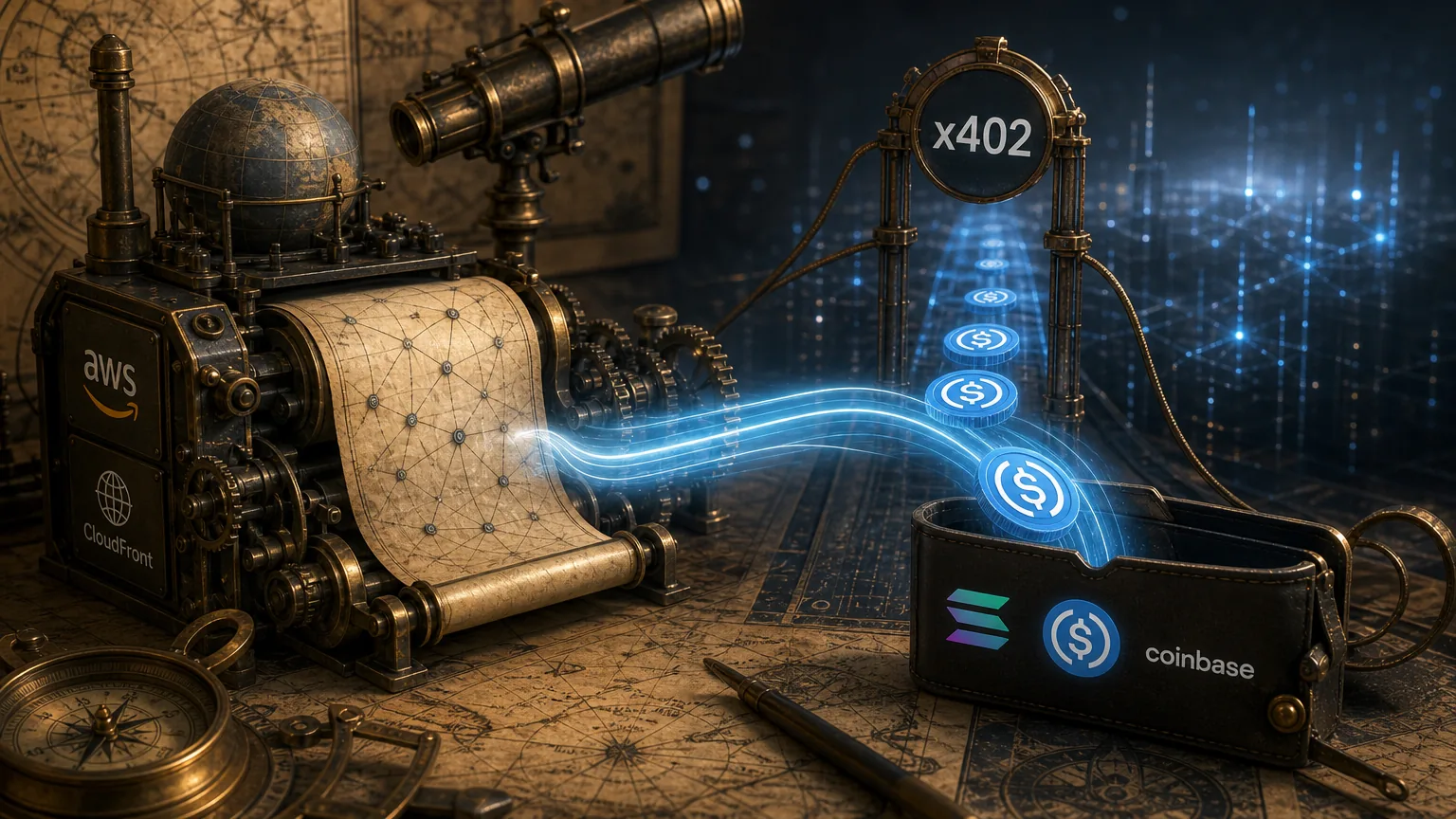
Amazon Web Services announced on June 17 that publishers running websites behind AWS CloudFront can now charge AI bots per-request in USDC (USDC), with payments settling on Solana through the x402 open payment protocol. The integration turns AI crawler traffic, which the announcement says now accounts for more than half of web traffic for many content providers, from a bandwidth cost into a direct revenue stream.
"Instead of blocking bots (which account for up to 50% of traffic), publishers can set a per-request price for access, and get paid with USDC," the official @solana account announced on June 17, drawing 1,027 likes and 183 retweets within hours.
How x402 Turns HTTP 402 Into a Payment Rail
The HTTP 402 status code ("Payment Required") has existed since HTTP was first designed, but remained formally unused for decades. The x402 open standard, developed by Coinbase cbBTC$81,550.99-0.7%, repurposes it as a machine-native payment protocol: a server returns a 402 response, a client pays, and access is granted with no API keys, no account creation, and no billing subscriptions.
The protocol operates with three parties: a client (the AI agent), a resource server (the publisher's web property), and a facilitator (the server that verifies and executes payment settlement across blockchain networks). The design is network-agnostic by specification, supporting EVM chains, Solana (SVM), and Stellar. The x402 GitHub repository describes implementation as requiring one line of server-side code and one function for the client.
For the AWS CloudFront integration, this mechanism runs inside AWS WAF Bot Control. When an AI agent requests a paid endpoint, AWS WAF returns an HTTP 402 response containing three pieces of information: the price, the accepted blockchain networks, and the publisher's wallet address. The agent signs a payment authorization and resubmits the request. The x402 facilitator, operated by Coinbase, verifies the payment on-chain before the content is released. Crucially, if the publisher's server returns an error response after payment is submitted, the transaction does not settle, protecting publishers from paying out for failed requests.
What Publishers Can Configure
AWS WAF Bot Control identifies more than 650 AI bot types, according to the announcement. These include well-known crawlers such as GPTBot (OpenAI), Claude-Web (Anthropic), and Perplexity-Bot. Publishers assign pricing rules per bot category rather than applying a single blanket rate: verified crawlers may receive free access, unverified agents may face a per-request fee, and specific content may be fully blocked regardless of payment.
The analytics layer gives publishers visibility into paid request volume, average revenue per bot category, settlement failure rates, and which content paths are generating the most AI-driven revenue. AWS does not hold publisher funds at any point and collects no revenue share from the payment flow. Only the nominal Solana network cost applies; x402 carries no protocol-level fee (the protocol is open source).
Payments are denominated in USDC and settle on Solana or Base, with Coinbase serving as the x402 facilitator across both chains.
AI Bot Traffic Has Become the Majority Category for Many Publishers
AI-specific crawler traffic has increased by more than 300% year over year, per the announcement, and now exceeds half of total web traffic for many publishers. Publishers have historically responded to that load by blocking known AI bots in robots.txt, a blunt instrument that removes all monetization possibility from what has become the majority category of their inbound traffic.
The x402 model inverts that default: block becomes charge, and charge becomes queryable data. A media publisher can discover which AI training pipelines value their content most, set prices accordingly, and receive USDC directly to a wallet without a payment processor intermediary. For AI agents, the payment replaces the account-and-API-key workflow. The wallet is the credential.
AWS Follows Google Cloud Into Solana's AI Payments Layer
The timing places AWS as the second major cloud provider to anchor AI agent payment infrastructure on Solana within two weeks. On June 5, the Solana Foundation and Google Cloud launched Pay.sh, a gateway service that lets AI agents pay for APIs per-request in stablecoins, with Solana as the settlement layer, built on x402 and a companion standard called MPP.
Pay.sh targeted the inbound side of the equation: AI agents paying for access to Google Cloud's own APIs (Gemini inference, BigQuery, BigTable) and a community marketplace of third-party endpoints. The AWS integration extends the model outward, to the content delivery layer that sits in front of billions of web pages. Where Pay.sh is a marketplace for AI-consumable APIs, the CloudFront integration addresses the broader web, where any publisher with a CloudFront distribution can now participate.
Circle USDC$1.000+0.0% (Circle) issues the USDC that settles these payments. Solana's role as the settlement chain, with fast finality, low fees, and a deep USDC liquidity base, is what makes per-request micropayments practical rather than theoretical. A per-request charge of fractions of a cent would be economically unworkable on chains where the transaction fee alone exceeds the payment value.
Two Major Cloud Providers, Thirteen Days Apart, Both Chose Solana
Two of the world's three largest cloud providers have now integrated Solana as a payment settlement layer for AI workloads within thirteen days of each other. AWS and Google Cloud. The mechanism in both cases is x402, the open standard Coinbase developed and open-sourced.
The practical effect is that Solana stablecoin rails are being embedded in infrastructure that operates at internet scale, not just crypto-native applications. CloudFront serves a significant share of the web; WAF Bot Control's 650+ identified AI bot types span the major AI labs and autonomous agent frameworks. Publishers who deploy this configuration are, by design, routing AI commerce through Solana.
For the broader AI payments thesis on Solana, the AWS announcement adds a concrete enterprise endorsement to what had previously been a developer-driven narrative. The infrastructure layer (CDN, WAF, cloud compute) is where that narrative becomes durable.
Solana Compass x402 developer resources: x402 on Solana: Your AI Agent Can Pay for Its Own Data and Charge AI Agents for Your Laravel APIs with x402.

Solana 🧭 Compass
@SolanaCompassSolana Compass is an independent Solana analytics and staking platform, operating a validator on Solana mainnet since September 2021. Its network statistics and...
Comments
Please login to leave a comment.
Contents


Related Content
How Pyth Propagates Financial Data At The Speed of Light | Mike Cahill
Breakpoint 2024: Keynote: The State of the USDC Economy Is Strong (Jeremy Allaire)
Clustly Launches GenOS Agent Network and Lists USDC Tipping Endpoint on Solana Foundation's pay.sh
Solana Claims Top Spot on x402 as AI Agents Settle $3.3M USDC in a Single Week
TinyHumans AI Launches Tiny Place, an Agent-to-Agent Social Economy on Solana
Worldpay's Neil Kreisel on USDC Integration and Blockchain Payments
The Future Runs on Pipe | ep. 43
Bonkbot & Memecoin Trading On Telegram with Karol
Circle's USDC Bridge Adds Solana, Linking It to 18 Other Chains
Pay.sh Adds MCP Elicitations, Requiring Human Approval Before AI Agents Spend USDC
Circle Burns $250M USDC on Ethereum, Issues $910M on Solana as BNY Mellon Opens Institutional Mint Access
Scale or Die at Accelerate 2025: The State of Solana MEV
Circle Minted $11 Billion in USDC on Solana in August, Pushing Solana Past 10% of Total Supply
What's Next For Solana In 2026?
What Crypto Can Learn From Web2 Advertising | Antonio García Martínez (Spindl)
Latest news
X9.150 QR Code Payments Demo at Money20/20 Lets One Invoice Be Paid Over FedNow, RTP or USDC on Solana
Alpenglow Tracker Flags 45% of Solana Stake as Not Ready Two Days Before Epoch 1064, Most of It on Agave 4.3.0 and 4.3.1
LI.FI Brings Ondo Tokenized Stocks and ETFs to Solana Through LI.FI Intents
SkyAI Sells All of Its SOL, Opens $201M Tender Offer Without SOL Price Condition
Solana Says It Led All Chains in Stablecoin Transfers in September With 557M, Edging BNB Chain by 2.6%
Yuga Labs Launches Mudwater, a Physical and Digital BAYC Trading Card Game, on Solana
Fidelity's FCAT Finds Solana More Reliable, With Stake, Hosting and Client Software Still Concentrated
Helius Opens Solana Preconfirmations to All Paid Plans and Adds Four New Filters
Firedancer Bug Bounty Platform Goes Live With 3x Rewards for Alpenglow Findings After Jump's $1M Audit Contest
Ramp Adds USDG on Solana With Zero-Fee Dollar Conversions for Business Payments
Solana Token Markets


