Drift Opens DFX Claims for April Exploit Losses, With Redemptions Starting Near 1 Cent per Dollar

Drift Foundation opened DFX claims for 1 April exploit victims. Each DFX redeems for ~0.0104 USDT at launch, from a pool fed by Velocity revenue and Tether.
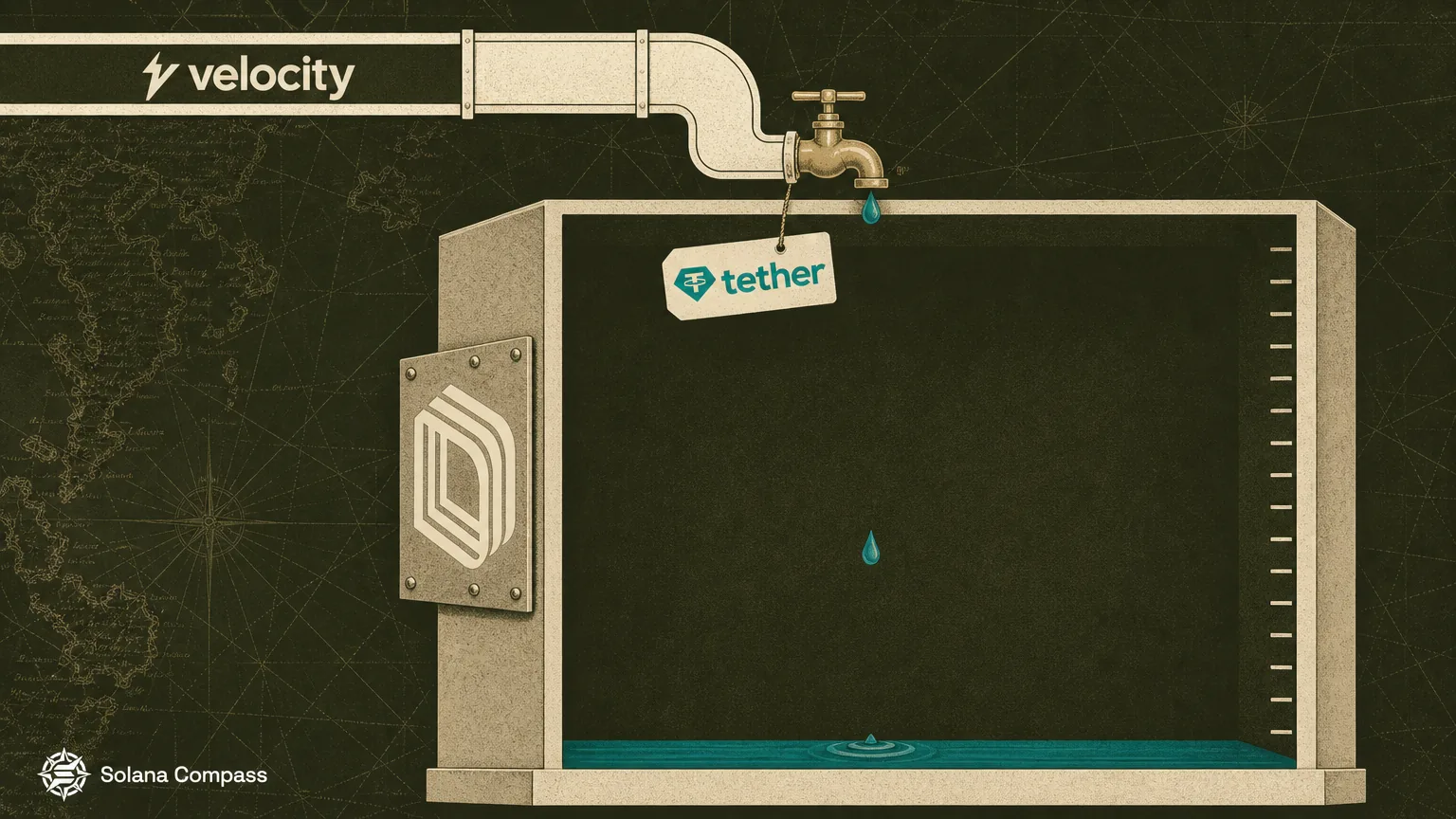
The Drift Foundation opened claims and redemptions for DFX, the recovery token for users who lost funds in the 1 April 2026 Drift exploit, on 1 October 2026. Drift Protocol DRIFT$0.016-0.4% users with a verified loss can claim 1 DFX for every 1 USDT lost, the Foundation said in its launch post on X, and redeem each token for a share of a Recovery Pool. At launch that share is small: the Foundation's DFX claims and redemptions guide puts it at about 0.0104 USDT per DFX, roughly 1 cent for every dollar lost.
The Recovery Pool holds about 3.11M USDT, according to a follow-up post from the Foundation, against a fixed DFX supply of 299,500,810.998 tokens. The Foundation's 30 September recovery update puts the total taken from Drift users on 1 April at about $295.4 million. The exchange has since been rebuilt as Velocity, whose leadership handover we covered on 29 September.
How to claim DFX on the Drift claim portal
DFX claims run through the portal at dfx.drift.trade, and only the wallet that controlled a user's Drift account on 1 April 2026 can claim. The portal checks that wallet against the snapshot of verified losses with a Merkle proof, a cryptographic check that a wallet and its amount are on the snapshot list, then shows the allocation. According to the Drift Foundation guide, users tick boxes to accept the DFX terms, approve a transaction in their wallet and wait for a "DFX claimed" message. The portal also shows an Insurance Fund card, which the guide describes as a separate claim with its own terms that is not DFX.
The DFX claim window closes at 00:00 UTC on 1 January 2028, and DFX still unclaimed at that point will be permanently burned. The Drift Foundation also warned that it will never DM users, ask for a fee or ask them to connect a wallet anywhere other than dfx.drift.trade.
DFX redemption value: 0.0104 USDT and the formula behind it
A DFX token has no fixed value. Each one redeems for the Recovery Pool balance divided by the number of DFX outstanding, which the guide puts at about 0.0104 USDT at launch, consistent with 3.11M USDT spread across 299.5M tokens. A user with a verified 1,000 USDT loss holds 1,000 DFX, redeemable at launch for about 10.40 USDT.
Redeeming burns the DFX and pays out USDT in a single transaction, and redemptions are final. Any wallet holding DFX can redeem, including wallets that bought or received it rather than claiming. The guide sets out three properties: the Recovery Pool only grows, the redemption amount never falls and DFX supply only shrinks. A redemption removes USDT and burns DFX in the same proportion, so the rate for remaining holders is unchanged, and every later deposit is then shared among fewer tokens. In the guide's own example, if 10% of supply is redeemed, each remaining DFX receives about 11% more of every subsequent deposit; the guide adds that its figures illustrate the mechanics and are "not a projection or a promise."
The structure resembles a creditor's claim on a bankruptcy estate that pays out as the estate collects, except that each DFX holder decides when to cash in.
DFX is a standard SPL token on Solana, so holders can also transfer it or trade it on secondary markets such as Raydium RAY$1.94-1.8%, according to the guide. The Drift Foundation makes no representation about where or how DFX will trade, which means a market price can sit above or below the redemption amount.
What fills the DFX Recovery Pool: Velocity revenue, Tether and recovered funds
The DFX redemption value rises only when money enters the Recovery Pool. The Drift Foundation guide names four sources:
- A daily share of Velocity's Net Protocol Revenue, deposited at 00:00 UTC until the pool has received the full amount of verified losses.
- A matched deployment from Tether USDT$0.999+0.1% of up to 127.5M USDT, committed to support "relaunch and user recovery."
- Up to 20M USDT from strategic partners to support user recovery.
- Any stolen funds recovered through a freeze, a bounty or law enforcement.
Velocity's revenue share is tiered. The guide says net trading fees are split 15% to the Insurance Fund, 15% to vAMM capital and 70% as Net Protocol Revenue. Of that revenue, the pool takes 60% of the first 30,000 USDT each day, 70% of the band from 30,000 to 100,000 USDT, and 90% of anything above 100,000 USDT. The pace of the daily deposits therefore tracks trading activity on Velocity.
The guide does not give an amount or timetable for how the Tether and strategic-partner commitments reach the pool. At the current supply, each 1M USDT deposited adds about 0.0033 USDT to the redemption value of every DFX, and revenue deposits stop once the pool has received the full verified loss total of about 299.5M USDT.
Recovered funds are the least predictable source. The 30 September update says about $9.2 million of stolen funds has been frozen after the attacker moved them through Tornado Cash in August, and that recovering frozen funds involves law enforcement and takes time. Three of the four Ethereum wallets holding the stolen funds have not moved and hold 107,165 ETH, according to the same update. The Drift Foundation and Bybit bbSOL$122.43+2.0% also run a public bounty paying 10% of any funds recovered.
How affected Drift users reacted to the DFX launch
Replies to the Drift Foundation's announcement centred on the gap between losses and the launch value. One user contrasted a $1,000 loss with about $10 back. Another asked why DFX would be burned after 1 January 2028 when they might prefer to wait years for a fuller recovery; under the guide, the burn applies to DFX left unclaimed when the window closes.
For affected users, the practical facts are a claim window that runs until 1 January 2028 and a redemption rate that steps up once a day, when the 00:00 UTC deposit lands. Drift's Recovery Dashboard shows the pool balance, outstanding DFX supply and current redemption amount in real time, and each deposit is an on-chain transaction.

Solana 🧭 Compass
@SolanaCompassSolana Compass is an independent Solana analytics and staking platform, operating a validator on Solana mainnet since September 2021. Its network statistics and...
Comments
Please login to leave a comment.
Contents


Projects


Related Content
Drift: Can This Solana DEX Compete With Binance? | Cindy Leow, Chris Heaney
Building Solana's Largest Perps DEX | Cindy Leow & Chris Heaney
Building Binance On-Chain | Cindy Leow & Chris Heaney, Drift Protocol
Drift: The Solana DEX Powering Onchain Liquidity | Cindy Leow & Chris Heaney
Product Keynote: Drift (Cindy Leow)
Drift Protocol: Fusing CEX Agility with DEX Integrity on Solana
Solana's Breakout DeFi Lending Protocol | Mary Gooneratne
Solana Ecosystem Call ft. Jito, Kamino Finance, Drift, Genopets, and Udi Wertheimer (Jan 24)
How Bitcoin Hedges Against Currency Debasement | Raoul Pal Interview
Ship or Die at Accelerate 2025: The Quest for a Digital Dollar
The State Of Solana DeFi With Kyle Samani & Chris Heaney
Drift Co-Founder Cindy Leow Steps Down, Hands Rebuilt Velocity Exchange to New Team
Project 0: The Largest DeFi Prime Broker, Only Possible on Solana
How NEAR Is Building Crypto's Interoperability Layer | Illia Polosukhin
Validated | So How Does DeFi Work, Anyway?
Latest news
Raydium Q3 2026 Net Revenue Jumps 264% to $7.99M on Tokenized Stocks and LaunchLab, Blockworks Report Shows
Solana Mobile Launches Seeker Connect, a One-Tap 'Connect with Seeker' Wallet SDK for Expo, Kotlin and Web Dapps
Arcium Opens Blackthorn Private AI Inference to Selected Users in Private Alpha
Solana Alpenglow Is Live on Mainnet as Anza Retires TowerBFT at Slot 459,653,000
Bastion Trading Tells SkyAI Chairman and Three Directors to Explain SOL Liquidation or Resign
Western Union Taps Noah to Pay Remittances Into Stablecard as USDPT on Solana
Bitwise Staking Report: Solana Ends Q3 With 69% Staked, a 5.99% Gross Yield and 659 Validators
Alpenglow Is Pending Activation on Solana Mainnet, With TowerBFT Set to Retire at Slot 459,653,000
X9.150 QR Code Payments Demo at Money20/20 Lets One Invoice Be Paid Over FedNow, RTP or USDC on Solana
Alpenglow Tracker Flags 45% of Solana Stake as Not Ready Two Days Before Epoch 1064, Most of It on Agave 4.3.0 and 4.3.1
Solana Token Markets


