Solana Foundation Announces Solana DvP, an Open-Source Atomic Settlement Program With Input From J.P. Morgan

Solana Foundation announced Solana DvP, an MIT-licensed escrow program that settles asset and cash legs in one transaction, with input from J.P. Morgan.
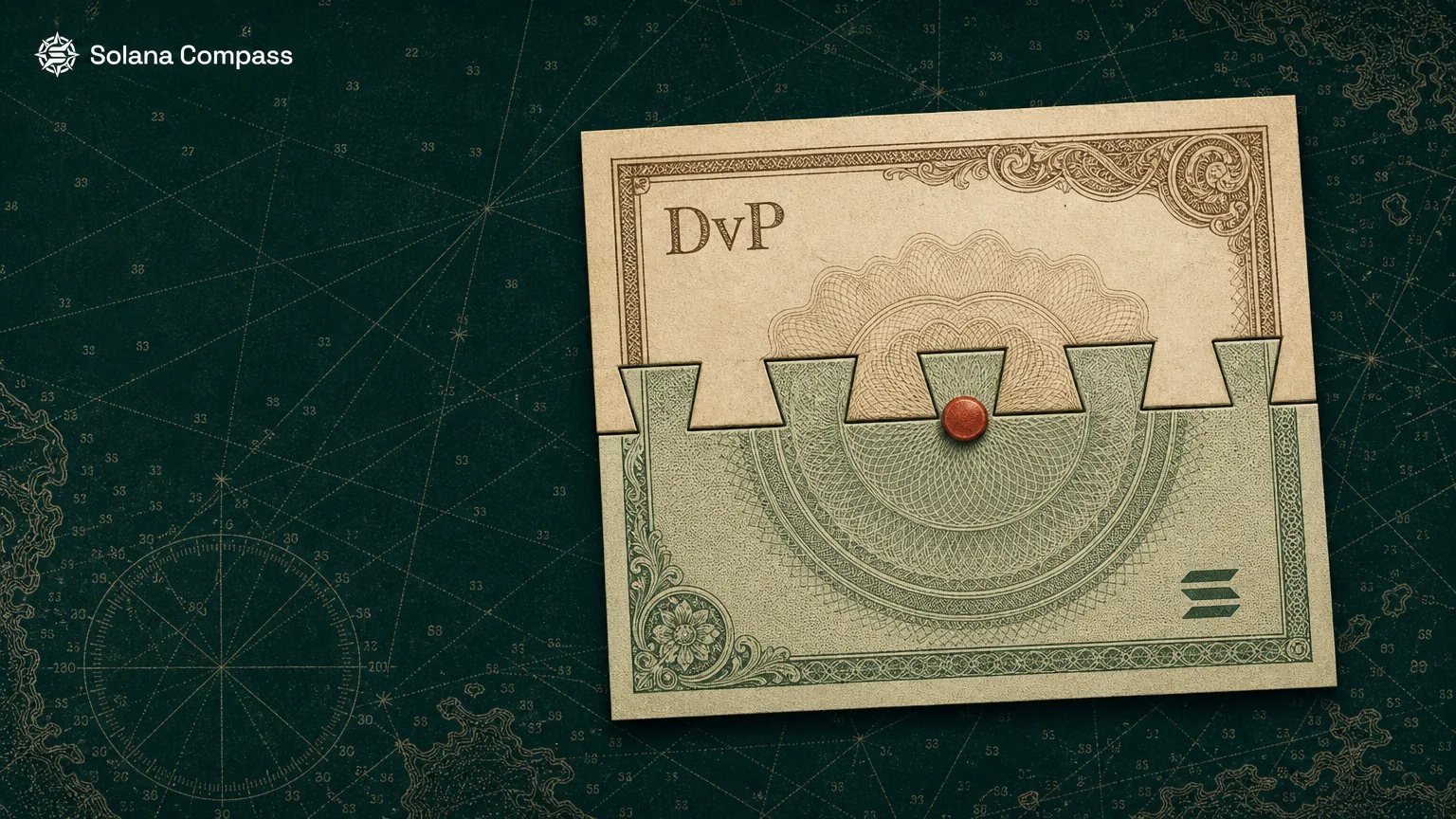
The Solana Foundation on 6 October 2026 announced Solana DvP, an open-source escrow program for delivery-versus-payment settlement on Solana, released under the MIT license. Delivery-versus-payment, or DvP, is the rule that a security and the cash paying for it change hands at the same moment, so neither side is left having paid for nothing. J.P. Morgan gave the Foundation input on securities settlement practices.
The release says traditional markets get that guarantee through a chain of clearinghouses, depositories and custodians that ties up capital for one to two days. Solana DvP puts both sides of a trade in a single transaction: both legs settle together, or neither does. The Foundation's aim is one shared program for institutions that, in its words, "have typically relied on bespoke smart contracts" to settle onchain.
Catherine Gu, the Foundation's head of product for digital assets, said in the release that atomic settlement "removes counterparty risk that is inherent in traditional finance" and promised "finality in seconds instead of days." The seconds figure is the Foundation's claim; it has published no settlement data, and no institution has been named as a user.
How the Solana DvP escrow settles both legs in one transaction
Solana DvP holds each side of a trade in its own escrow account and releases both in one transaction, signed by a third party the traders name in advance. The Foundation's documentation describes three steps: record the terms, fund the two escrows, settle.
Recording a trade stores the two parties, the two tokens, the amounts, an expiry time and the settlement authority, which the docs describe as a third address "such as the venue or agent that arranged it". Each party then funds its leg with an ordinary token transfer. No DvP-specific integration is needed, so a custodian or wallet that can send tokens can take part.
Only the settlement authority can settle, and it cannot change where the proceeds go, because the destinations are fixed when the trade is created. Until it signs, either party can pull its own leg back or reject the trade. After the expiry time the program refuses to settle, though refunds still work. A trade can also carry an earliest settlement time. Those two clocks are the "enforced deadlines" in the announcement.
The docs are plain about what the program leaves out. It has no order book, no netting, no partial fills, no eligibility or KYC check, and no leg outside Solana: "a cash leg on existing rails settles separately and is reconciled." It removes the risk that one side delivers and the other does not. It does not remove the issuer's credit risk, or the trade's dependence on the settlement authority being available to sign.
Which Token-2022 assets the program accepts and rejects
Solana DvP works with tokens from both the original SPL Token program and Token-2022, the newer token standard whose optional extensions let issuers build compliance controls into an asset. A single trade can mix the two. The release names the extensions "regulated issuers depend on": permanent delegate, pausable tokens and transfer hooks.
Those controls keep working while tokens sit in escrow. According to the docs, an issuer's freeze, pause or permanent-delegate authority "can move, freeze, or halt the escrowed tokens for the life of the trade", so the issuer is a trusted party in every settlement.
Four extensions are refused: transfer fees, interest-bearing tokens, Scaled UI Amount and non-transferable tokens. One of those rules reaches the Foundation's own tooling. The docs note that the tokenized-security template in Mosaic, the Solana Foundation's issuance toolkit, always adds Scaled UI Amount, so a token minted from that template cannot be a leg in a Solana DvP trade. The Foundation points those issuers to a separate delegation-based settlement pattern that needs no program.
What J.P. Morgan contributed, and the limits set by the release's disclaimer
J.P. Morgan's part in Solana DvP was advisory. The Foundation's release says the bank "provided Solana Foundation with valuable input on institutional settlement practices and requirements", and carries a disclaimer setting the limit: "J.P. Morgan's involvement with Solana DvP was limited to providing input regarding securities settlement practices and should not be construed as J.P. Morgan designing, developing, operating, approving, certifying, warranting, endorsing, or guaranteeing Solana DvP or its performance in any way."
Rhodel D'souza, head of markets digital assets at J.P. Morgan, said in the same release that a shared, open standard for atomic delivery-versus-payment "is exactly the kind of foundational infrastructure institutional market participants require to operate at scale without introducing settlement risk and counterparty exposure. We were pleased to contribute our settlement expertise."
The bank has handled delivery-versus-payment settlement on Solana before. On 11 December 2025, J.P. Morgan arranged a US commercial paper issuance on Solana for Galaxy Digital, creating the token and, in its own description, facilitating "the delivery-versus-payment settlement of the primary issuance", with proceeds paid in USDC. J.P. Morgan's Scott Lucas discussed that trade at Breakpoint 2025.
Cantina audit, mainnet deployment and the pending production release
The program is deployed on Solana mainnet and has been audited, but the Foundation has not yet declared a production release. The docs list the same program ID on mainnet-beta and devnet and say the figures are what the solana program show command reported on 2 October 2026. The source repository shows a commit dated 29 September 2026 setting the code's ID to "the deployed dvp34 program address", although its README, last edited in July, still carries an older note calling that ID a placeholder.
The release says Solana DvP "has undergone external security audits and is ready for use with real funds." The Foundation's announcement thread adds that it is "welcoming design partners ahead of the production release". No date has been given for that release and no design partners have been named. CoinDesk, which reported the announcement the same day, likewise described the program as audited and ready for real funds. The program is also upgradeable on both clusters, which the docs flag as a dependency on whoever holds the upgrade authority.
The docs and the repository name Cantina as the auditor. Cantina's report covers a review from 21 to 28 May 2026 and lists 21 findings: four medium, six low and 11 informational. All four medium findings are marked fixed. They concerned funds getting stuck during refunds, for example when a token account requires a memo on incoming transfers, and a closed trade's address being reused to capture a late deposit. The current docs describe the countermeasures: the program attaches the memo itself, each party can reclaim its own leg independently, and a permanent marker account stops a trade address from being used twice.
The Foundation also said it plans to add privacy "so that trade settlements can be made private and confidential." Today the docs state that escrowed and settled amounts are public, even for tokens that support confidential transfers.
For an institution issuing or trading tokenized assets on Solana, the practical change is that the final exchange of two tokens can run through a shared, audited program in place of a contract written for one deal. Solana DvP leaves matching, eligibility and the legal side to its users: the docs say whether a finalized Solana transaction also counts as settlement finality in law "depends on the parties' agreements and the regimes that apply."

Solana 🧭 Compass
@SolanaCompassSolana Compass is an independent Solana analytics and staking platform, operating a validator on Solana mainnet since September 2021. Its network statistics and...
Comments
Please login to leave a comment.
Contents

Projects


Related Content
Worldpay's Neil Kreisel on USDC Integration and Blockchain Payments
Why Payment Processing Companies Need to Start Thinking About Blockchain w/ Nabil Manji (Worldpay)
Inside the Solana Foundation with Austin Federa
What Is Flipcash? | Ted Livingston
Morgan Stanley's MSSE and MSOL Begin Trading on NYSE Arca With Staking From Day One
Breakpoint 2024: Debate: The Solana Foundation Should Be Dissolved
Product Keynote: Artemis (Jon Ma)
PayAI Launches x402 Batch Settlement on Solana in Public Preview, Bundling USDC Micropayments Into Channel Claims
Jeonbuk Bank Completes Solana Private-Channel Stablecoin Remittance PoC With Solana Foundation and Node Infra
SkyTrade's John Docquerel on Monetizing Airspace and the Future of Air Travel
MetaDAO's Futarchy Just Executed Its First Onchain Take-Private as ZKFG-008 Passes
Ship or Die at Accelerate 2025: Lightning Talk: Pipe Network
E*TRADE from Morgan Stanley Launches Spot Crypto Pilot With SOL Among Three Initial Assets
Crypto's Role in Payments w Arnold (Sphere Labs)
SkyTrade: Building The World's First Air Rights Market | Jonathan Dockrell, Skytrade
Latest news
DeFi Development Corp. Estimates NAV Per Share Doubled Since August as SOL Treasury Reaches 2.56 Million
Solana Foundation Announces Solana DvP, an Open-Source Atomic Settlement Program With Input From J.P. Morgan
MetaDAO Renames Futardio as Backable, Its Permissionless Fundraising Platform on Solana
DGLD, the Swiss Gold Token From MKS PAMP, Goes Live on Solana via SwissBorg With Arrakis Liquidity
Triton One Announces Account Sync, an SDK That Serves Solana Account Reads From a Local Cache
Shiba Inu (SHIB) Goes Live on Solana via Sunrise, Confirmed by the Official SHIB Account
Backpack Securities Lists Tokenized BlackRock (BLK) Stock on Solana via Sunrise, Trading 24/7 on Raydium
Tokenized Shares of Drone Maker Powerus (PUSA) Go Live on Solana via Backpack Securities, a Day After Its Merger Closed
Backpack Wallet Adds Solana v1 Transaction Support and Launches AI Search
Colosseum Copilot v2 Can Now Review Your Solana Project Against 8,286 Hackathon Submissions
Solana Token Markets


