Triton One Announces Account Sync, an SDK That Serves Solana Account Reads From a Local Cache

Triton One's Account Sync SDK answers Solana getAccountInfo calls from a local cache fed by a gRPC or WebSocket stream, billed at $0.08/GB with no request fee.
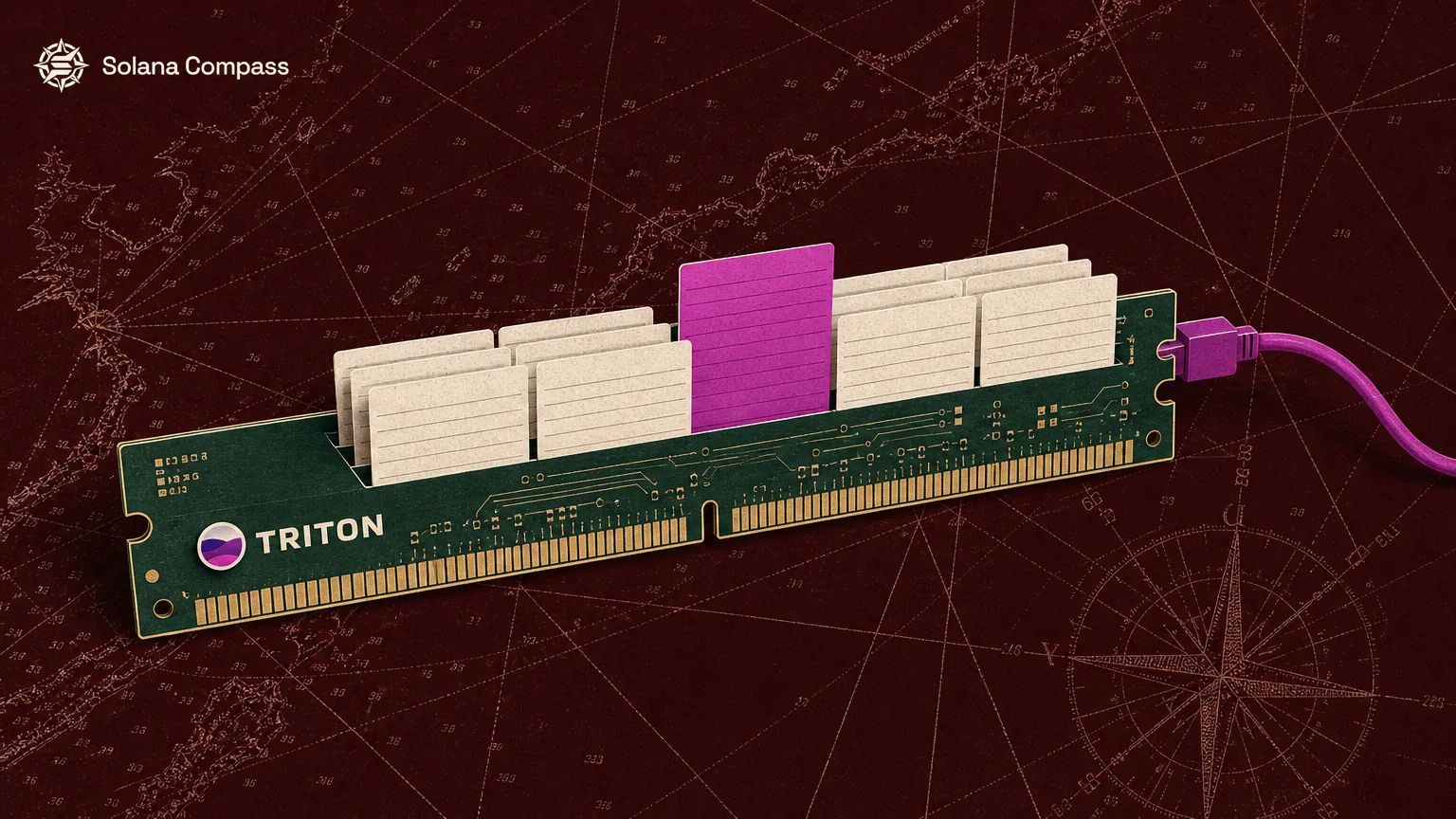
Triton One announced Account Sync on 5 October 2026, a software development kit (SDK) that answers a Solana SOL$101.64+0.5% application's account reads from a copy held in the app's own memory instead of sending each one to an RPC node. The RPC provider says the change takes the per-request charge out of repeated polling and leaves customers paying for bandwidth, which it prices at $0.08 per gigabyte.
The announcement came in a post from Triton One's official X account and an accompanying Triton blog post. The code was public before the announcement: npm's registry entry for the JavaScript package lists version 0.1.0 with a publish date of 16 September 2026.
How Account Sync replaces getAccountInfo polling with a streamed cache
Account Sync keeps a local copy of the accounts an app cares about and updates that copy from a live stream, so a repeat read never leaves the machine. On Solana, an account is where data such as a wallet's token balance or a trading pool's reserves is stored, and an RPC node is the server an app asks for that data.
Polling means asking the node for the same account again and again to see whether anything changed. Triton's blog post describes the cost of that pattern: "you're billed for both the request and the bandwidth on every call, because the RPC node has to look up the account, serialise the entire payload, and send the complete JSON back, even if nothing has changed."
According to the blog post, the Triton SDK fetches an account once over JSON-RPC on the first read, subscribes to its updates over gRPC or WebSocket, and applies those updates to a local store. Later reads are served from the app's memory. The closest everyday comparison is following the edits on a shared document instead of downloading the whole file every few seconds to check for changes.
The cache covers getAccountInfo, getMultipleAccountsInfo and their parsed and context variants, the blog post says, while every other JSON-RPC method goes to an RPC node as before. Triton ships the SDK as the @triton-one/triton-sdk package for JavaScript, which stands in for @solana/web3.js, and as the triton-sdk crate for Rust, which stands in for solana-client. The company describes the migration as "swap one import, add one accountSync config block, and you're done."
Bandwidth-only RPC pricing: $0.08/GB with no per-request charge
Triton's blog post lists standard RPC polling at "$10/M + $0.08/GB", a per-request charge plus a bandwidth charge, and Account Sync at "$0.08/GB" alone. The same table prices direct gRPC streaming at $0.08/GB. Triton says Account Sync "lets you pay for just one RPC request plus the bandwidth cost of updates, and never for data that hasn't changed."
On that model, an Account Sync bill follows how often the watched accounts change, while a polling bill follows how often the app asks.
getMultipleAccountsInfo latency benchmark and the SDK's stated limits
Triton's Account Sync documentation reports a JavaScript getMultipleAccountsInfo benchmark in which median latency fell from 12.01 ms on standard RPC to 1.65 ms with Account Sync, an 86.3% reduction, and 90th-percentile latency fell from 14.94 ms to 1.98 ms, an 86.8% reduction.
The latency figures are Triton's own. Triton's documentation page does not describe the test setup, and Solana Compass found no independent benchmark or third-party coverage of Account Sync on 5 October 2026.
Triton names the cases where Account Sync is the wrong tool. Its documentation says standard RPC calls "may be more appropriate" for an application that reads account data infrequently, and the blog post says "latency-critical trading (HFT, MEV, liquidation engines)" should use direct gRPC streaming, which it calls "still the fastest path." The documentation's support table shows that browser apps can use only the WebSocket transport, and that the Rust crate supports only gRPC, on the Tokio runtime.
Where the SDK sits alongside Cloudbreak and SuperBank
Account Sync is documented under Triton's Project Yellowstone section, and it puts a data stream behind the read calls most Solana apps already make. Solana Compass covered two earlier Triton One products aimed at reading Solana data in June 2026: Cloudbreak, a Postgres-indexed store for getProgramAccounts queries, and SuperBank, a ClickHouse-based layer for historical ledger data.
Triton's blog post aims Account Sync at wallets, DEXs, explorers and portfolio dashboards that poll continuously. For those teams the saving depends on their own workloads, and the blog post names no customers already using it.

Solana 🧭 Compass
@SolanaCompassSolana Compass is an independent Solana analytics and staking platform, operating a validator on Solana mainnet since September 2021. Its network statistics and...
Comments
Please login to leave a comment.
Contents

Projects


Related Content
Running and Scaling Solana RPCs (w/ Brian Long, co-founder of Triton) - Solfate Podcast #37
Triton One Publishes Alpenglow Integrator Guide: What Solana RPC, gRPC and Indexing Users Must Change
Solana Change Log: SIMD Updates, Program Deployments, and Web3.js v2
Solana Changelog Aug 21 - SIMD Updates, Commits, and Developer Resources
Solana Changelog March 7 - Verifiable Builds, Admin RPC, and Geyser
Alpenglow Is Pending Activation on Solana Mainnet, With TowerBFT Set to Retire at Slot 459,653,000
WTF RPC? w/ Brian Long (Triton One)
Crypto's Next DePIN Catalyst With David Rhodus, Pipe Network
Solana Changelog - Nov 12 - web3.js v2, skip preflights in the CLI, and SIMD-0191
Solana Changelog March 7 - Verifiable Builds, Admin RPC, and Geyser
Triton One Open-Sources SuperBank, a 38x Faster Historical Ledger Layer for Solana Built on ClickHouse
Solana Changelog Apr 16 - Vote Instructions, Bank forwarding, QOS
Solana Changelog - April 16 - Vote Instructions, Bank Forwarding, QoS
Solana Foundation Launches Official RPC Performance Dashboard at solana.com/data
Triton One's Cloudbreak Cuts getProgramAccounts Latency 99% With Postgres-Indexed Account Storage
Latest news
Solana Policy Institute Asks SEC to Define 'Permissionless' Ledgers by Who Controls Validators
Circle Gateway Brings Unified EURC Balances to Solana, With 20M EURC in a New Pre-Mint Account
Sanctum Q3 2026 Report: TVL Hits a Record 18.62M SOL as Gross Profit Falls 16% in SOL Terms
Bitquery Traces $1.4B of Raydium CLMM Volume, 22.7% of the Total, to One Wash-Trading Wallet
J.P. Morgan Asset Management Brings Its MONY and JLTXX Tokenized Money Market Funds to Solana
Decrypt Picks Jupiter to Power Trading in Its Money Accounts on Solana
Solana Company (HSDT) Named a Hong Kong Strategic Enterprise, Plans Solana Validators in the City
Kamino Says Its AUTO Market Passed $170M a Month After Fixed-Rate Borrowing Launched
Raydium Q3 2026 Net Revenue Jumps 264% to $7.99M on Tokenized Stocks and LaunchLab, Blockworks Report Shows
Solana Mobile Launches Seeker Connect, a One-Tap 'Connect with Seeker' Wallet SDK for Expo, Kotlin and Web Dapps
Solana Token Markets


