
Helius hSOL$99.08-3.4% has launched Solana Privacy Rings on mainnet, giving Solana users encrypted balances and transfers without leaving the network. In the default Ring, the token and the amount of each transfer are hidden onchain, while wallet addresses stay visible. Decrypt and ORE ORE$103.17-11.5% are already using it, with more apps integrating, Helius said in its launch post on 10 November 2026.
Helius announced the release in a post that ended "Now live on mainnet." Minutes later the Solana Foundation confirmed the launch: "Public by default, private by choice. Solana Privacy Rings from @Helius are live on mainnet, with programmable privacy at Solana speed."
This is the mainnet version of the system we covered when Helius CEO Mert Mumtaz revealed Rings in private beta in August 2026. In June 2026, Helius acquired the team behind ZK Compression, Light Protocol, to build a privacy layer for Solana.
How Solana Privacy Rings work: deposit, transfer privately, withdraw
A Ring is a shared pool on Solana that holds encrypted balances. A user deposits SOL, an SPL token or a Token-2022 token into the Ring, sends it to other Ring users with the asset and amount encrypted, and can withdraw back to an ordinary public balance at any point. Helius says the deposit and the withdrawal are visible onchain; the balances and transfers in between are not.
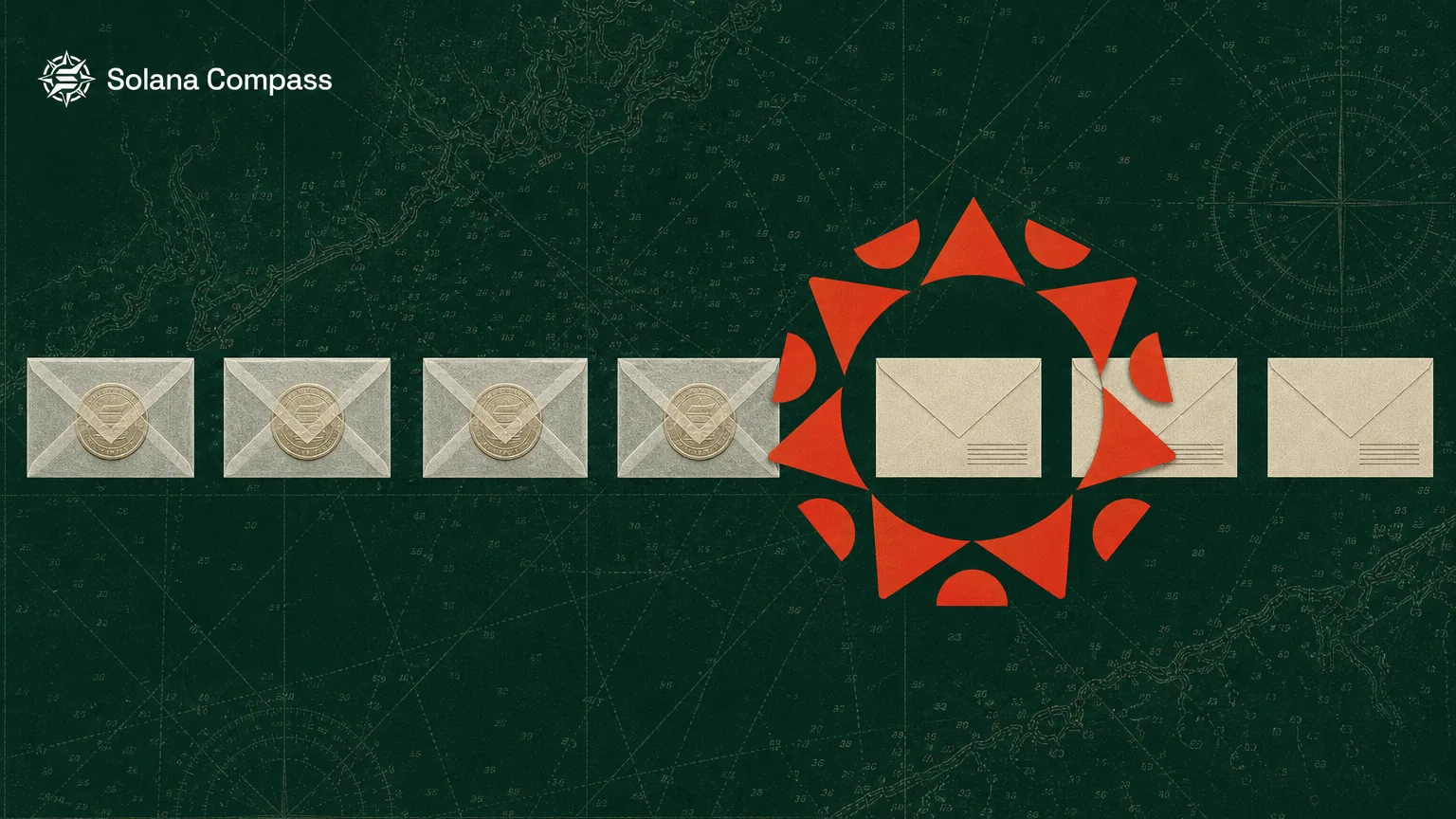
A sealed envelope is a fair comparison for the default Ring. Anyone watching the chain can see who sent an envelope to whom, but not what was inside or how much. Each transfer carries a zero-knowledge proof, a short piece of maths that lets Solana check the transfer is valid (the sender had the funds, nothing was created from thin air) without seeing the numbers. Users keep custody: only the owner's signature can move funds.
Holders read their own balances with a viewing key. The Helius encryption documentation says that key can stay on the user's device or be handed to an RPC provider for read-only access, which can see the balance but cannot spend it. A per-transaction key lets a user disclose a single transfer, to an auditor or a counterparty, without opening up the rest of their history.
The Helius architecture documentation puts a confidential transfer at about 140,000 compute units, with a 192-byte Groth16 proof. One Ring tree handles about 86 private transfers per block, or roughly 430 per second at current block times, according to the same page. The documentation says additional trees scale capacity beyond that.
Helius ZK proofs settle on Solana mainnet, with no L2 or sequencer
Privacy Rings transactions execute directly on Solana, verified by the Solana Privacy Program on mainnet, with no separate sequencer or L2 between the user and the chain, according to the Helius launch post.
Mert Mumtaz, Helius CEO, made that the centre of his own announcement. "I was existentially worried for the future of Solana for the past few years given its lack of privacy," he wrote on X, adding that Helius "joined forces with the best ZK devs on Solana, and built the solution" and that "execution is on Solana, not an L2 or secondary network."
For users, a private transfer behaves like any other Solana transaction. It lands in the same blocks, uses the same wallet address and needs no bridge out to a privacy chain and back. Apps can call the privacy features from their own Solana programs, with no second network to integrate. In the Helius launch post, Mumtaz put the stakes in scaling terms: "the final scaling frontier in crypto is actually privacy."
Decrypt, ORE and Aurora Intents are first to use confidential transfers
Three integrations were live on launch day, per Helius.
Decrypt said it has partnered with Helius "to add confidential transfers to the Decrypt Money Account." The privacy covers sending funds only; swaps, Earn and prediction-market positions inside the Money Account remain public, according to Decrypt's announcement as relayed by KuCoin.
ORE said it is integrating Rings for transfers of the ORE token, so that "users can move ORE without publicly revealing the assets or amounts involved."
Aurora took a cross-chain route. Aurora Intents now delivers swap output from other chains straight into a recipient's confidential balance on Solana: "Same Solana address. No extra shielding step." The service is powered by NEAR Intents. Aurora's demo repository is explicit that the deposit itself is public, including depositor, recipient, asset and amount, and records a mainnet deposit confirmed on 6 November 2026 at 38,518 compute units.
The integration list is longer than the launch list. Helius names Backpack, DFlow, Jupiter JUP$0.255+5.8%, Squads and Titan as integrating, plus on-ramps from Crossmint, MoonPay and Paybis. Squads co-founder Stepan Simkin wrote that Rings are "programmable, heavily audited and soon to be formally verified," and that "onchain privacy is coming to both multisig and altitude very soon."
Certora, OtterSec and ZK Security audits; formal verification and Custom Rings pending
Certora, OtterSec and ZK Security audited the core program and the zero-knowledge circuits, according to the Helius launch post. Engineers from the Solana Foundation, Blueshift, Zcash and the three audit firms took part in the trusted setup, the one-off ceremony that generates the public parameters the proofs depend on.
Formal verification, a mathematical check that the circuits behave exactly as specified, is still underway. Helius expects it to finish by the end of 2026. In an August 2026 interview with Genfinity, Mumtaz described three audits running in parallel with formal verification of the circuits, and expected mainnet within one to two months. Mainnet arrived in November with the audits complete and the verification work still running.
Custom Rings are also not live yet. These are Rings that institutions and apps configure for themselves: confidential or fully anonymous modes, where sender and recipient are hidden as well as the amount, plus auditor access and their own compliance policies. Helius says Custom Rings are under audit and targets a mainnet release in Q4 2026. Until then, the default Ring is the only one on mainnet.
Default Ring compliance: Range, Chainalysis and Elliptic after the Privacy Cash pause
The launch comes six days after another Solana privacy protocol ran into trouble. On 4 November 2026, Privacy Cash paused deposits after Elliptic traced funds from the Binance hack into its pools.
The default Ring takes a narrower approach to privacy. Addresses, deposits and withdrawals stay visible, so money entering and leaving a Ring can still be followed; what is hidden is the asset and the amount moving between known parties. Helius lists Range, Chainalysis and Elliptic as compliance partners, and the anonymous mode that would hide counterparties is reserved for Custom Rings with their own policy controls.
Two Solana Foundation staff quoted by Helius made the institutional case. Cat McGee, Technical Privacy Lead, said that "as more real money moves through it, privacy needs to become part of this infrastructure." Ben Brophy, Head of Institutional Growth, Europe, said that "for institutions to meaningfully participate in onchain finance, privacy needs to be built into the infrastructure from the start."
What to watch: formal verification, Custom Rings in Q4 2026 and Squads multisig privacy
The next milestones for Solana Privacy Rings are set out in Helius's own launch post and its partners' announcements:
- formal verification of the circuits, which Helius expects to complete by the end of 2026;
- Custom Rings, including the anonymous mode, targeted for mainnet in Q4 2026;
- the integrations still in progress, including when Squads, Jupiter and Backpack ship live features.
A payments company or trading desk that wants private balances on Solana can now get them in the same transactions, programs and wallets it already uses, with no separate privacy network to bridge to.


