Grayscale Models SOL Supply Growth Below Gold by 2031 if SIMD-0550 and SIMD-0553 Pass

Grayscale models SOL supply growth falling to 1.1%/yr by 2031, below gold's 1.8%, if SIMD-0550 and SIMD-0553 pass their August 18 Solana governance vote.
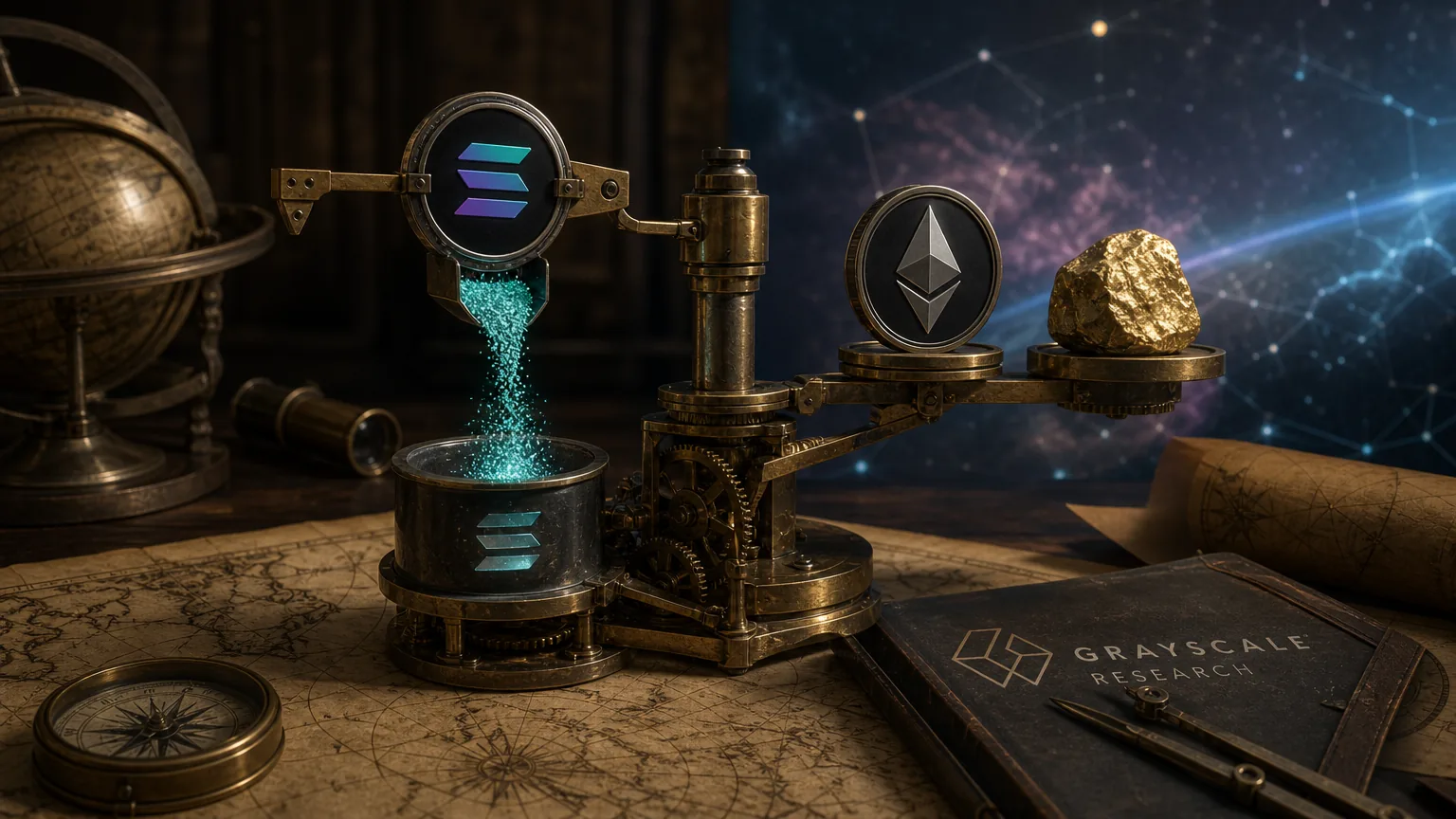
Two days before Solana's August 18 governance vote closes, Grayscale Research published a supply analysis by Zach Pandl, the firm's Head of Research, modeling SOL (SOL) annual supply inflation falling to roughly 1.1% by 2031 if SIMD-0550 and SIMD-0553 both pass. That sits below gold's 1.8% annual supply growth, drawn from World Gold Council data on above-ground gold stock from 2015 to 2025.
The comparison spans four assets. Grayscale's model also places Ethereum (ETH) at approximately 0.4% annual supply growth by 2031 under EIP-8363, matching Bitcoin's projected post-halving trajectory. US CPI has averaged 3.3% per year over the past decade, per Bureau of Labor Statistics data cited in the report. Pandl's note is clear about the conditions: the 1.1% figure assumes immediate implementation, steady network activity, and a Solana staking ratio held roughly constant. These are modeled projections.
How SIMD-0550 Reshapes the SOL Inflation Schedule
Under Solana's current design, annual inflation falls by 15% per year until reaching a 1.5% terminal rate. SIMD-0550 proposes doubling that disinflation rate to 30%, moving the timeline to reach terminal inflation from 2032 to approximately H1 2029.
Helius hSOL$125.08-3.9% estimated in analysis supporting the proposal that faster disinflation would cut cumulative SOL emissions by 18.9 million tokens over six years.
The direct consequence is lower staking yields. Grayscale's model shows nominal staking returns falling from 5.84% today to approximately 4.34% one year after implementation, and to 2.25% by year three. Pandl describes the trade-off in the report: "token holders who stake would receive fewer tokens, because staking rewards are paid through new token inflation. However, with fewer tokens in circulation, scarcity value may increase."
SIMD-0553: Daily SOL Burns Projected to Rise from 648 to 7,500-9,000
The companion proposal restructures how transaction fees flow. Solana currently charges a flat 5,000-lamport signature fee. SIMD-0553 would replace that with a 2,500-lamport inclusion fee plus a separate resource-based fee that burns entirely, rather than flowing to validators or the staking pool.
At current network activity, daily SOL burns run at approximately 648 SOL against daily issuance of roughly 60,000 SOL. Grayscale models SIMD-0553 pushing daily burns to between 7,500 and 9,000 SOL, contingent on sustained transaction volume.
Both proposals entered formal Solana governance on August 8, with voting closing August 18. Solana Compass covered the debate among validators and stakers when the formal vote opened.
EIP-8363: Ethereum's Route to 0.4% Annual Supply Growth
Grayscale runs a parallel analysis for WETH (ETH) via EIP-8363. The mechanism would burn increasing portions of validator consensus rewards as ETH's staking participation rate rises, reaching 100% of new consensus rewards burned once staking hits 50% of supply. With approximately 42 million ETH currently staked (around 34% of total supply), applying the formula at current ratios would reduce net consensus yield from approximately 2.6% to 1.2%, per Blockonomi. A proposed 18-month transition period would soften the impact on validators.
Grayscale's 0.4% Ethereum estimate holds only if the staking ratio remains near one-third. Unlike Solana's August 18 deadline, EIP-8363 is still in the research and EIP process without a fixed governance vote window.
August 18 Vote: Solana Closer to Implementation Than Ethereum
Passing SIMD-0550 and SIMD-0553 requires a two-thirds supermajority of participating staked SOL. Grayscale notes that "the Solana proposals seem to have broader agreement and have a better chance of being implemented" than the Ethereum counterpart, citing the comparative maturity of Solana's on-chain governance.
The institutional framing from a firm managing billions in crypto assets, modeling SOL alongside Bitcoin in a supply-scarcity chart against gold, adds a new dimension to a governance debate that has centered on validator economics and staker yield compression. The August 18 vote determines whether Solana's trajectory into that chart holds.

Solana 🧭 Compass
@SolanaCompassSolana Compass is an independent Solana analytics and staking platform, operating a validator on Solana mainnet since September 2021. Its network statistics and...
Comments
Please login to leave a comment.
Contents


Projects

Related Content
Why Solana Should Change Its Inflation Rate | Weekly Roundup
Solana's Inflation Is Too High - Lightspeed Podcast
Why Solana Should Change Its Inflation Rate | Weekly Roundup
Why Solana Needs To Fix Its Inflation Rate | Tushar Jain
Three Tokenomics Proposals Line Up for Formal Votes as Solana's Governance System Goes Live
Gold Capital Markets: Oro Labs
Solana's Onchain Nasdaq Thesis | Carlos Gonzalez Campo
Why Solana's Inflation Proposal Didn't Pass | Weekly Roundup
A Solana Data Deep Dive With Carlos Gonzalez Campo
Solana Validators Debate SIMD-0550 and SIMD-0553 as SOL Issuance Cuts Near
Anza CEO Says SIMD-123, SIMD-550, and SIMD-553 Will All Ship This Year
Solana's Tokenized Gold Market Cap Grew 689% in a Year, Outpacing Every Other Chain
Solana Changelog - January 10, 2023 - dApp-Controlled Account Fees, SIMD, and Sandstorm!
Solana Changelog - January 10, 2023 - dApp-Controlled Account Fees, SIMD, and Sandstorm!
Anza Researchers Propose a Geo-Aware Solana Leader Schedule in SIMD-0674 and SIMD-0675
Latest news
Bitquery Traces $1.4B of Raydium CLMM Volume, 22.7% of the Total, to One Wash-Trading Wallet
J.P. Morgan Asset Management Brings Its MONY and JLTXX Tokenized Money Market Funds to Solana
Decrypt Picks Jupiter to Power Trading in Its Money Accounts on Solana
Solana Company (HSDT) Named a Hong Kong Strategic Enterprise, Plans Solana Validators in the City
Kamino Says Its AUTO Market Passed $170M a Month After Fixed-Rate Borrowing Launched
Raydium Q3 2026 Net Revenue Jumps 264% to $7.99M on Tokenized Stocks and LaunchLab, Blockworks Report Shows
Solana Mobile Launches Seeker Connect, a One-Tap 'Connect with Seeker' Wallet SDK for Expo, Kotlin and Web Dapps
Arcium Opens Blackthorn Private AI Inference to Selected Users in Private Alpha
Solana Alpenglow Is Live on Mainnet as Anza Retires TowerBFT at Slot 459,653,000
Bastion Trading Tells SkyAI Chairman and Three Directors to Explain SOL Liquidation or Resign
Solana Token Markets


