
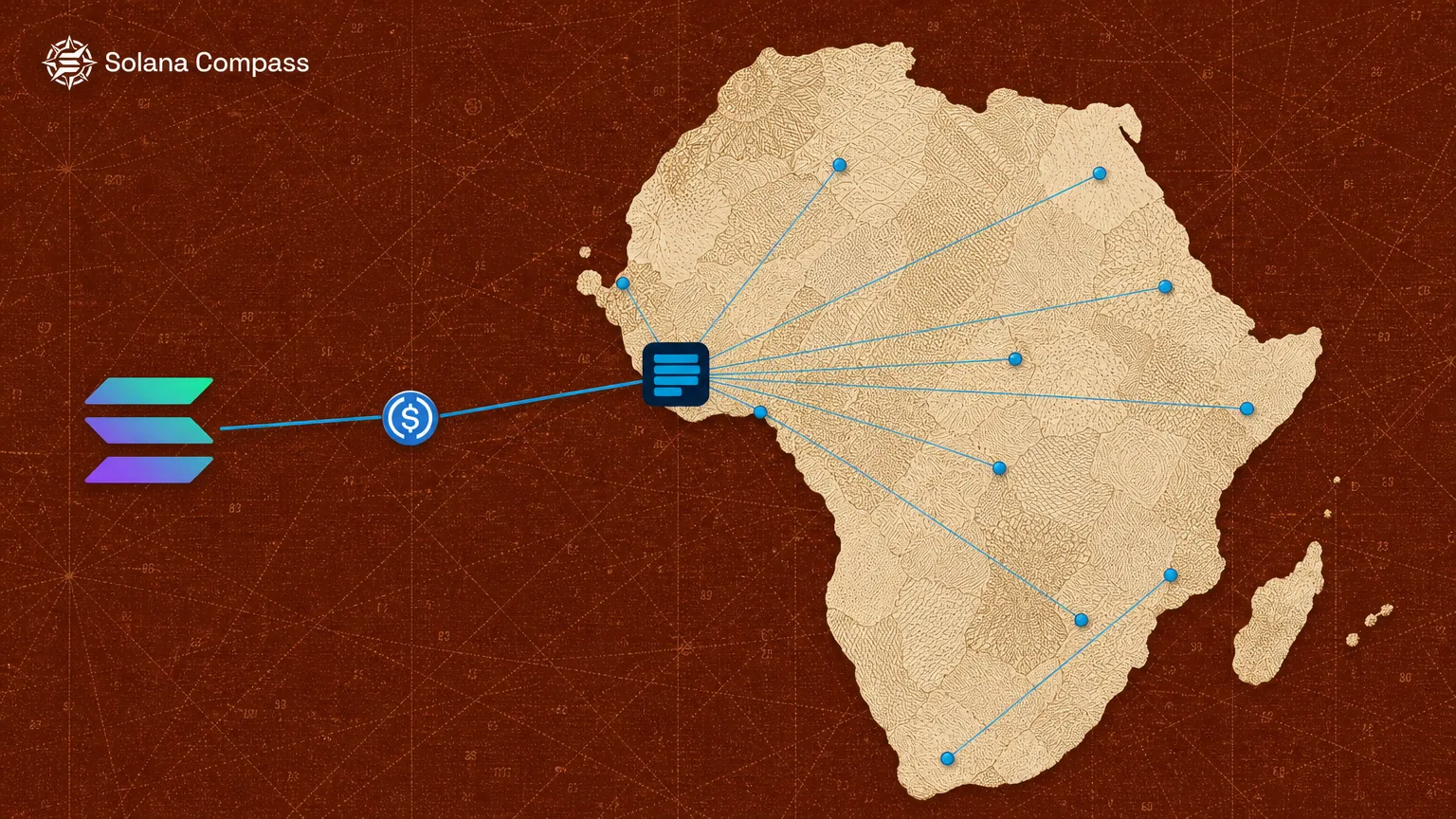
Paystack is connecting its African payments network to Solana SOL$71.71-0.7%. Chief executive Shola Akinlade set out the plan on stage at Breakpoint in London on 16 November 2026, and Solana's official account posted the talk with the line that more than 400,000 businesses use Paystack to collect over $15 billion a year.
The product behind the plan is an API called Global Stack, according to Condia and TokenPost. Both describe it as one connection between the ways Africans already pay, such as bank transfers, mobile money including M-Pesa, and cards, and the onchain economy. Akinlade's talk was titled "Bringing Africa's 41 Currencies Onchain", Technext reported. No go-live date for the Solana connection has been published.
How Global Stack moves money between African currencies and USDC
A product site at globalstack.io carries the Global Stack name and the same description, though it does not name the company that runs it. It sets out four steps: collect by bank transfer or mobile money, hold the balance in stablecoins, convert back to local currency, and pay out in 20 African markets. "Money moves through stablecoins such as USDC and lands in local currency," the site says, and every worked example on it uses USDC. It lists Solana, Base and Ethereum as the networks for sending and receiving stablecoins.
The site's payroll example shows what that means for a business. A platform funds one USDC balance, then pays contractors in Kenya by M-Pesa and in Nigeria and Ghana by bank transfer, each in their own currency. A quote fixes one all-in rate, covering the exchange rate and every fee, for up to an hour. USDC plays roughly the part a dollar account at a correspondent bank plays in a traditional cross-border transfer: the shared currency in the middle.
The other building blocks the site lists:
- Named virtual accounts that give each customer local bank details in their own name in Nigeria, South Africa, Ghana and Kenya
- On and off ramps between stablecoins and the naira, cedi and rand
- A wallet for each customer, with sub-wallets, under one account
- A managed treasury desk for transfers of $500,000 and up
The site's coverage map shows payouts to 20 countries, from Senegal and Côte d'Ivoire to Tanzania and Zambia, by bank transfer, mobile money or both depending on the market. The Global Stack developer documentation puts coverage at 14 currencies across 21 African countries. Access runs through a waitlist, with the site saying "We're onboarding new teams in batches", and payouts in US dollars, euros and pounds are listed as coming soon.
Paystack's scale and licences behind the Solana plan
Paystack arrives with its distribution already built. Condia reports that Paystack handles more than 60 million payments a month, works with over 50 banks and holds 11 licences across seven markets.
In January, Paystack moved under a new parent company, The Stack Group, whose founding shareholders are Stripe, Akinlade and Paystack employees, pending regulatory approvals. In that post Paystack said its payment volume had grown more than twelve times since the Stripe acquisition in 2020. It also said it holds a microfinance bank licence in Nigeria and is "finalizing a stablecoin license in a key market, pending regulatory approvals". The group's experimental arm, TSG Labs, describes itself as a venture studio focused on AI and stablecoins.
Condia also reports that the Central Bank of Nigeria picked Paystack for its first supervisory pilot for virtual asset service providers, an oversight exercise that Condia says does not amount to a licence.
Zelle, Visa USDPT and Africa: Solana's Breakpoint week in payments
Paystack's talk came on the same Breakpoint day that Zelle picked Solana for its ZelleUSD stablecoin, and four days after Visa added Western Union's Solana-issued USDPT as a settlement asset. Both come from US payment companies. Paystack starts from inside African markets, where earlier Solana footholds include the ZARsc rand stablecoin and the stablecoin subscription for the Dangote refinery IPO.
For Solana, the prize is reach. A processor that says 400,000 businesses collect through it has put the network into its plans for moving money between African currencies. The Global Stack site pitches the product to fintechs, neobanks, payroll platforms and payment providers, so the businesses that touch the Solana leg directly are companies that move money for others.
What to watch next: go-live date, waitlist and stablecoin licence
- A go-live date for the Solana connection, and when the Global Stack waitlist opens more widely
- Whether Paystack's own merchants get access, or only the fintechs and platforms the site targets
- How the talk's 41-currency goal maps onto the 20 payout markets listed today
- Approval of the stablecoin licence Paystack said in January it was finalising, and the dollar, euro and pound payouts listed as coming soon


