
Ledger hardware wallets now show Solana DeFi transactions in plain words before you sign them. Ledger switched on Clear Signing for Solana on 16 November 2026, starting with Jupiter JUP$0.246-6.9% (JUP) and Kamino Finance KMNO$0.028-4.6% (KMNO). Ledger's announcement post says Clear Signing now covers nine Solana apps and "eighteen of the twenty-two core things" people do on the network every day. Ledger built it with the Solana Foundation and Anza.
Until now, using most Solana apps from a Ledger meant turning on blind signing, which means approving a transaction the device can only show as a raw hash. Ian Rogers, Ledger's chief human agency officer, compared that to "signing a blank check" when he presented the launch at Breakpoint in London, according to Decrypt, and called the upgrade "a huge step for every Solana user."
What Ledger Clear Signing shows for a Jupiter trade
With Clear Signing, the Ledger screen shows what you send, what you get and who you are dealing with. Decrypt reports that a Jupiter swap which used to take 13 hard-to-read screens on a Ledger now fits on three.
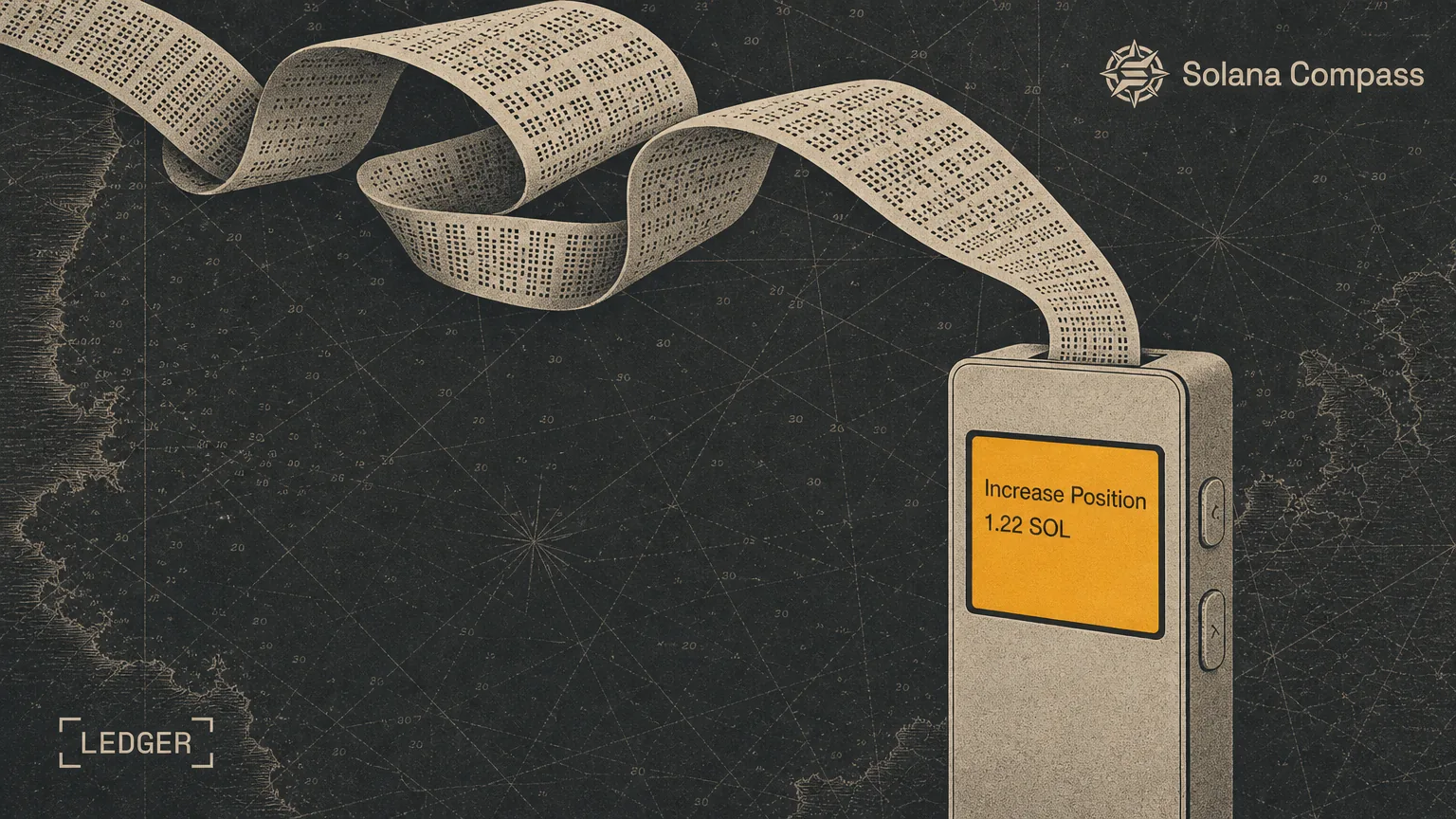
Ledger's technical write-up uses a Jupiter Perpetuals trade to show the change. Opening a long position takes eight raw instructions: creating a temporary token account, moving SOL into it, wrapping it, a signature check, two price-oracle updates, the position increase itself and closing the temporary account. The device now shows one screen:
Jupiter Perpetuals
Increase Position

Collateral:     1.22 SOL
Side:           long
Size increase:  13,780.36 USD
Worst price:    112.08 USD
The SOL wrapping folds into the collateral line. The oracle updates and signature check disappear because they are housekeeping signed by keepers, and the temporary account vanishes because it is opened and closed in the same transaction. You still see the numbers that decide what happens to your money.
Clear Signing needs version 1.17.0 or later of the Ledger Solana app.
This goes further than the readable signing Jupiter brought to limit orders and DCA in September. That release covered off-chain messages under Anza's message-signing standard. The 16 November launch covers on-chain transactions themselves.
Why blind signing on Solana was hard to fix
On Ethereum, a DeFi action is usually one call to one contract, so a wallet can describe it in a line. A Solana transaction is a flat list of instructions, each of which can touch a different program. The Ledger blog says even simple swaps run to five to eight instructions, and complex ones pass 20. Show each instruction on its own and the screen fills with steps that mean nothing to the person signing.
Ledger's answer is to trace where value moves across the whole transaction. Under a draft standard Ledger proposed called sRFC 41, each instruction declares what goes in and what comes out: which account, which token, how much. The device then works in four passes:
- Annotate each instruction with its inputs and outputs.
- Merge instructions where one's output feeds the next through the same account and token, keeping only the start and end of the chain.
- Hide scaffolding, such as temporary accounts, only when the device can verify it is safe to drop.
- Render the remaining intents on screen.
sRFC 41 builds on sRFC 39, the community standard for Clear Signing display metadata, which sets how a single instruction is formatted. sRFC 41 is still a discussion draft, posted by Ledger on 29 May 2026, and apps can choose whether to adopt it. Codama, a framework Solana programs use to publish a machine-readable description of their instructions (an IDL), supports sRFC 39 natively.
Solana's short transaction lifetime also needed a fix. A transaction expires after about 30 seconds, which is not long to read a Ledger screen. Ledger's two-step flow has the device show the full review and record what you approved; the wallet then swaps in a fresh blockhash, and the device signs only after checking that nothing else changed.
Ledger's 57,000-transaction test across Jupiter, Kamino and OKX
Ledger says it validated the engine offline on about 57,000 real transactions across 40 programs, including Jupiter, Kamino, OKX xBTC$64,976.03-0.1%'s DEX router and DFlow's aggregator. The sample took every transaction that called each program, not only those from a program's own frontend. The Ledger blog reports the share of transactions that now review as a single intent:
| Program | Avg. raw instructions | Avg. intents shown | Reviewed as one intent |
|---|---|---|---|
| Kamino Lending | 7.5 | 1.9 | 72% |
| Jupiter Lend (vaults) | 2.2 | 1.7 | 67% |
| Jupiter Perps | 4.2 | 1.5 | 53% |
| OKX DEX Router | 3.9 | 2.0 | 49% |
| Jupiter Aggregator v6 | 3.9 | 2.5 | 40% |
Source: Ledger blog, 16 November 2026.
Ledger's Jupiter Aggregator sample alone held 11,689 transactions in 801 distinct shapes. Live traffic is far larger. Jupiter's v6 aggregator program processed about 7.3 million transactions from about 314,000 signing wallets on 15 November, according to Solana Compass program data. It ran between 5.9 million and 8.4 million transactions a day from 10 to 15 November.
At that rate, Ledger's whole Jupiter sample is two to three minutes of an ordinary day. Ledger writes no transaction patterns, which is what makes that gap manageable: a route through the same programs that Ledger has never seen is read by the same rules.
Kamino adds Ledger Direct Connectivity and Transaction Check
Kamino shipped a second piece on the same day. Ledger Direct Connectivity lets you connect a Ledger to Kamino over USB or Bluetooth, with no third-party wallet in between. When you lend, borrow or manage a position, the device shows the contract, amounts and recipient in plain language. Borrowing USDC against SOL, for example, shows what you borrow, how much and where it goes.
On Ledger's touchscreen signers, Kamino says, Transaction Check adds a second layer: it simulates each transaction before approval and warns on the device if it finds a known threat or details it cannot verify.
Kamino CEO Michael Weisz said in the company's post that "Ledger users on Solana no longer have to blind sign," and that "the more users can verify what they approve, the more capital can safely come onchain."
Where Ledger Clear Signing still falls back to blind signing
Transactions the system does not support still fall back to blind signing, and Ledger's own count of 18 out of 22 core actions leaves four uncovered. The Ledger blog lists the hard cases plainly:
- DFlow decides some value flow at runtime, so the device shows the quoted output but not the amounts sent and received.
- Orca ORCA$1.18-2.2% Whirlpool swaps branch on flags such as which direction the swap runs, logic that static descriptors cannot yet express.
- A 22-instruction Kamino "multiply" refinancing (flash loan, swap, repay, withdraw, deposit, borrow, flash repay) reduces to seven intents, after 12 refresh instructions and three account creations are removed. Ledger has not yet shown it is safe to collapse further.
What app builders need: Codama IDLs with sRFC 39 and sRFC 41 metadata
For an app to be clear-signed, Ledger needs a description of its instructions. Ledger keeps these descriptors in a curated GitHub registry in Codama format. It signs each instruction's static descriptor with its own hardware security module, so the device can trust it. Ledger asks teams to publish a Codama IDL carrying the sRFC 39 and 41 metadata and to get in touch.
Ledger's roadmap lists:
- more programs, with new merge rules checked weekly against its transaction corpus;
- named accounts and conditional arguments as shared conventions across protocols;
- work with the Solana Foundation on transaction expiry;
- moving sRFC 41 from a Codama plugin into Codama itself or into standard app adoption.
Solana's own announcement post pointed to approving pay.sh agent payments with Ledger Agent Intent, the approval queue for AI agents that Ledger introduced on 15 October 2026. Ledger is also bringing Solana Mobile's Seeker app to its touchscreen Ledger Atom.
What to watch next is how far the 18-of-22 coverage spreads: whether the four remaining core actions and apps beyond the first nine publish sRFC 39 and 41 metadata, and whether sRFC 41 moves past the discussion stage.


