
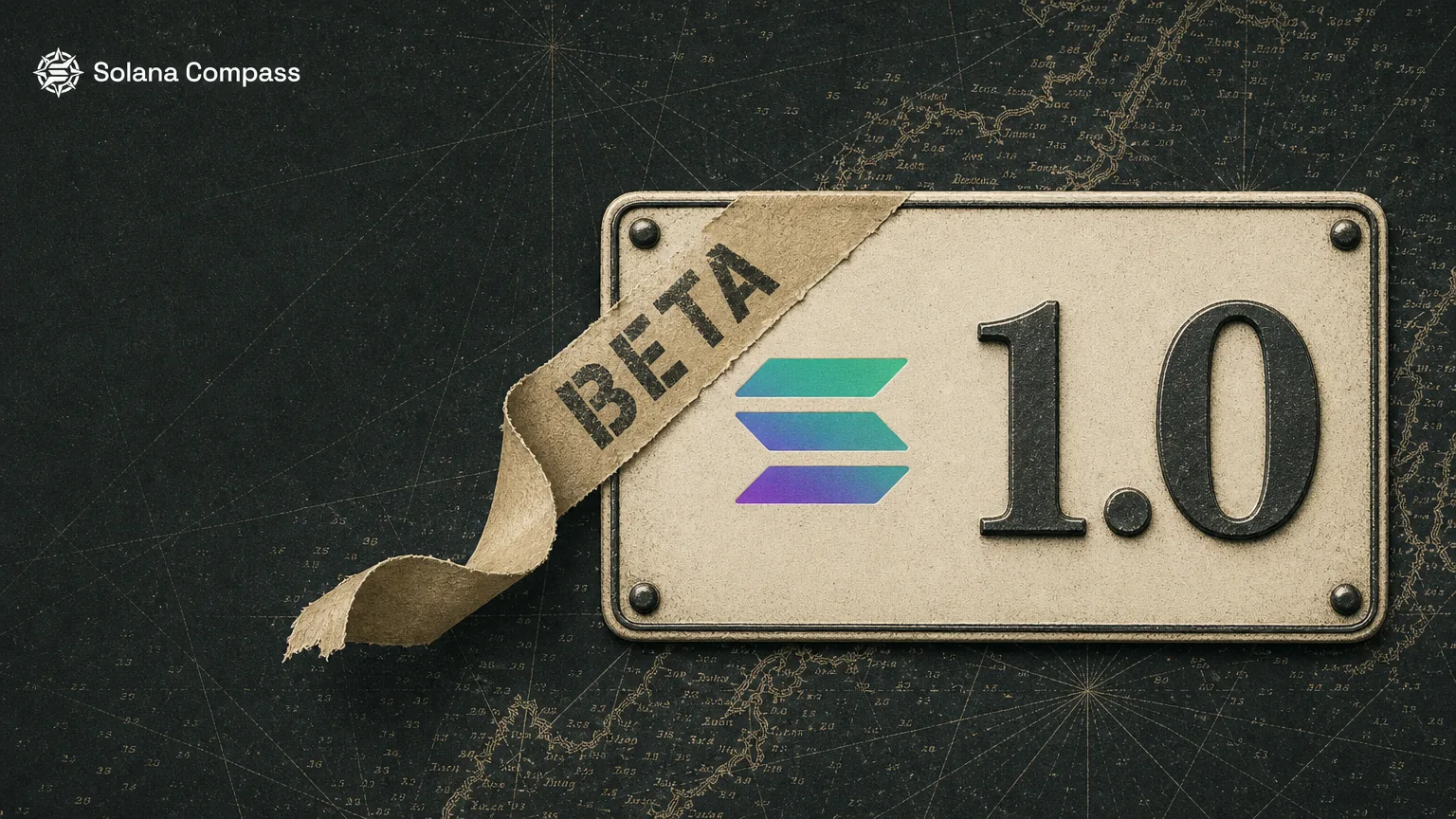
The Solana Foundation retired the "mainnet beta" name on 16 November 2026 and introduced Solana 1.0. It is the same Solana SOL$71.41-0.7% network under a new label, plus a single protocol version that every validator client can point to. The Foundation says SOL balances, accounts, assets, apps and transaction history stay exactly as they were, and users do not need to do anything.
In its announcement, the Foundation describes Solana 1.0 as "the network's graduation from 'mainnet beta' to 'mainnet,'" retiring a designation the network has carried since launch. It coordinated the rollout with Anza, the team behind the Agave validator client, and with the Firedancer team. Solana's official account put it more briefly on X: "mainnet-beta → mainnet. Introducing Solana 1.0." The news landed during Breakpoint, which runs at Olympia London from 15 to 17 November.
What Solana 1.0 changes for SOL holders, developers and validators
For people who hold SOL or use Solana apps, Solana 1.0 changes nothing. Improvements to their experience, the Foundation says, come through the underlying upgrades and the applications that adopt them. The work sits with the people who build on the network and run it, and the Foundation's guidance splits by role:
- Application developers should review changes to the APIs, SDKs and infrastructure their apps use, tracked weekly in the Solana Changelog.
- Validator and RPC operators should check which client releases support each protocol rollout and follow the upgrade and activation instructions in the Agave documentation or the Firedancer documentation.
- Documentation and tooling teams should update network references as the new naming rolls out.
Protocol version vs client version: how Agave and Firedancer fit
The protocol is the set of shared rules every validator follows. A client is the software that implements those rules. Agave and Firedancer are separate codebases with their own release schedules and version numbers. "A shared protocol version lets everyone refer to Solana's evolution without using one client's release number as shorthand for the entire network," the Foundation writes.
Solana 1.0 gives the protocol a number of its own, and "different client releases can therefore support the same protocol version while retaining their own version numbers." The web works the same way: browsers ship on their own version numbers while implementing a shared standard. Anza confirmed on X that Solana 1.0 is shared across clients and that Agave keeps its own version numbers.
For operators running Agave, release numbers such as those in Anza's Agave v4.5 schedule carry on as before. A version label is also not an activation switch. "Announcing a protocol version does not activate every associated improvement at once," the announcement says, and client releases and feature activations keep their own rollout requirements and timelines.
Why the Solana Foundation dropped the beta label now: Alpenglow and client diversity
The Foundation's case is that the label lagged the network. "Solana has been a live production network since genesis, supporting transactions, applications, and assets under a mainnet-beta label that never evolved to signal its production status," the announcement says. It points to two recent changes as the reason to retire it now: a new consensus system and a second independent validator client.
Alpenglow, the consensus upgrade that went live on mainnet on 21 October 2026, changed how validators agree on blocks. The Block reports that Alpenglow targets transaction finality, the point at which a transaction counts as settled, of about 150 milliseconds, down from 12.8 seconds.
Firedancer, the validator client built by Jump Crypto independently of Agave, went live on Solana mainnet in December 2025. Solana Compass counts 699 validators voting on and producing Solana's blocks in epoch 1088, which began on 16 November, and each of them runs a validator client. The Foundation argues that independent implementations "limit the impact of bugs affecting one client." A network with two codebases is also the network that needs a version number neither client owns.
Does the mainnet-beta RPC endpoint change?
The Foundation's announcement does not mention RPC addresses or the mainnet-beta cluster name that developer tools use, so it neither announces nor rules out a change to them. It says documentation, websites, explorers and other ecosystem surfaces "will progressively reflect the updated designation."
That rollout is visible already. The Foundation's clusters and public RPC endpoints page now lists the production cluster as "Mainnet", with the public endpoint https://api.mainnet.solana.com. As of 16 November, Anza's cluster documentation still uses "Mainnet Beta" and lists https://api.mainnet-beta.solana.com. Developers with hard-coded mainnet-beta strings in their apps or configs should watch the Solana Changelog and their client's documentation for any notice that affects those settings.
Where the next protocol rollouts will be tracked
The announcement does not set out the next protocol version or a schedule for one. For upcoming features, compatible client releases, activation status and technical guidance, the Foundation points to its Solana Upgrades page, which is where operators will see which Agave and Firedancer releases support each rollout under the new scheme.
The Foundation frames the rename as recognition of "progress on network performance, resilience, and developer experience." For anyone running a node or shipping an app, the useful part is the new reference point: one protocol number for what the network does, and separate client numbers for the software that does it.


