
Solana SOL$73.58+3.0% is getting an official launchpad for real-world assets. Superstate, Formation and Corda announced Exposure on 16 November 2026, a platform where issuers mint "Exposure Tokens" backed by tokenized funds that non-US investors can trade and use across Solana DeFi. The first Exposure Token is expected in the coming weeks. Corda's own first product, EPIC, went live on Solana the same day.
What Exposure is: a Solana RWA launchpad for non-US investors
Exposure is billed as "the official Solana RWA Launchpad" in Superstate's announcement. Issuers create Exposure Tokens, each backed by tokenized real-world assets. At launch the backing will be funds that asset managers have tokenized with Superstate. The tokens are "available only to non-US investors," will trade on Solana decentralized exchanges and, according to Superstate, can be integrated into lending markets, vaults, Earn products and centralized exchanges.
No Exposure Token exists yet. Superstate's release says the first one "is expected to go live in the coming weeks," and the coalition's Exposure site says "the first Exposures are launching soon."
The Solana Foundation is on board: Nick Ducoff, its GM, Institutional, is quoted in the release alongside executives from the three founding partners.
How Exposure Tokens work: permissioned mint, permissionless DeFi
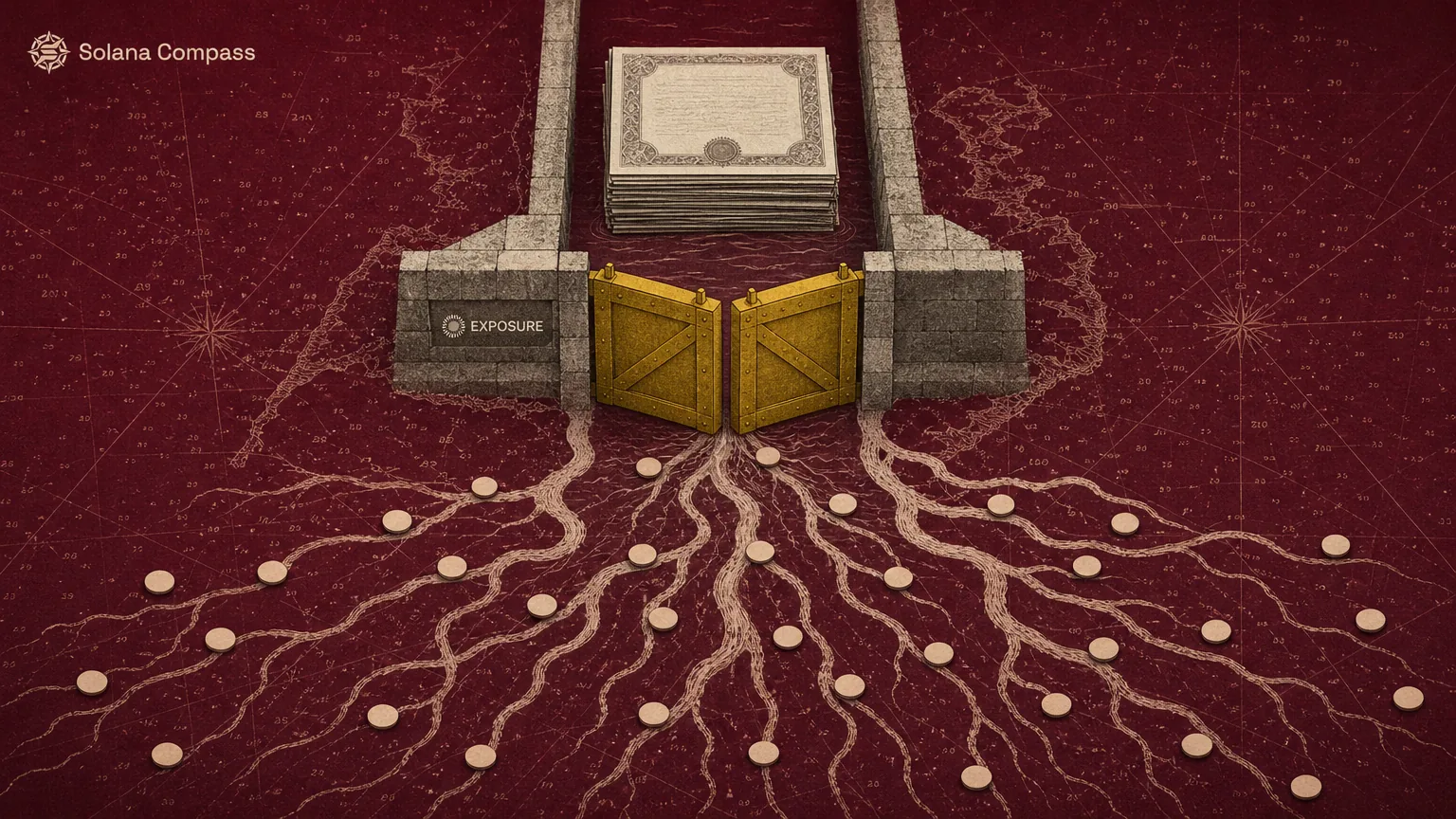
Exposure puts the compliance check at one point: the mint. Only authorized non-US persons can mint new Exposure Tokens or burn them to redeem. Once a token exists, it moves through DeFi like any other Solana token. The Exposure site lays the flow out in three steps: issuers curate the exposure, authorized participants mint and burn, and "DeFi puts them to work," with tokens "permissionless once minted."
The roles split cleanly. Issuers, starting with Formation and Corda, mint each Exposure Token and set its backing assets and terms. Superstate provides "the issuance and compliance infrastructure to facilitate minting and burning by authorized non-US persons," and is acting only as a technology provider in this arrangement, according to the release. Superstate's launch thread put it in one line: issuers curate the backing assets, and Superstate's infrastructure ensures "only authorized, non-US users can mint and burn them."
The design targets a familiar problem. Tokenized funds usually restrict who can hold them, which keeps them out of open lending pools and ordinary AMMs that cannot check who they are dealing with. Exposure moves the check upstream so the token itself can circulate freely, which is the demand Superstate says it is meeting from vaults, Earn programs, exchanges and lending markets.
Ducoff described this as the first time issuers can make permissioned assets permissionlessly composable while keeping control over the assets and their compliance. Corda Foundation President Todd McDonald framed the gap from the demand side: "earn programs and lending markets still cannot readily access" real-world assets, and "Exposure is where that changes."
Launching an ordinary token is a different job: anyone can put a new token on Solana in minutes without writing code. An Exposure Token adds an eligibility gate at creation and redemption, and a backing asset chosen by the issuer.
Who is behind Exposure: Superstate, Formation by Orca and Corda
Superstate tokenizes funds for asset managers through its FundOS service, and those funds will back the first Exposure Tokens. Superstate CEO Robert Leshner said Exposure brings Superstate's issuer infrastructure "to Solana, and we're proud to power it as part of this coalition."
Formation is the company formed when Orca ORCA$1.19+1.1% and Loopscale merged in October. Formation CEO Luke Truitt said "putting an asset onchain is only the first step. What matters is whether people can trade it, borrow against it, and build with it." Formation says that as of 31 October 2026 more than 30 million users have transacted over $550 billion in digital assets on its software. On the trading side, Orca's main exchange program handled about $9.6 billion of swap volume over the 30 days to 17 November, according to Solana Compass data.
Exposure is a separate, offshore track from Formation's US plans: Formation Securities notified the SEC on 9 November that it intends to run a tokenized securities venue on Solana.
Corda is a real-world asset protocol on Solana, governed by the Corda Foundation and "supported by R3, an independent partner," per the release. R3 builds the permissioned Corda blockchain used by financial institutions, and The Block reported in May 2025 that R3 was partnering with Solana to bring real-world assets onto a public chain, citing more than $10 billion in assets issued on the Corda network.
Corda's EPIC structured product goes live on Solana
Separately from Exposure, Corda's first product went live on 16 November. Corda said "EPIC, is live on @Solana," describing it as "composable across DeFi from day one." Solana's account called EPIC "an onchain structured product built for Solana DeFi, opening a $2.5T market to onchain capital." On stage at Breakpoint, McDonald gave the same figure a narrower framing: "$2.5T in structured products are currently out of reach for onchain capital," as Corda posted. Neither post explains how the $2.5 trillion is calculated.
Corda's pitch targets yield. In its launch thread, Corda said onchain products today either pay below SOFR, the benchmark overnight US dollar lending rate, or carry high risk and volatility, and that the fix is "quality, risk-on RWAs with issuers like @inside_r3."
EPIC and Exposure Tokens are distinct. Corda is one of the first two Exposure issuers, but none of the launch materials describe EPIC as an Exposure Token, and the non-US mint and burn rules are stated for Exposure Tokens.
Exposure in context: Solana's earlier permissioned RWA experiments
Superstate has tried the gated route on Solana before. In July, Raydium RAY$1.45+4.0% launched KYC-gated pools with Superstate as the first partner, which keep the check inside the trading venue. Superstate's tokenized funds have also been used as borrowing collateral on Kamino Finance KMNO$0.028-1.3%. Exposure goes a step further: the check happens once at the mint, so any Solana venue can list the token without building its own whitelist.
What to check before the first Exposure Token
Superstate's disclaimer sets out the holder's position plainly. Exposure Tokens are issued by third-party issuers, not Superstate, and "holders of Exposure Tokens have no claim on any backed asset, on the issuer, or on Superstate." The tokens "may trade at prices that differ from the value of any backed asset," and they are not offered to US persons.
That makes the first issuances the thing to watch: which funds back them, the terms each issuer sets, and how closely secondary prices on Solana DEXs track the backing assets once only authorized participants can mint and redeem. For EPIC, the underlying assets, return and eligibility rules are the first details to check in Corda's app.


