
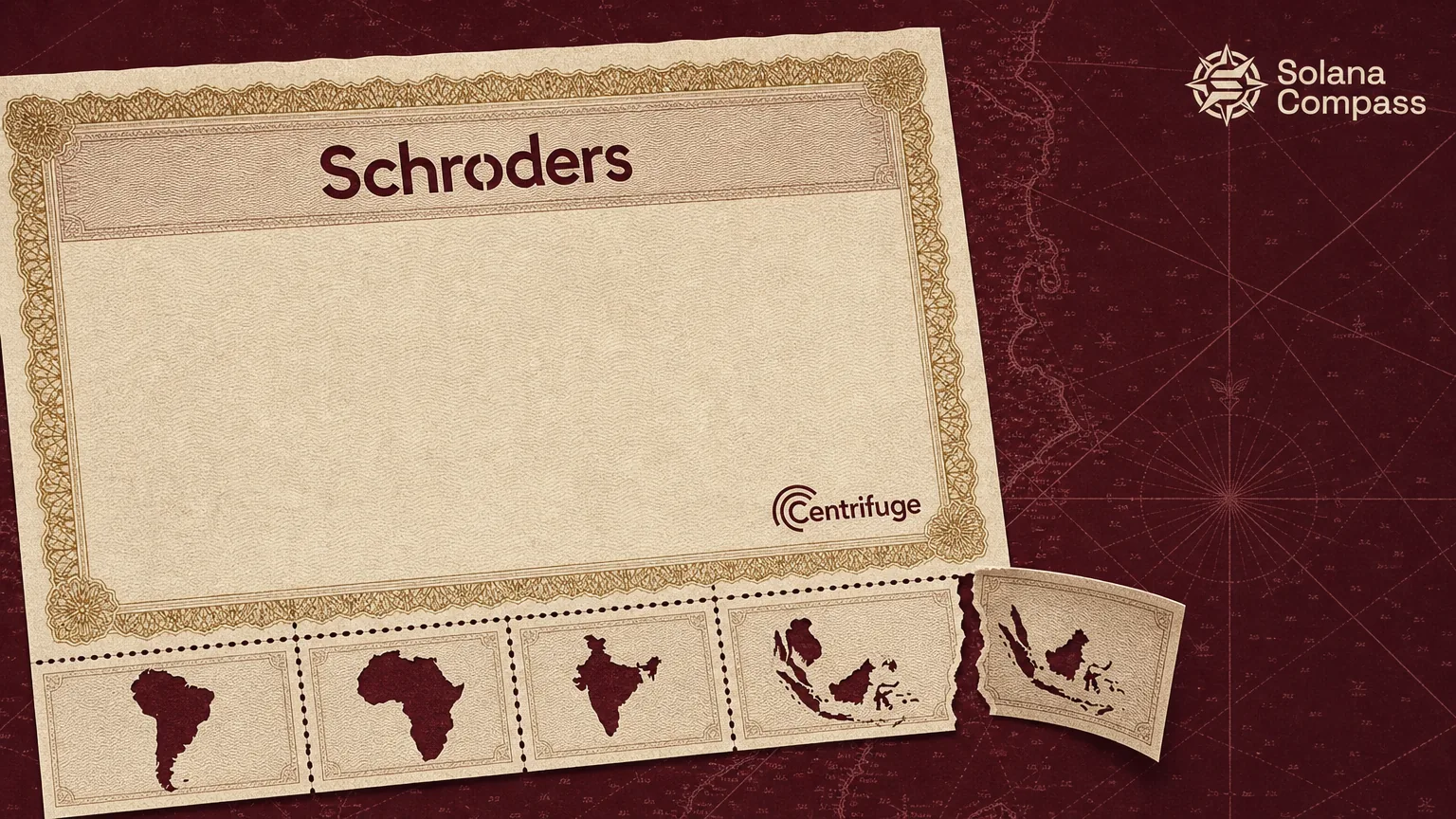
Schroders has brought an emerging market bond fund to Solana through the tokenization platform Centrifuge. Solana's official account announced the move on 4 November 2026, calling it the London-based manager's first fund on Solana, with "$1.1 trillion in assets under management behind it." Centrifuge said the token, which carries the ticker SISF, is now live on the network.
SISF gives onchain investors exposure to bonds issued by governments and companies across developing economies, a step away from the Treasury bills and money market funds that have dominated tokenized fixed income so far.
How the Schroders SISF feeder share class works on Solana
SISF is legally a feeder fund with an onchain share class, CoinDesk reported. The feeder invests in Schroders' Emerging Market Bond Fund, and investors hold tokenized shares of the feeder rather than shares of the underlying fund. The value of each SISF share tracks the underlying fund's net asset value, the per-share worth of its holdings.
A feeder works like a holding account that buys into a larger pool: the manager keeps running one portfolio, and the token is a new way to own a slice of it. Centrifuge supplies the issuance and management infrastructure. CoinDesk puts the assets tokenized on Centrifuge's platform at more than $750 million.
The underlying strategy is an established one. According to Centrifuge's announcement, Schroders has invested in emerging markets debt for more than 50 years, has more than 40 dedicated investment professionals in the asset class, and runs sovereign, corporate and local-currency strategies. The fund's returns rise and fall with how reliably those borrowers repay, how their currencies move and how their economies fare, CoinDesk noted.
Marita Mcginley, Schroders' head of operations for APAC and digital assets, described the choice of network directly in Centrifuge's announcement: "we are tokenising this specific investment strategy and issuing it on Solana, marking our first deployment on the network."
Emerging market debt adds currency and credit risk to tokenized bonds on Solana
Cash-like products have led tokenization so far: tokenized U.S. Treasuries and money market funds still account for $14 billion of the $39 billion tokenized real-world asset market, CoinDesk reported using RWA.xyz figures. An emerging market bond fund earns its return from lending to sovereigns and companies in markets outside the U.S. and Europe, with the currency and credit risk that comes with that.
Anil Sood, Centrifuge's chief strategy and growth officer, said in Centrifuge's announcement that onchain fixed income has so far been built mostly around cash and short-duration government debt, and that emerging markets debt brings a different source of risk and return.
Nick Ducoff, head of institutional growth at the Solana Foundation, made a similar point in Centrifuge's announcement: "We are moving beyond tokenized cash products toward a market where sophisticated, actively managed strategies can be issued, distributed and integrated on public blockchain infrastructure."
John Mensack, Schroders' senior investment director for fixed income, said the firm recognises "the importance of bringing relevant emerging markets debt opportunities onchain, helping to make the asset class more accessible and fit for the future."
Schroders joins New York Life and J.P. Morgan in tokenized funds on Solana
SISF lands in a Solana fund market that has filled up quickly in 2026. In June, Centrifuge put Janus Henderson's AAA-rated CLO fund on Solana and Baillie Gifford issued a tokenized bond fund natively on Solana. Centrifuge made New York Life Investment Management's high yield bond fund available on Solana in September, and in October JPMorgan Chase's J.P. Morgan Asset Management brought its MONY and JLTXX tokenized money market funds to the network.
SISF is the closest match to the New York Life product: a large manager's existing bond strategy, packaged by the same platform, on the same network. The difference is what sits inside. New York Life's fund holds U.S. corporate high yield debt, while SISF holds debt from emerging economies, adding sovereign borrowers and non-dollar currencies to the menu of onchain fixed income on Solana.
Schroders has tokenized a fund before. In August it received approval in Ireland for a tokenized share class of a U.S. dollar money market fund called Schroders Onchain Active Returns (SOAR), CoinDesk reported; SISF is the firm's first product on Solana. Other large managers are moving the same way. CoinDesk noted that Federated Hermes, with $911 billion in assets, plans to issue its first tokenized fund shares in early 2027.
Centrifuge's blog says SISF "initially launches" on Solana and describes the network as one of the largest ecosystems for tokenized real-world assets, with more than $4 billion in RWA value onchain by Centrifuge's count. The platform's stated aim is for tokenized strategies to become "building blocks for vaults, collateral, financial applications" on public chains. No DeFi integration for SISF has been announced.
What to check before using Schroders' SISF token
The 4 November announcements describe the fund and its structure. The dealing terms live in the fund's own documentation, and they are the details to check: who is eligible to subscribe and from which jurisdictions, the minimum investment, the currency used to subscribe, fees, and how often the onchain share price is updated against the underlying fund's net asset value. The SISF mint address is worth taking from Centrifuge or Schroders directly. Solana Compass's token index shows several Pump.fun tokens named "Schroders" or "Schroders Cat" created between 13:31 and 13:33 UTC on 4 November, minutes after Solana's post; none of them is the fund, and the official address is the one Centrifuge or Schroders publishes.
For Solana, the headline is the asset class. A $1.1 trillion manager has launched its first fund on the network with a strategy built on emerging market credit and currency exposure, a different kind of risk from the cash and credit funds already on Solana.


