Helium Launches HeliumOS, a Full Carrier-Enablement Platform for Connectivity Businesses

Helium launched HeliumOS on September 1, giving carriers and MVNOs a full BSS/OSS and Wi-Fi offload platform built on Helium's decentralized wireless network.
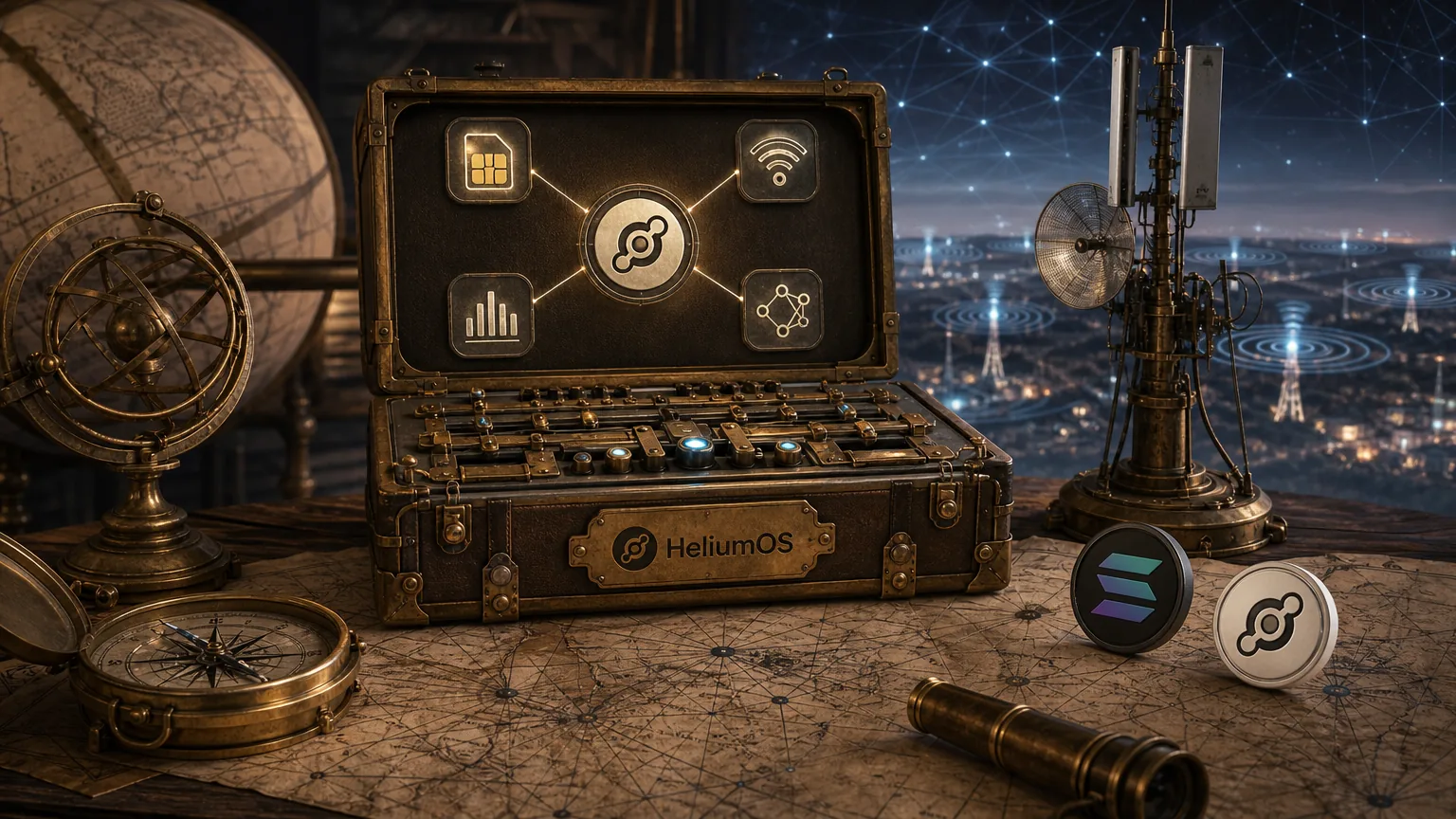
On September 1, Helium Network HNT$0.460+0.1% launched HeliumOS, a software platform that gives carriers, MVNOs, ISPs, and venue operators the full stack to build and run connectivity businesses on the decentralized Helium wireless network. The release marks a deliberate shift in Helium's commercial approach: the carrier-enablement tooling built to run its own consumer mobile service is now available to outside operators.
What HeliumOS Includes
The platform ships with four integrated modules. The Carrier Enablement module handles BSS/OSS functions: subscriber management, SIM activation, billing, provisioning, and carrier integrations. WOX (Wi-Fi Offload Experience) manages real-time session visibility and connection control, letting operators route subscribers between macro-cellular networks and Helium's community-built hotspot layer. HeliumAI provides no-code data analytics with dashboard generation and MCP server connectivity. A fourth module, the Wi-Fi Toolkit, enables Passpoint-based offload, the industry-standard protocol for automatic and secure Wi-Fi association, so operators can add passwordless handoff to mobile applications without building a custom authentication layer.
All four modules connect to the Helium Network, which spans tens of thousands of access points across the United States, with expansion into Mexico and Brazil.
The Indoor Coverage Gap HeliumOS Targets
Between 70 and 80 percent of mobile data consumption happens indoors, according to The Fast Mode, where signal attenuation from walls and building materials degrades macro network performance most. Conventional alternatives (distributed antenna systems, small cells, enterprise Wi-Fi) carry substantial capital costs and ongoing maintenance. Global carriers spend more than $200 billion annually on wireless infrastructure, with Helium noting declining telecom capex projections through 2026 even as indoor data demand grows.
HeliumOS offers a different model. An airport, arena, school, or shopping center can work with a HeliumOS operator to get managed Wi-Fi offload coverage without acquiring spectrum or deploying hardware. A new MVNO can use the Carrier Enablement stack to launch subscriber management and billing rather than standing up those systems independently. In both cases, the underlying data traffic flows across Helium's community-deployed access points. The infrastructure belongs to the network's deployers, and HeliumOS separates the business of operating a wireless service from the business of owning the physical layer.
Affiniti Ventures as the First HeliumOS Customer
Helium's official launch announcement names Affiniti Ventures, the company behind Noble Mobile and Helium Mobile, as HeliumOS's first customer. Affiniti acquired Helium Mobile earlier in 2026, and its position as launch customer makes internal sense: Helium Mobile has already been running on the carrier-enablement and network-integration tooling that HeliumOS now packages for external operators.
Helium CEO Mario Di Dio presented HeliumOS at the Real Estate and Digital Infrastructure Summit in Las Vegas following the launch, targeting commercial real estate operators as a customer segment for both venue Wi-Fi offload and deployer buildouts.
HIP-150 Governance Passes, Completing a 48-Hour Milestone Window
On August 31, the day before HeliumOS launched, Helium's governance community voted to approve HIP-150, which realigns HNT HNT distribution to weight deployer rewards more closely with where coverage is most valued and to scale deployer earnings with network growth. The vote closed at 18:11 UTC.
As we covered in July, HIP-149 activated on July 29, establishing a $0.05/GB earnings floor and $0.30/GB cap for MOBILE MOBILE deployers, indexed to the carrier data rate, and retiring Proof-of-Coverage on both Mobile and IoT networks. HIP-150 continues that economic realignment, bundling three changes to HNT distribution in a single governance vote.
The timeline traces a coherent build: HIP-149 established the deployer earnings mechanics in July, HIP-150 refined the distribution logic in August, and HeliumOS opens the network to commercial operators in September.
Helium Network Runs on Solana, HNT Rewards Settled On-Chain
The Helium Network operates on Solana. Reward calculations, HNT minting, and token settlement (including the floor/cap mechanics from HIP-149 and the distribution changes from HIP-150) execute through on-chain Solana programs. HNT, MOBILE, and IOT are SPL tokens.
When a HeliumOS operator routes subscriber data across a community access point and the deployer earns an HNT reward, the settlement happens on Solana. The Waimea Valley deployment earlier this week, which connected 14 access points at an Oahu conservation area serving 1,206 daily devices, shows the kind of venue deployment HeliumOS is built to enable and scale through its platform.
The commercial logic behind HeliumOS: a carrier or MVNO building on the platform brings subscriber data volume, which increases the reward pool flowing to community deployers. Larger rewards attract more hotspot deployments, which expands the coverage HeliumOS operators can offer. Whether that loop materializes at scale depends on operator adoption, but the infrastructure and the governance rules supporting it are now both live.

Solana 🧭 Compass
@SolanaCompassSolana Compass is an independent Solana analytics and staking platform, operating a validator on Solana mainnet since September 2021. Its network statistics and...
Comments
Please login to leave a comment.
Contents


Projects

Related Content
How Helium Is Leading Crypto's DePIN Revolution | Abhay Kumar
Helium's Wireless Revolution: Can 100M Devices Go On-Chain?
Ship or Die at Accelerate 2025: Lightning Talk: Helium
Leading Solana's DePin Future | Amir Haleem
Helium Discloses 23-Hospital Health System Carrying 145 TB of Mobile Data in a Week Over Existing Wi-Fi
Helium Opens NYC Expansion Zones at MSG, Radio City, Grand Central, Javits Center, and Port Authority
Helium Moves Mobile Network Data to Apache Iceberg Tables Anyone Can Query With SQL, Switch-Over Due November 1
Product Keynote: Helium
Helium Says First Wakefern Grocery Stores Are Live on the Helium Network, Carrying Carrier Traffic Over Store Wi-Fi
Helium Network Offloads 274TB of Mobile Data Monthly at 2,485 Restaurant Locations Across 34 Chains
Breakpoint 2023: Helium - Exploring DePIN, Helium, and Future Opportunities on Solana
Breakpoint 2023: How Helium Migrated to Solana
Helium HIP-149 Goes Live, Establishing $0.05/GB Floor and $0.30/GB Cap on Mobile Deployer Earnings
Helium Network Ends Redondo Beach Pier's Years-Long Connectivity Dead Zone
Andrew Yang's Noble Mobile Acquires Helium Mobile, Leaving HNT and DAO Intact
Latest news
Jito Announces BAM Direct Bundle Ingest, Routing Solana Bundles Past the Block Engine's 50ms Hop
Squads Builder Says Falcon-512 Post-Quantum Multisig Voting Has Been Tested on Solana Mainnet
Pando Solana ETF (2831) Starts Trading in Hong Kong With 268,300 Units Changing Hands on Day One
Building Financial Software on Solana: Quicknode's Free Book Builds Ten Finance Programs, From Escrow to Perps
Anza Sets Alpenglow Mainnet Date: Solana's Consensus Switch Is Scheduled for October 21 at About 14:50 UTC
SkyAI Sells About 1M SOL to Fund Planned Tender Offer of Up to $201M, Rejects Forward Industries' Proposal
USDGO Goes Live on Jupiter Lend's AMM on Solana in Anchorage-Issued Stablecoin's 'DeFi Debut'
ASTER on Solana: Sunrise Lists Aster''s Token and Names a Contract Address, With No Word Yet From Aster
Solana's First Full Epoch at the 200ms Slot Time Target Averaged 218.3ms and Lasted 26.2 Hours
US Spot Solana ETFs Shed About $25M in a Week as Outflows Hit All Five Sessions
Solana Token Markets


