
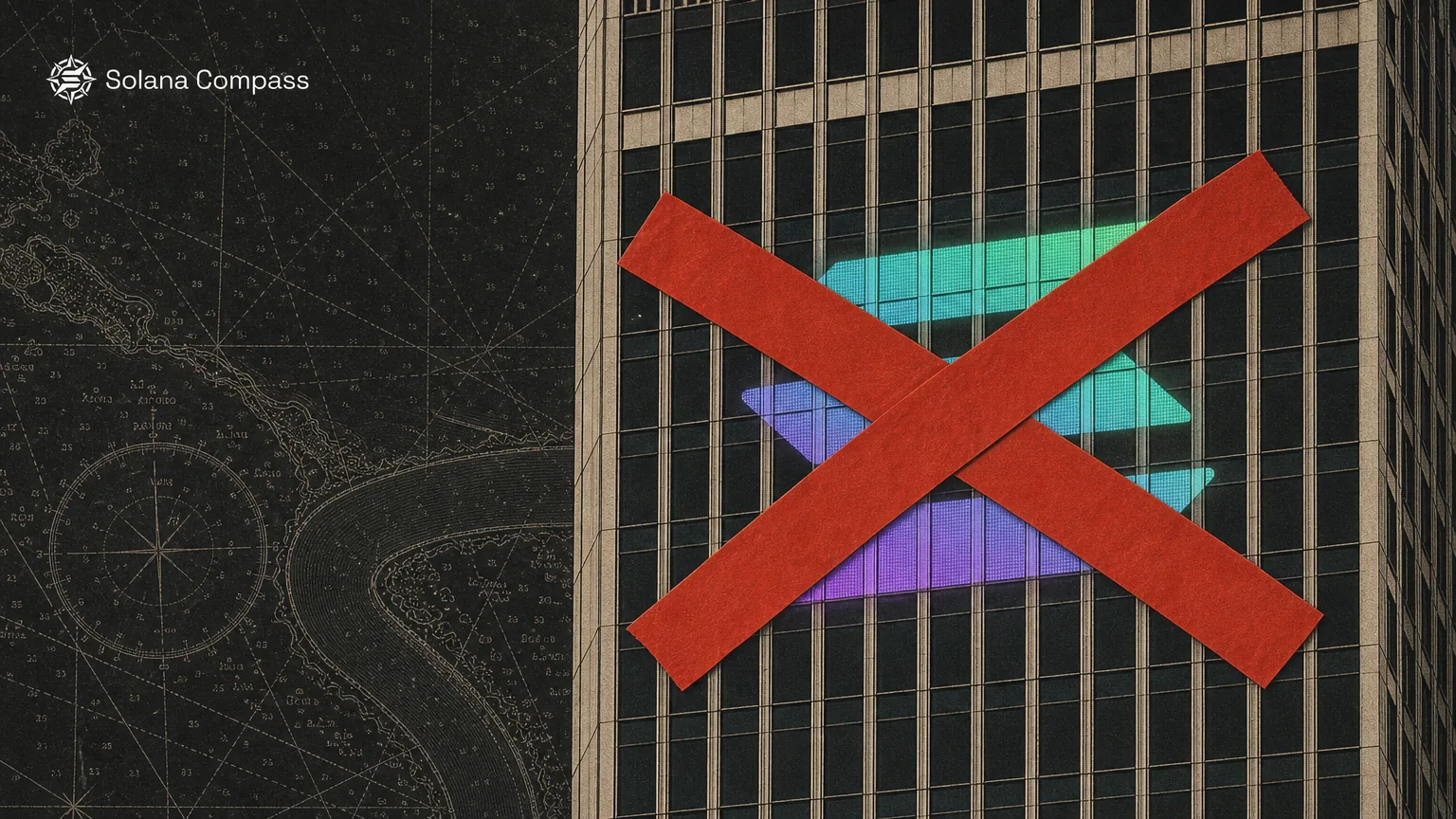
An official at China's central bank says the bank stopped Solana SOL$90.51+0.1%'s Accelerate China 2026 events and will investigate the companies and people behind Solana's advertising in Shanghai.
The official, the unnamed head of a People's Bank of China (PBOC) department, spoke in an interview with Financial News, a newspaper the PBOC supervises, published on 6 November 2026. The official called SOL "in essence a virtual currency", Beijing's term for crypto, and said promoting Solana breaks rules China issued in February. The interview gives the regulator's account of the Shanghai opener that was postponed on the morning of 16 October.
What the PBOC official told Financial News about Solana
The PBOC official said "recent monitoring found" that Solana ran "high-profile ads through relevant domestic entities", carrying out virtual-currency marketing by promoting the Solana brand. (Quotes from the Chinese text are our translation.) The ads appeared on the outside of the Citigroup Tower in Lujiazui, Shanghai's main financial district, in mid-October.
According to the official, the PBOC worked with local financial regulators, the police and market-supervision authorities to halt the offline events, and "will conduct an investigation of the entities and individuals involved" with other departments. Financial News wrote that the events, planned for Shanghai and other cities, were "urgently halted by the relevant departments before they opened".
The official gave two grounds: the SOL token itself, and the fact that Solana also "provides technical services for the issuance and trading of major virtual currencies such as USDT", the stablecoin issued by Tether USDT$0.9980.0%. Both count as illegal financial activity under the February rules, according to the official, who added that virtual currencies cannot yet meet customer-identification and anti-money-laundering requirements and "easily trigger market speculation".
The USDT point has scale behind it. Solana Compass token data shows about 3.84 billion USDT circulating on Solana, held by about 3.1 million wallets, as of 6 November 2026.
The interview names no company or person under investigation, and gives no timeline or penalties. As a next step, the official said the PBOC will work with other departments and local governments with a focus on "domestic virtual-currency traders and the domestic affiliated entities of overseas virtual-currency issuing and trading platforms".
The February 2026 virtual-currency notice behind the Solana probe
The rules the official cited are the Notice on Further Preventing and Handling Risks Related to Virtual Currencies (Yin Fa [2026] No. 42), issued on 6 February 2026 by the PBOC and seven other bodies, including the Ministry of Public Security and the China Securities Regulatory Commission. It replaced a 2021 notice and restates that virtual-currency business inside mainland China is illegal financial activity. It also extends the same controls to real-world-asset tokenization.
Two clauses fit the PBOC official's account. Overseas entities and individuals "may not illegally provide virtual-currency-related services to domestic parties in any form". And domestic entities and individuals who "knowing or ought to know" that an overseas party is doing so still assist it "are pursued for liability according to law", with criminal liability where a crime is involved. Financial News quoted the assistance clause in its background to the interview; it is the provision that reaches companies and individuals inside China.
The official's statement concerns promotion and the domestic parties who helped with it. It says nothing about people who hold SOL, validators, or exchanges outside the mainland.
How the PBOC account differs from Lily Liu's October explanation
Solana Foundation president Lily Liu gave a capacity reason on 16 October. In a post on X, she wrote that "event registrations quadrupled overnight, far exceeding the event cap we had registered with local authorities", and that the team would postpone "in order to comply with local requirements". We reported her explanation the same day.
Both accounts can be true at once: a venue over its registered cap and an official decision to stop crypto promotion are separate grounds. The PBOC official's version is broader. It places the halt inside an action against virtual-currency marketing, treats the ads as the trigger, and does not mention capacity. The Solana Foundation, Liu and the main Solana account had not publicly responded to the Financial News interview as of publication on 6 November.
Solana's Hong Kong stablecoin and ETF activity across the border
Solana's recent activity in Hong Kong has continued alongside the mainland action. On 30 October, Solana announced that Anchorpoint's HKDAP, a Hong Kong dollar stablecoin, will mint and redeem natively on Solana, as we covered in our report on the Standard Chartered-backed issuer. Earlier in October the Pando Solana ETF began trading on the Hong Kong exchange.
The mainland notice runs the other way, barring overseas crypto services to mainland users and holding domestic helpers liable. For teams working in the region, the February notice draws the line at the mainland border, and the PBOC official's comments show offline brand advertising is treated as promotion under it.
What to watch in the PBOC investigation of Solana's Shanghai ads
- Whether the PBOC or Shanghai authorities name the domestic companies or individuals under investigation, or announce penalties.
- Whether the PBOC posts a formal statement of its own; the account so far comes from one official's newspaper interview.
- Any response from the Solana Foundation or Lily Liu, and whether the postponed Shanghai event is rescheduled or formally cancelled.


