Kled AI Signs $12M Data Deal, Calls Marketplace Officially Profitable

Kled AI signed a $12M non-exclusive data licensing deal on June 26, making the marketplace officially profitable. Contributor rewards distribute on Solana.
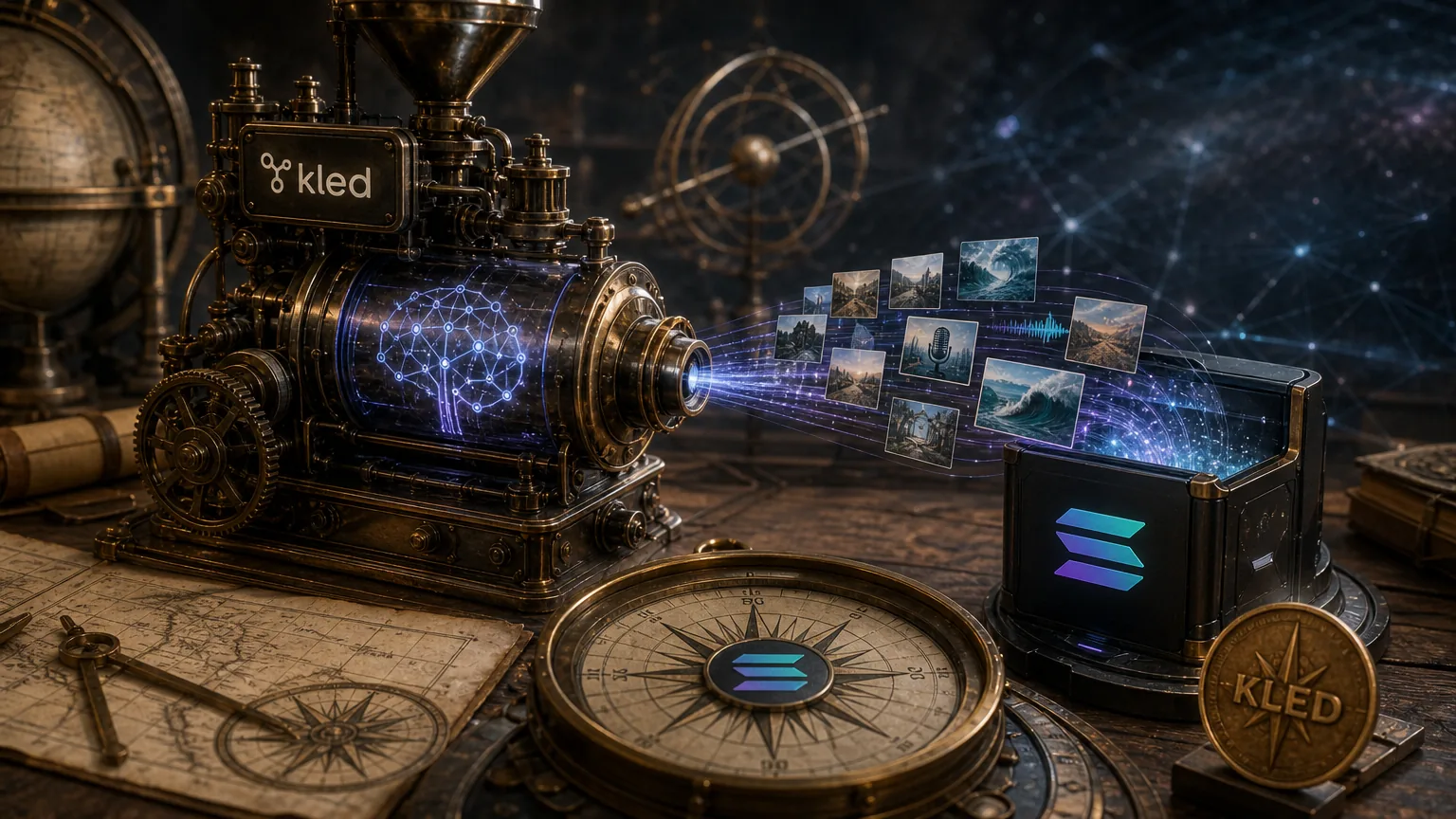
Solana-based data marketplace Kled AI announced on June 26 that it has signed a $12 million non-exclusive data licensing deal spanning two years, marking what the company calls its first point of profitability. "Kled has just signed a $12 million non-exclusive data deal over the next 2 years making the marketplace officially profitable," the company posted from its official account.
The Solana Foundation's official account described Kled the same day as "one of the largest human-powered data collection efforts, distributing rewards on Solana." The announcement drew 72,242 views and 481 likes on Kled's post within hours of publication.
What Kled AI Builds, and Why the Solana Connection Is Structural
Kled operates a two-sided marketplace where individual contributors upload photos, videos, audio recordings, and transcriptions, and AI companies and research institutions license the resulting datasets for model training. Enterprises access the catalog through the Kled Enterprise Portal using natural-language queries; contributors receive compensation tied to how their data gets used.
The Solana connection goes deeper than payment routing. Kled's Proof-of-Data mechanism records a cryptographic hash of each contributor submission directly on the Solana blockchain, creating an immutable record of data provenance and preventing fraudulent or duplicate entries. The platform's native KLED token runs on Solana and serves as the reward layer for the contributor network: earnings can be taken in USD (via Cashapp, Venmo, or PayPal) or converted to KLED and held on-chain. Staking KLED also entitles holders to a share of data sale fees.
That on-chain proof layer matters commercially. Legal pressure on AI companies to demonstrate that their training data was sourced with proper consent and attribution is translating into real enterprise procurement, and Kled's Solana-anchored provenance record offers a verifiable audit trail that a spreadsheet-based rights ledger cannot.
Platform Scale Behind the Deal
The $12 million contract is a licensing revenue deal, not equity. It is structurally distinct from the $10 million in total equity funding Kled has raised, including a $5.5 million seed round that closed in March 2026, backed by Sebastian Thrun (founder of Waymo), Aglaé Ventures (Bernard Arnault's venture fund), and K5 Global, among others.
The platform has accumulated significant scale to support that kind of contract:
Those pipeline figures come from a KuCoin analysis of Kled's tokenomics published in March 2026. The $12 million deal converts part of that pipeline into contracted revenue.
Data types on the platform span egocentric video, robotics point-of-view sequences, multilingual voice recordings, medical imagery, before-and-after photos, and household behavior footage. These are sectors where AI companies cannot easily source training data through web scraping alone.
Tokenomics Tied Directly to Revenue
Kled's KLED token buyback mechanism connects marketplace revenue to token supply in a direct way. When contributors convert cash earnings to experience points (XP) to unlock higher-value tasks, the equivalent dollar amount triggers a market purchase of KLED: 50% of those tokens are permanently burned, and 50% fund the platform's fraud detection reward pool. Revenue-funded buybacks supplement this further at the company's discretion.
The fraud detection pool itself runs as a consensus system: users earn KLED for correctly validating anonymized data samples, with majority agreement among respondents determining accuracy. Incorrect responses reduce trust scores and future pay multipliers.
Top contributors currently earn roughly $7,000 per month, with platform updates targeting the first $10,000-per-month earner. The V3 update also introduces partner-run labeling and model evaluation programs paying $50–$1,000 per hour depending on expertise. The token had 12,330 holders as of June 26, per Solana Compass data, with approximately $1.4 million in 24-hour trading volume. For a data-economy token that only launched in October 2025, that is a real on-chain footprint.
What Comes Next
Kled outlined several near-term plans alongside the deal announcement: an Android launch (the app has been iOS-only through its growth phase), doubling daily upload capacity, doubling Trace registrations, and deploying a new fraud detection model.
The Android launch is the most significant expansion by reach. Kled reached a top-100 App Store ranking in multiple countries on iOS alone, and Android represents the larger global smartphone segment it has not yet addressed.
The deal also arrives the day after The DATA Foundation (formerly Story) announced Kled as a flagship integration partner, registering 1.5 billion Kled contributor records on its on-chain data provenance registry. That gives enterprise buyers a second layer of licensing traceability on top of Kled's own Proof-of-Data system, strengthening the compliance argument that is driving procurement in the first place.
The company was founded in May 2025 by Avi Patel and CTO Aryan Bansal under parent company Nitrility Inc. in San Francisco. Within about 13 months of founding, it has a Solana Foundation partnership, $10 million in equity raised at a $100 million+ valuation, and now a $12 million revenue contract that management says tips the business into profitability.

Solana 🧭 Compass
@SolanaCompassSolana Compass is an independent Solana analytics and staking platform, operating a validator on Solana mainnet since September 2021. Its network statistics and...
Comments
Please login to leave a comment.
Contents
Projects

Related Content
Kled V3 Launches on iOS, Rebuilding Its Solana-Paid AI Data App Around Lab
Tracking Investments and Earning Rewards with Matthias from Asset Dash
Sorare x Solana: Transforming Sports, Crypto and Collecting
Storing Solana History on IPFS/Filecoin - Project Old Faithful with Brian Long
The Future of Staking On Solana | Michael Repetný
Solana Changelog - February 21, 2023 - Epoch Rewards V2, Ledger Versioned Transactions, and Kaizen
The Long-Term Vision for the DA Layer w/ Connor O'Hara (Celestia Labs)
Storing the Solana history on IPFS/Filecoin - Project Old Faithful w/ Brian Long from Triton
SkyTrade: Building The World's First Air Rights Market | Jonathan Dockrell, Skytrade
Scale or Die 2025: Stake auction: the good, the bad, the ugly (Michael Repetny | Marinade)
A Blockchain Dev's Guide to Leaving Cities w/ Austin Adams (Anagram)
Why Businesses Are Building On Solana | Baxus, Tzvi Wiesel
Breakpoint 2024: Product Keynote: Tensor (Richard Wu)
SkyTrade's John Docquerel on Monetizing Airspace and the Future of Air Travel
Blockchain Analytics and Data on Flipside Crypto (feat. GJ Flannery, Flipside) - Solfate Podcast #43
Latest news
Solana Accelerate China's Shanghai Opener Postponed on the Day as Organisers Cite Venue Logistics
Castle Labs Report Ranks Solana First for App Revenue as RWA Value Holds at $4.4 Billion
SIMD-0675 Analysis Recommends a 10% Stake Floor and a Run Length of 3 to 7 for Solana's Geo-Aware Leader Schedule
Solana Mobile Names Ledger Its First Hardware Expansion Partner, Preinstalling the Seeker App on Ledger Atom
NEAR Launches Confidential SOL Yield on Kamino via Gauntlet Vault as NEAR Token Lists on Solana Through Sunrise
Bitso Lists Western Union's Solana Stablecoin USDPT in Mexico
Bastion Trading Won't Tender Into SkyAI's $3.00 Offer, Demands Disclosure of SOL Sales
ckSOL Goes Live as DFINITY Says the Internet Computer Now Speaks Solana
Collector Crypt Posts Record $433.5M Q3 Pack Sales as 548 Wallets Supply 83%, Pine Analytics Finds
Jito Announces BAM Direct Bundle Ingest, Routing Solana Bundles Past the Block Engine's 50ms Hop
Solana Token Markets


