Building Financial Software on Solana: Quicknode's Free Book Builds Ten Finance Programs, From Escrow to Perps

Quicknode has published Building Financial Software on Solana by Mike MacCana: ten programs from escrow to perpetual futures, free by email or in paperback.
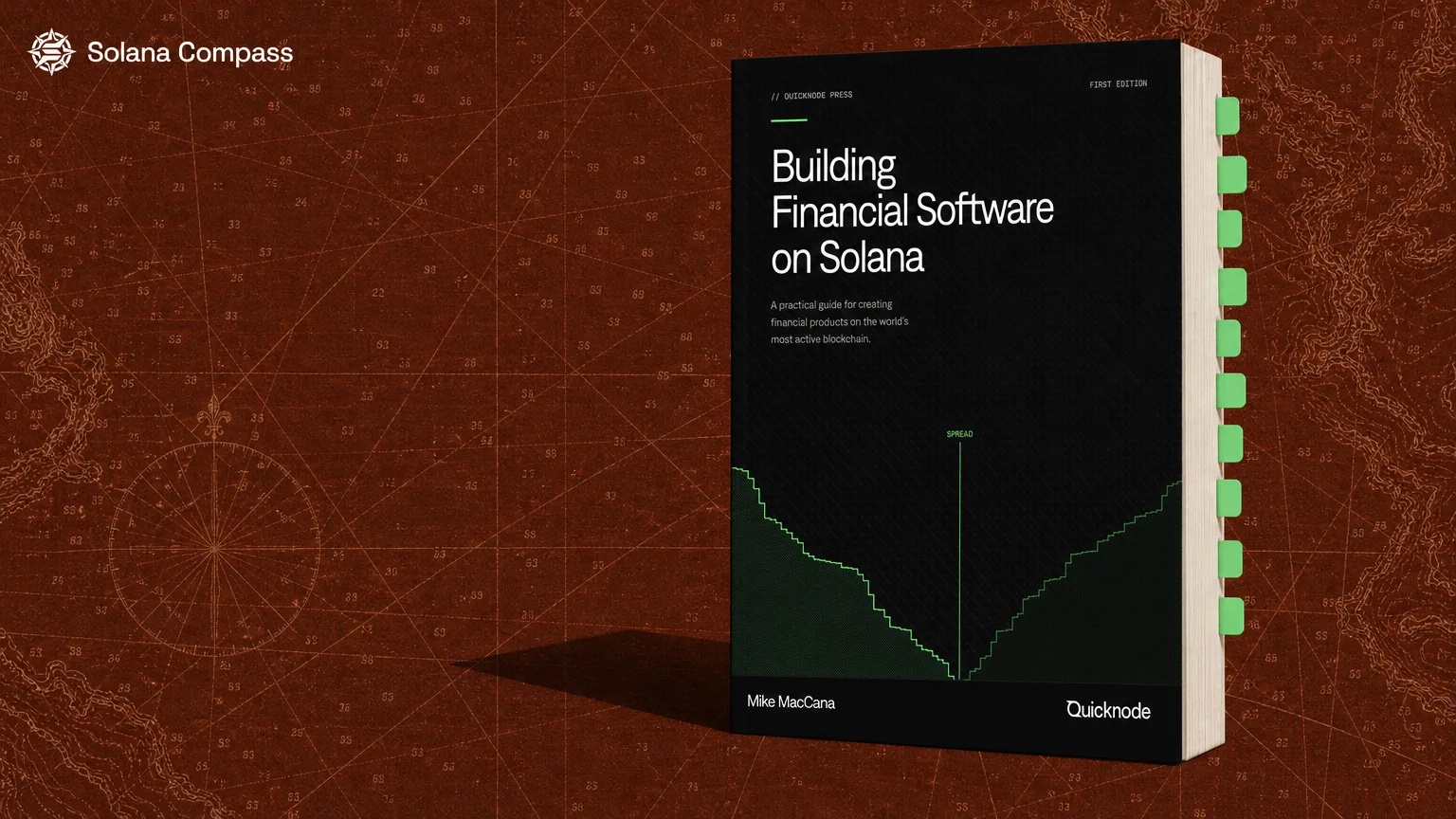
Quicknode has published Building Financial Software on Solana, a book by Mike MacCana that builds ten financial products as Solana SOL$107.16-0.3% programs, the code other blockchains call smart contracts. MacCana announced the book on 13 October 2026, describing it as what he had been working on for the previous six months, and Quicknode's Solana account posted its own announcement the same day.
The full book is free. The book's site emails it to anyone who enters an address and shows the first 25 pages without one. A paperback is listed on Amazon at $54.99, with Quicknode named as publisher and a print length of 313 pages.
Solana Compass has not read the full text and is not reviewing it here. The details in this article come from the book's site, its Amazon listing, the companion code, and posts by the author and publisher. According to the site, MacCana created the Solana Foundation's Professional Education Program, a four-day course, and maintains the code repository the book is built on.
The ten financial programs in Mike MacCana's book
The Amazon listing names the ten products: an escrow, a fundraiser, a betting market, a managed fund, an order book exchange in the style of the NYSE or Nasdaq, an automated market maker (AMM, an exchange that trades against a pool of tokens instead of matching orders), an options exchange, a proprietary AMM, lending and borrowing, and perpetual futures.
For each one, the listing says, the book explains how the program stores its state, how to calculate balances "without losing a penny", how facts from outside the chain are verified onchain, and "how onchain money gets stolen, and the checks that stop it". The listing adds that the book assumes no Solana experience and no finance background, and that named engineers and founders from the Solana ecosystem technically reviewed every chapter.
MacCana gave more detail on the security material in a reply on X, saying the book covers ownership checks, account recreation attacks, direct deposits made to distort other users' shares, and the accuracy of interest calculations. r0bre of Accretion.xyz, who says he did some last-minute technical reviews of the book, wrote that he expects to use it "as a reference when reviewing applications during our audits".
Companion code in Anchor 1, the Anchor 2 release candidate and Quasar
The code for the ten programs lives in a public GitHub repository, quicknode/solana-program-examples, with each one written in Anchor 1, Anchor 2 and Quasar. The repository's README calls Anchor the most popular framework for Solana development. Anchor 2 is a ground-up rewrite that has not been released, and the repository builds against the 2.0.0-rc.1 release candidate. Quasar, per the README, is a newer, faster framework with Anchor-compatible ergonomics.
Each finance program ships with tests that run in LiteSVM, which executes a program in-process without a local validator, according to the README. Each also carries Kani model checks, automated proofs that test the program's arithmetic across a declared range of inputs. Joe Caulfield and the Solana Foundation are credited with originally creating the repository. Its FAQ sets out the limits of the code: "None are audited or deployed to mainnet, so treat them as reference implementations to learn from, not code to deploy as-is."
Where to get Building Financial Software on Solana, and its Claude plugin
Quicknode also maintains Solana Finance, an MIT-licensed plugin for Claude Code that describes itself as the companion plugin to the book. It bundles a set of instructions the AI coding tool applies when it works on Solana programs. MacCana said the skill is focused on finance, so that an AI tool asked to calculate interest or to work out how many tokens to assign liquidity providers "will know the right way to do that".
Neither piece of code was new when the book launched. The plugin was packaged in June 2026, according to its commit history, and the examples repository describes itself as current as of September 2026.
Beyond the free download and the Amazon paperback, Quicknode said the book is coming to Barnes & Noble and independent bookshops "in next few days". For Solana developers, the free edition and the public repository put ten worked finance programs and their tests within reach without a purchase.

Solana 🧭 Compass
@SolanaCompassSolana Compass is an independent Solana analytics and staking platform, operating a validator on Solana mainnet since September 2021. Its network statistics and...
Comments
Please login to leave a comment.
Contents


Related Content
Study QuickNode | ep. 39
TOP 5 Books Every Founder Needs With Chris Heaney from Drift Protocol | ep. 23
TOP 5 Books Every Founder Needs With Cris Heaney from Drift Protocol | ep. 23
The State Of DeFi Lending With Mary Gooneratne
Solana Perp Platforms Cross $1.08 Trillion in Cumulative Volume, Second Globally
Solana Changelog Oct 30th
Solana Changelog October 30th
Lily Liu Defends Solana Foundation Against Perps Kingmaking Claims as Flash Trade Exits
Solana's Breakout DeFi Lending Protocol | Mary Gooneratne
What's Next For Crypto In 2026 | Kairos Research
The Jupiter End Game With Kash Dhanda
Building Binance On-Chain | Cindy Leow & Chris Heaney, Drift Protocol
How To Improve Solana's Market Structure | Eugene Chen
Phoenix Trade Lists Cerebras Systems, TSMC, Qualcomm, Arm Holdings, and ASML as Equity Perps During Big Tech Earnings Week
Solana Changelog - Mar 19: Anza's Agave Client, Compute, and create-solana-program
Latest news
Building Financial Software on Solana: Quicknode's Free Book Builds Ten Finance Programs, From Escrow to Perps
Anza Sets Alpenglow Mainnet Date: Solana's Consensus Switch Is Scheduled for October 21 at About 14:50 UTC
SkyAI Sells About 1M SOL to Fund Planned Tender Offer of Up to $201M, Rejects Forward Industries' Proposal
USDGO Goes Live on Jupiter Lend's AMM on Solana in Anchorage-Issued Stablecoin's 'DeFi Debut'
ASTER on Solana: Sunrise Lists Aster''s Token and Names a Contract Address, With No Word Yet From Aster
Solana's First Full Epoch at the 200ms Slot Time Target Averaged 218.3ms and Lasted 26.2 Hours
US Spot Solana ETFs Shed About $25M in a Week as Outflows Hit All Five Sessions
Jito Details BAM's Alpenglow Plan: Maintenance Mode for All Mainnet Nodes, No FireBAM During the Transition
Anza CEO Brennan Watt Proposes Raising Solana's Block Compute Limit From 50M Back to 100M CUs
Helium Says First Wakefern Grocery Stores Are Live on the Helium Network, Carrying Carrier Traffic Over Store Wi-Fi
Solana Token Markets


