SIMD-0675 Analysis Recommends a 10% Stake Floor and a Run Length of 3 to 7 for Solana's Geo-Aware Leader Schedule

A solana.com analysis of SIMD-0675's geo-aware leader schedule recommends a 10% stake floor and a run length of 3 to 7, weighing faster handoffs against risk.
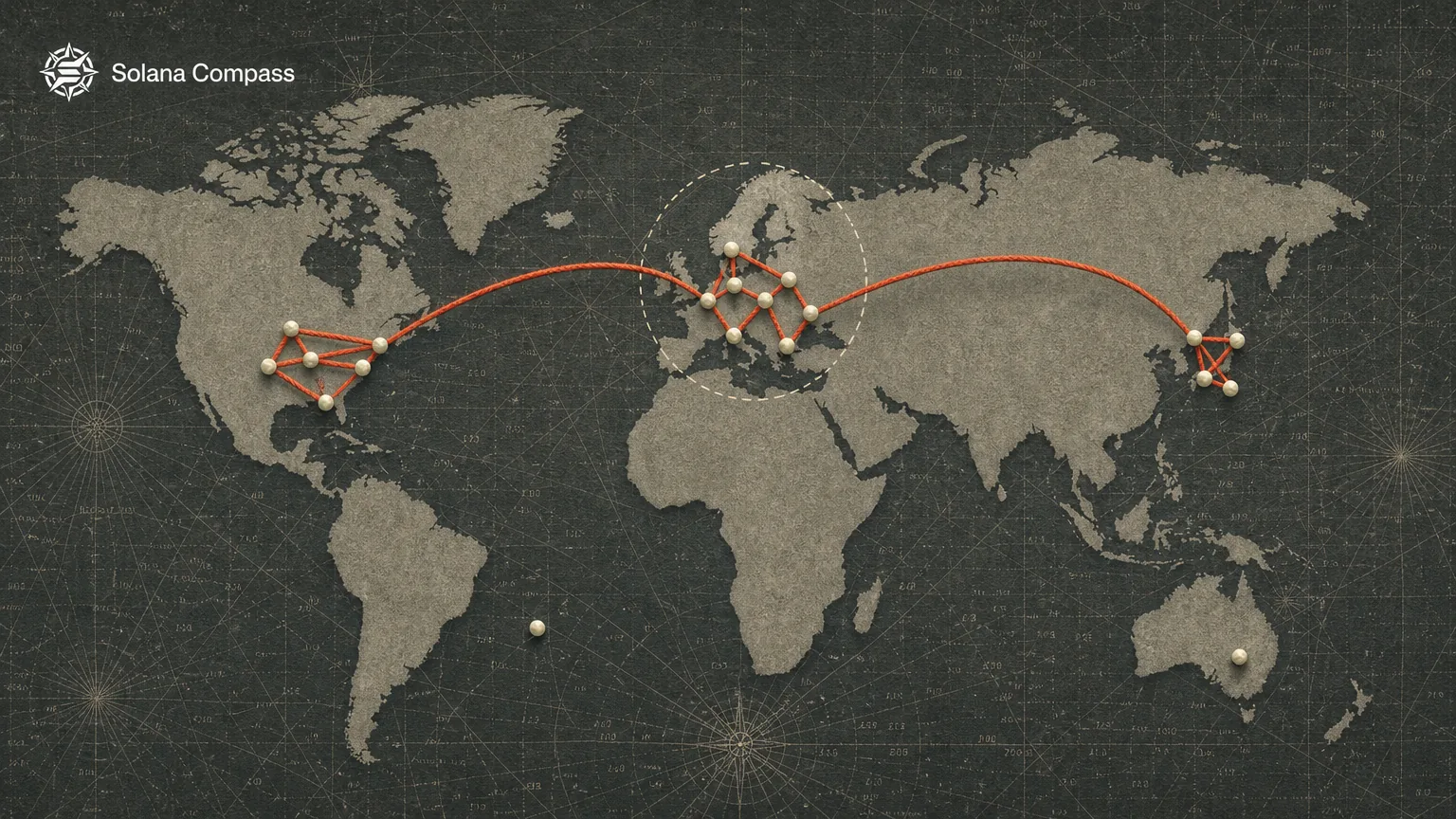
An analysis published on solana.com on 14 October 2026 has put numbers on the two settings that decide how Solana SOL$106.00+1.3%'s proposed geo-aware leader schedule behaves. Written by Umberto Natale, the study recommends keeping the stake floor (STAKE_FLOOR) around 10% and setting the run length (RUN_LENGTH) somewhere between 3 and 7, depending on which risk the network most wants to limit.
The proposal itself, SIMD-0675, is the one we covered when Quentin Kniep and Roger Wattenhofer opened it on 29 September. It keeps Solana's stake-weighted random draw of block producers, known as leaders, and only reorders it so that validators close to each other lead back to back. Each validator keeps the same number of leader windows. The two settings control how "close" is defined and how many nearby leaders can be chained before the schedule moves on.
The study's central trade-off sits at a run length of 7. There, according to the analysis, the reordered schedule cuts the average delay between consecutive leaders by 29.1 milliseconds, 86% of the 33.9 ms it reaches at a run length of 50. The cost is that the network stays in one region for longer: about 5.4 extra leader windows, or 4.3 seconds, on average. All of these figures come from a model. Natale built 6,250 synthetic networks on top of the 124 locations where Solana validators run today, and estimated latency from distance alone rather than measured round trips.
Why the SIMD-0675 stake floor stops at 10%: Asia's share of stake
The stake floor sets a radius around every validator location: the smallest distance that takes in at least that fraction of total stake. Validators in crowded hubs end up with short radii and isolated ones with long radii, and two leaders count as neighbours when they fall inside the larger of their two radii.
The analysis wants that floor as high as possible, because a higher floor makes it costlier to game the schedule with a fake location and reduces how long the network dwells in one region. What caps it is the smallest region that still forms its own local groups. Under today's geography that region is Asia, whose share of stake moved between 10.4% and 11.6% over epochs 1000 to 1041 and sat at 10.4% in the latest snapshot, according to the study. Push the floor above Asia's share and Asian validators' groups fill up with leaders from other continents. The study takes the largest floor below that line, 10%, and Natale writes that it "has to be revisited if Asia's share drops."
Africa, Oceania and South America do not get local groups at any reasonable floor, the analysis finds; with one or two locations each, they hold too little stake. Europe and North America, with 64 and 42 of the study's 124 locations, stay self-contained at every floor tested. The price of the 10% floor over a 2% one is latency: at a run length of 8, the study measures a 29.8 ms gain at 10% against 35.4 ms at 2%, and says every security metric improves in exchange.
Run length 3 to 7: what each millisecond costs in regional persistence
Run length is how many nearby leaders the schedule groups before writing them out as one block. The gain flattens quickly. At the 10% floor, a run length of 3 delivers 65% of the maximum gain, 5 delivers 79% and 10 delivers 91%, per the analysis. The risk does not flatten: geographic persistence keeps growing almost in a straight line. Going from 7 to 10 adds 1.7 ms of gain for 2.7 extra windows in one region; going to 50 adds 4.8 ms for 35 extra windows.
Natale's way through this is to price the trade. Above 7, the study finds, each extra millisecond of handoff gain costs about a second of added same-region persistence. Stricter budgets point lower: roughly 500 ms of risk per ms of gain gives a run length of 5, 250 ms gives 4, and protecting against attackers holding less than the floor gives 3. The analysis is open that the exact "knee" partly reflects how the experiment was set up, landing at 5, 7 or 14 depending on the largest run length in the grid.
The regional effect is short-lived. Over 30-second spans the differences are large: under a random schedule about 7% of those spans in the model contain no Asian leader, rising to about 40% at a run length of 10. Over five minutes, the study finds the schedule indistinguishable from random for any run length up to 10. A review posted to the SIMD-0675 pull request on 15 October, which links the analysis as the full write-up, summarises the position this way: "I believe 3 is the most conservative choice and I don't have strong arguments to motivate a RUN_LENGTH lower than 7."
Fake locations and coalitions in the geo-aware leader schedule
Each validator reports its own coordinates, and the schedule takes them at face value. The analysis models an operator that claims an empty spot in the South Pacific. With 10% of stake and a 10% floor, only validators at one Argentinian and one Australian location, about 0.03% of stake together, could join its groups, so its blocks of leader windows would hold only its own. Before the analysis appeared, CryptoSlate argued on 9 October that this reliance on unverifiable locations was the proposal's weak point.
The study proposes no way to verify locations; its defence is the floor. The gain from lying stays small below the floor and starts to climb once an operator's stake reaches it. At a run length of 7, a false location is worth 0.28 extra consecutive windows to an operator with 4.07% of stake, which the analysis gives as the largest validator's share, and 1.69 windows to one with 10%.
No single validator is near the floor today. On Solana Compass's validator rankings, Figment was the largest on 15 October (epoch 1058) with about 4.0% of 437.8 million activated SOL, and the five largest held about 15.4% between them. Their data-center labels also show the geography the study works with: four of those five run in Paris or Frankfurt, the fifth in Ashburn, Virginia.
For groups of validators acting together, the change is small in absolute terms. At the 10% floor, the chance that a coalition holds three consecutive windows rises from 14.85% at a run length of 3 to 16.07% at 10, according to the study's appendix. Natale notes this "does not directly quantify additional MEV revenue."
Where SIMD-0674 and SIMD-0675 stand
The analysis argues for a range, but the proposal's text has not moved. The SIMD-0675 pull request is open and unmerged, and its text still specifies STAKE_FLOOR = 10% and RUN_LENGTH = 3. The repository's bot requires at least one approval from an Anza team member and one from a Firedancer team member; neither has been recorded. The location registration it depends on, SIMD-0674, is also unmerged, and no activation date exists for either. Outside GitHub, coverage so far has restated the study's figures (TokenPost on 15 October) rather than challenged them.
A leader window is four slots, which since 200ms slots went live at epoch 1053 means 0.8 seconds. That is why the analysis treats its two kinds of millisecond differently: a millisecond of handoff gain is saved at every change of leader, every 0.8 seconds, while a millisecond of risk is a stretch of time spent in one region or under one operator. Natale writes that the two are "not the same thing."
For Solana, the study frames the payoff as "reducing pressure for stake concentration in macroregions," so that validators do not need to sit next to everyone else to hand off quickly. It says validators in sparse locations gain most, because they become far more likely to get a nearby predecessor than they are today. Three things decide whether that holds: whether the SIMD text moves from 3 toward 7, whether Anza and Firedancer reviewers sign off, and whether Asia's stake stays above the 10% line the recommendation rests on.

Solana 🧭 Compass
@SolanaCompassSolana Compass is an independent Solana analytics and staking platform, operating a validator on Solana mainnet since September 2021. Its network statistics and...
Comments
Please login to leave a comment.
Contents

Projects


Related Content
Anza Researchers Propose a Geo-Aware Solana Leader Schedule in SIMD-0674 and SIMD-0675
Why Solana Should Change Its Inflation Rate | Weekly Roundup
Why Solana Should Change Its Inflation Rate | Weekly Roundup
Three Tokenomics Proposals Line Up for Formal Votes as Solana's Governance System Goes Live
A Solana Data Deep Dive With Carlos Gonzalez Campo
Solana Validators Debate SIMD-0550 and SIMD-0553 as SOL Issuance Cuts Near
Solana Changelog Apr 16 - Vote Instructions, Bank forwarding, QOS
Solana Changelog Oct 16
Anza CEO Says SIMD-123, SIMD-550, and SIMD-553 Will All Ship This Year
Helius Makes the Case for Doubling Solana's Disinflation Rate in New SIMD-550 Research Paper
Solana Validators Push SOL Burn and Disinflation Proposals to the Edge of the Vote Threshold
Solana Changelog - January 24, 2023 - Bankless Leader, Explorer Updates, Nonvote RPC
Why Solana's Inflation Proposal Didn't Pass | Weekly Roundup
Solana Changelog - January 10, 2023 - dApp-Controlled Account Fees, SIMD, and Sandstorm!
Solana's Onchain Nasdaq Thesis | Carlos Gonzalez Campo
Latest news
SIMD-0675 Analysis Recommends a 10% Stake Floor and a Run Length of 3 to 7 for Solana's Geo-Aware Leader Schedule
Solana Mobile Names Ledger Its First Hardware Expansion Partner, Preinstalling the Seeker App on Ledger Atom
NEAR Launches Confidential SOL Yield on Kamino via Gauntlet Vault as NEAR Token Lists on Solana Through Sunrise
Bitso Lists Western Union's Solana Stablecoin USDPT in Mexico
Bastion Trading Won't Tender Into SkyAI's $3.00 Offer, Demands Disclosure of SOL Sales
ckSOL Goes Live as DFINITY Says the Internet Computer Now Speaks Solana
Collector Crypt Posts Record $433.5M Q3 Pack Sales as 548 Wallets Supply 83%, Pine Analytics Finds
Jito Announces BAM Direct Bundle Ingest, Routing Solana Bundles Past the Block Engine's 50ms Hop
Helium Moves Mobile Network Data to Apache Iceberg Tables Anyone Can Query With SQL, Switch-Over Due November 1
Squads Builder Says Falcon-512 Post-Quantum Multisig Voting Has Been Tested on Solana Mainnet
Solana Token Markets


