Arcium Opens Blackthorn Private AI Inference to Selected Users in Private Alpha

Arcium opened Blackthorn, its MPC-based private AI inference stack, to selected users on Oct 21 via a free serverless API, rented GPU units or self-hosting.
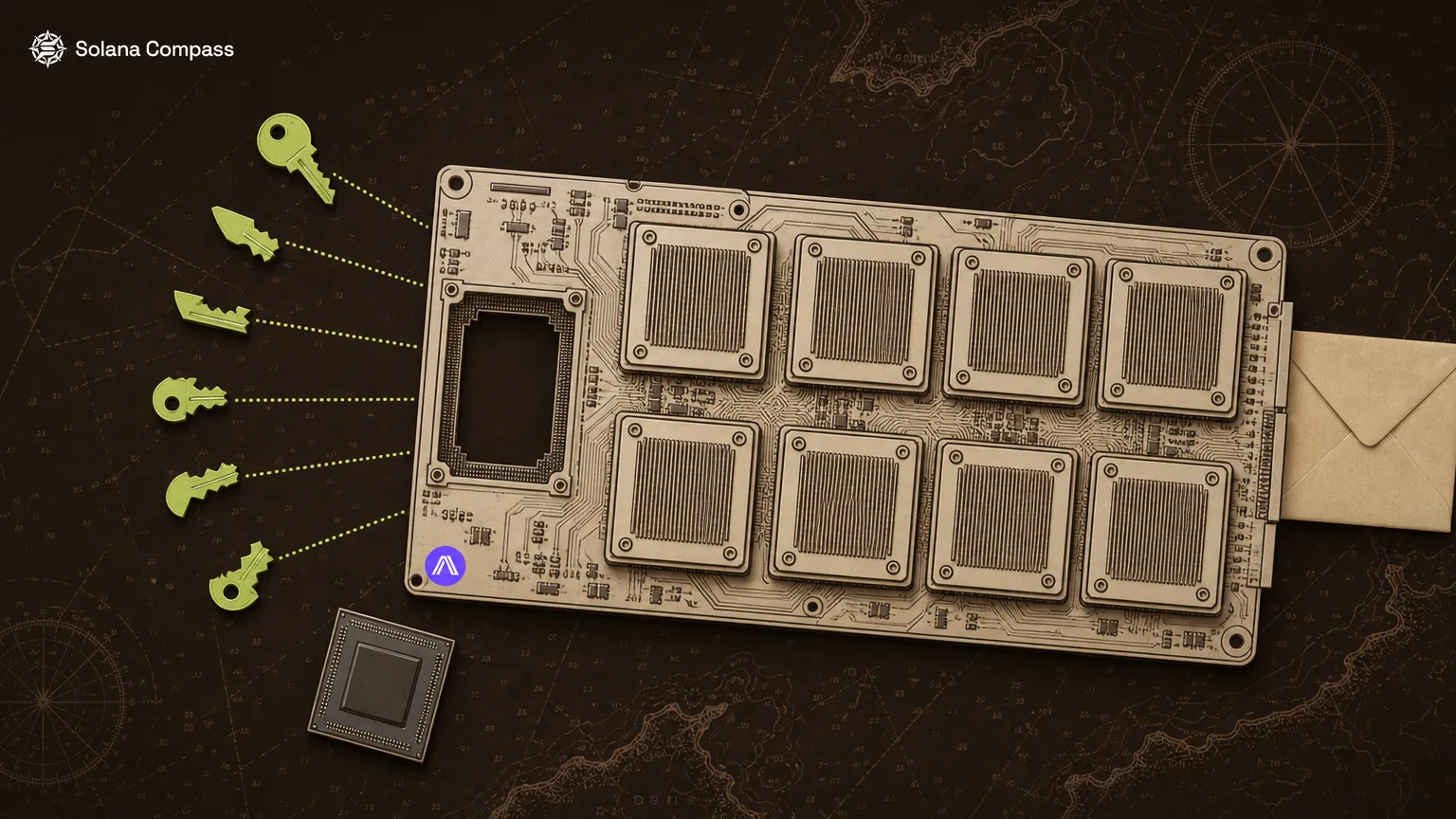
Arcium opened Blackthorn, its private AI inference stack, in private alpha on October 21, 2026, announcing the release on X at 12:30 UTC. Blackthorn runs AI models with prompts, outputs and model weights encrypted. Selected users can now reach it through a serverless API that is free during this phase, rented GPU servers with Blackthorn preinstalled, or their own NVIDIA hardware.
Arcium calls Blackthorn the first private AI inference stack to remove the CPU trusted execution environment (TEE), the sealed-off secure area inside a server's main processor, from the chain of hardware a user has to trust. That "first" is Arcium's own claim, and so is the line that Blackthorn runs any model "with little performance overhead compared to plaintext inference". No benchmarks have been published yet.
From Blackthorn early access in June to live private alpha access
When Arcium first showed Blackthorn in June, it was an early-access announcement for a product that was not yet in users' hands, as we covered in our report on the June Blackthorn launch. The MPC design and the pitch of running confidential AI on ordinary NVIDIA data-center GPUs date from then.
What changed on October 21 is access. The Blackthorn product page now reads "Private alpha live" and routes users to an application form. Arcium listed three ways in: its serverless API, rented dedicated hardware with Blackthorn preinstalled, or installation on a customer's own bare-metal servers with NVIDIA Hopper or Blackwell GPUs. Arcium added that the serverless API is free for selected users during this phase. The product page describes the API as pay-per-token, but publishes no rates. Access is by application and limited to selected users, so Blackthorn is not yet open to every developer who wants it.
How Blackthorn uses MPC and NVIDIA GPU confidential computing
Blackthorn keeps AI requests encrypted by splitting trust between cryptography and the GPU itself. Multi-party computation (MPC) lets a group of independent computers jointly hold a secret, such as an encryption key, without any single one of them ever seeing the whole key. Blackthorn uses Arcium's MPC network to do the job a CPU enclave normally does.
According to the product page, Blackthorn wraps requests in two layers. The inner layer is encrypted with keys the user controls. The outer layer, the secure channel between the host server and the NVIDIA GPU, is encrypted with AES keys that are secret-shared across MPC nodes on the Arcium Network. The model runs inside the GPU's encrypted compute region, which Arcium says sits "outside the reach of the operator, the cloud & Arcium", while the host machine that relays the encrypted traffic "never sees plaintext". Crypto Briefing reports that the encryption covers prompts, model weights and outputs.
The NVIDIA GPU stays in the trust chain. Blackthorn depends on NVIDIA's GPU confidential computing mode, so a user still trusts the GPU hardware. Arcium's design removes the CPU enclave and replaces it with keys no single machine holds. That reduces the hardware a user must trust without eliminating it.
The contrast with existing private AI products is the CPU. The TEE mode of Venice AI, a privacy-focused AI chat service, for example, routes requests to Phala's confidential computing network running on Intel TDX and AMD SEV processor enclaves, according to Phala. Blackthorn's pitch is that the processor no longer needs to be trusted.
Blackthorn H100 and B200 units, pricing and who it targets
Arcium's product page lists three dedicated Blackthorn units built on NVIDIA HGX servers, each running Arcium's bLLM runtime:
- BT H100 HGX: eight H100 GPUs with 640 GB of GPU memory
- BT B200 HGX: eight B200 GPUs with 1,440 GB
- BT B300 HGX: eight B300 GPUs with 2,304 GB, labelled "Coming soon"
Customers who would rather keep hardware in-house can install bLLM on their own Hopper or Blackwell GPUs instead.
Crypto Briefing names healthcare, finance, law and government as the target sectors, and notes that performance, latency and cost at production scale "remain to be proven" while Blackthorn is in private alpha. Those are buyers who handle data they cannot send to an ordinary AI provider in plaintext, which is the gap private inference is built to close.
Why Blackthorn is a Solana ecosystem story
The MPC nodes holding Blackthorn's key shares belong to the Arcium Network, the same encrypted-computation network that Solana applications already use. Benchdot Markets, an encrypted hiring prediction market, went live on Solana through Arcium in August, and Crypto Briefing describes Arcium as a confidential computing layer "with existing DeFi features on Solana". Arcium's token, ARX, is a Solana token that began trading in June. The Blackthorn product page does not describe any role for ARX in the product.
With Blackthorn, Arcium points a network built for private Solana applications at AI inference on standard NVIDIA servers, and the first selected users now have access to test it.

Solana 🧭 Compass
@SolanaCompassSolana Compass is an independent Solana analytics and staking platform, operating a validator on Solana mainnet since September 2021. Its network statistics and...
Comments
Please login to leave a comment.
Contents
Projects

Related Content
Why Privacy Matters For Solana | Yannik Schrade
Arcium Launches Blackthorn: Encrypted AI Inference on Any NVIDIA GPU via MPC
Ship or Die at Accelerate 2025: You Can (and Should) Be encrypted
Tech Talk: Arcium - Fully Encrypted Solana Execution
Scale or Die at Accelerate 2025: Encrypt or Die (Yannik Schrade | Arcium)
Keynote: Arcium (Yannik Schrade)
Breakpoint 2024: Product Keynote: Arcium (Yannik Schrade)
Arcium's Benchdot Markets Goes Live on Solana With $7.67M in Alpha Stake Volume
Arcium Launches ARX Token on June 22 With Binance Alpha as First Listing Venue
Let's Make Solana Cypherpunk w/ Yannik Schrade (Arcium)
Arcium Opens ARX Eligibility Checker and Launches Quests Phase 1 Ahead of June 22 TGE
Arcium Launches Mainnet Alpha on Solana, Bringing MPC-Based Encrypted Computation to Production
Arcium Hits 1 Million Confidential Computations as ZINC Breaks Into Solana's Top 3 by Fee Revenue
Breakpoint 2023: IONET's Vision for the Largest AI Compute Cloud on Solana
THEA Raises $8M to Build AI Inference Coordination and Settlement Layer on Solana
Latest news
Solana Mobile Launches Seeker Connect, a One-Tap 'Connect with Seeker' Wallet SDK for Expo, Kotlin and Web Dapps
Arcium Opens Blackthorn Private AI Inference to Selected Users in Private Alpha
Solana Alpenglow Is Live on Mainnet as Anza Retires TowerBFT at Slot 459,653,000
Bastion Trading Tells SkyAI Chairman and Three Directors to Explain SOL Liquidation or Resign
Western Union Taps Noah to Pay Remittances Into Stablecard as USDPT on Solana
Bitwise Staking Report: Solana Ends Q3 With 69% Staked, a 5.99% Gross Yield and 659 Validators
Alpenglow Is Pending Activation on Solana Mainnet, With TowerBFT Set to Retire at Slot 459,653,000
X9.150 QR Code Payments Demo at Money20/20 Lets One Invoice Be Paid Over FedNow, RTP or USDC on Solana
Alpenglow Tracker Flags 45% of Solana Stake as Not Ready Two Days Before Epoch 1064, Most of It on Agave 4.3.0 and 4.3.1
LI.FI Brings Ondo Tokenized Stocks and ETFs to Solana Through LI.FI Intents
Solana Token Markets


